
Are the bond and derivatives markets doing the tough work for central bankers? Swaps are pricing a globally coordinated cycle of interest rate increased over the next 12 months, and longer-term bond yields are hitting multi-decade highs in the US, Europe and Japan. That, in turn, has prompted Federal Reserve Chair Kevin Warsh and some policymakers from the Bank of England and European Central Bank to suggest they might not have to raise rates as much as expected because the debt markets are making it more costly to borrow, which should curb growth and inflation.
Sounds reasonable but market rates are a poor substitute for tighter monetary policy, and central bankers put their credibility at risk if they use it as an excuse for inaction.
Warsh observed in July that the markets had “done quite a bit” even before the Fed went on to raise rates in September. Then last month, the BOE partially used rising short-term market rates to justify its 6-3 decision to keep its main policy rate steady, despite above-target inflation. “Most members” of the BOE’s Monetary Policy Committee said market rates were producing “a broadly sufficient degree of monetary policy restraint,” according to the September meeting minutes . The ECB echoed the sentiment, saying in minutes published Thursday that markets could influence the prospective path of policy (emphasis mine):
The repricing at the long end of the yield curve , provided it remained orderly, also supported the intended monetary policy stance and could have implications for appropriate policy rates in the future. Model estimates suggested that the effects of higher long-term interest rates on growth and inflation could be material.
Relying on markets alone would constitute a losing strategy.
The late economist and Nobel laureate Paul Samuelson famously described former Fed Chair Alan Greenspan’s reactions to markets as an animal seeing his own reflection . “I am reminded of a monkey who for the first time has seen a mirror,” he said. “He sees an image of himself in the mirror and thinks that by looking at the reactions of that monkey—including its surprises—he is getting new information.” Economists Stephen Morris and Hyun Song Shin have dubbed this “the reflection problem,” in reference to Samuelson’s 1994 quote.
In practical terms, it’s possible rising bond yields would quickly reverse themselves if central banks didn’t follow through and raise rates, and there would have been no further headway made on reining in inflation. For tighter monetary policy to work, interest rates must remain elevated for an extended period, and the latest bond rout is less than two months old.
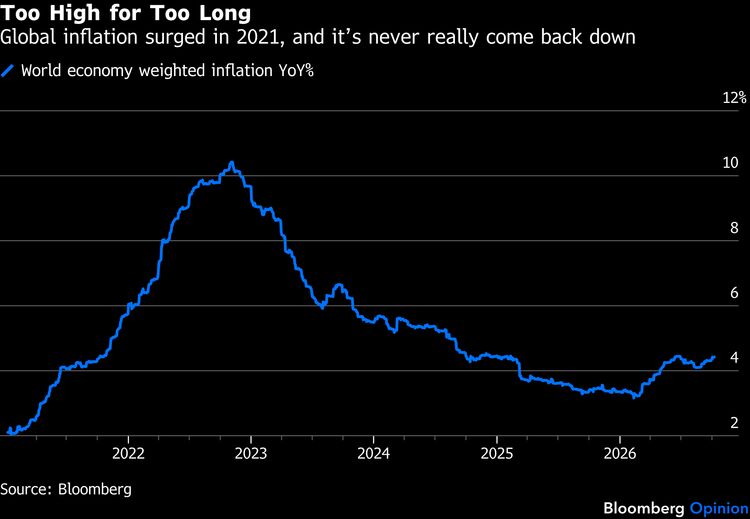
Global inflation has been elevated for six years now, and populist leaders — led by President Donald Trump and Japan Prime Minister Sanae Takaichi — are putting the future of independent central banking at risk. Meanwhile, the world continues to deal with the aftermath of a barrage of inflationary shocks, including the Covid-19 pandemic, the Russia invasion of Ukraine, Trump’s tariffs, the US-Israel war with Iran and an energy shock. In such a fraught environment, reputation and optics are just as important as economics, and central bankers can’t be seen sitting on their hands and hoping the markets do all the heavy lifting for them while they miss their inflation targets for another year.
The increase in market rates is due in part to a resistant global economy combined with abnormally wide federal budget deficits and a glut of borrowing from artificial intelligence companies — all of which underpin inflationary forces. It’s little wonder that 10-year Japanese note yields are their highest since 1996, 10-year US Treasury yields are the highest since 2002, UK yields are the highest since 2007 and German yields are the highest since 2009. And yet, those high yields, which influence borrowing costs throughout their respective economies, won’t be sufficient on their own to tame inflation. The reason being is that part of the rises are due to increases in so-called term-premiums, or the extra yield investors demand to hold longer-maturity bonds rather than shorter-term notes. Based on a market assessment of risk, term premiums are notoriously volatile and subject to swings in sentiment. A Bloomberg Economics model puts the US 10-year term premium at about 1.03%, but it was as low as 0.52% in June and negative just two years ago and has averaged 0.06% over the past five years.
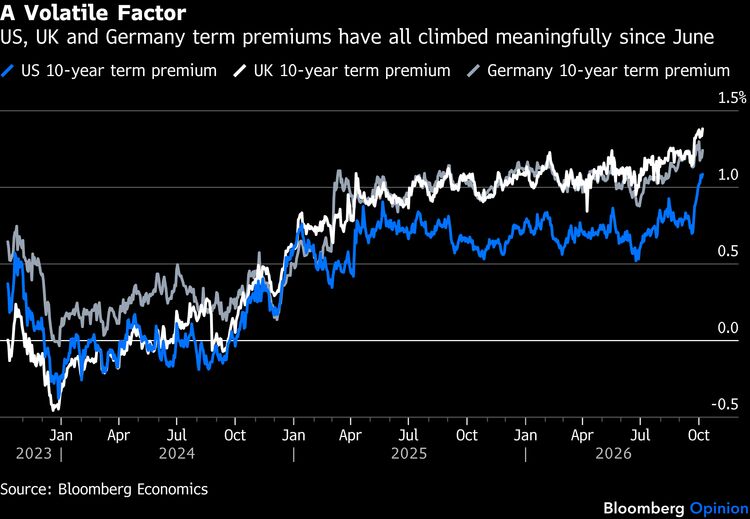
All this raises the odds of a looming “reflection problem.” Consider the Fed’s experience in late 2023, when it lifted rates for the final time of that cycle in September and longer-term yields continued to climb for another month or so. Federal Reserve Bank of Dallas President Lorie Logan said higher term premiums “ could do some of the work of cooling the economy for us, leaving less need for additional monetary policy tightening.” How did that turn out? Instead of continuing to tighten policy, the Fed kept rates on hold and the 10-year Treasury yield plummeted 1.20 percentage points in under two months. As for inflation, it failed to return to the 2% target. Oops. Will other central banks have to learn this lesson again the hard way?
Central banks need to work
with markets,
but they can’t depend on the markets to work
for them
. For policymakers, the recent rise in market rates is a welcome development that shows that their efforts are working. What it’s not is a sign that their work is done.
More From Bloomberg Opinion:
- The World Isn’t Ready for a Japan With Interest: Gearoid Reidy
- Bond Market Contagion Is Haunting Europe : Mihir Sharma
- Cheap Money Is History : The RBA's Blunt Warning: Daniel Moss
Want more Bloomberg Opinion? OPIN <GO>. Or Subscribe to our daily newsletter .