Twenty-five years to the month since the US Treasury shocked investors by ending sales of the 30-year bond, the Treasuries market is debating whether 20-year securities are now set for the chopping block.
Deutsche Bank AG strategist George Saravelos recently returned from visiting clients in New York reporting “mumblings of a coming suspension in 20-year Treasury issuance.” A Citigroup Inc. counterpart is advising to position for the 20-year to outperform the 10-year on the prospect of a “reduction, or perhaps cancellation, of the 20-year bond.”
The rationale, as with canceling the 30-year back in 2001, would be to reduce the Treasury’s borrowing costs. Even Steven Mnuchin, who brought the 20-year bond back to life when Treasury secretary in 2020, by 2024 told Bloomberg that maturity should be cancelled, saying “It’s just costly to the taxpayer.”
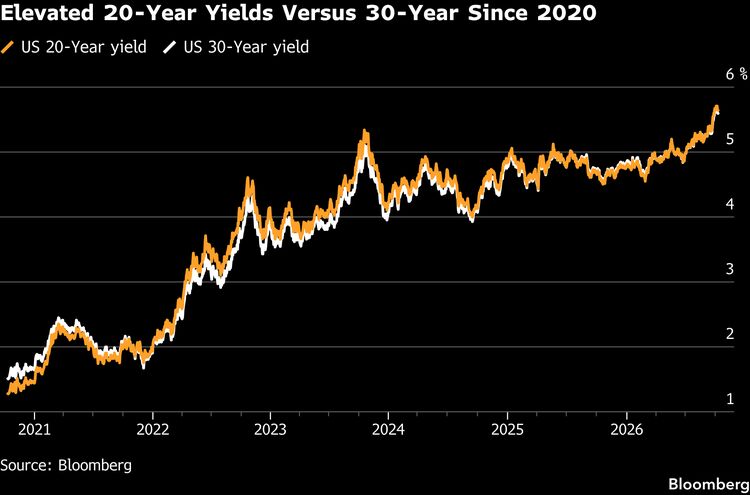
Indeed, for most of the time since the 20-year was reintroduced in 2020, it has been an outlier from the rest of the market, as its yield has been higher than those on the bonds surrounding it — the 10-year and the 30-year. That higher cost of financing for the US taxpayer has only become more pressing as interest expense has surged with Treasury yields at multi-decade highs.
All eyes are on the looming Nov. 4 release of the Treasury Department’s latest quarterly debt issuance plan. A key question for the so-called quarterly refunding statement is whether Treasury Secretary Scott Bessent is willing to cancel the 20-year without having laid the specific groundwork for such a move. The 2001 shock unleashed notable criticism of Treasury officials of the day — and the 30-year was eventually brought back.
For some, it’s a simple solution, and an extension of the extraordinary moves Bessent has already taken — expanding the department’s buyback program for older securities in an effort widely seen as aimed at bringing down the highest long-term borrowing costs in more than two decades.
“If you wanted to do something, leave everything and cut the 20 year,” said Padhraic Garvey, head of research for the Americas at ING Groep NV. “Nobody likes the 20 years,” he said. “But our baseline view is he leaves it as it is.”
If the Treasury is interested in contemplating a shift, initial signs could potentially emerge on Friday, when the department releases its usual questionnaire to primary dealers ahead of the refunding statement. The survey can include special topics of interest. In the past, the Treasury has polled dealers on their thoughts on demand for bills — which mature in up to 12 months — from stablecoins, for example.
Trimmed Auctions?
In the last refunding statement, in August, the Treasury made a subtle shift to its guidance, saying officials were evaluating potential future “changes” in coupon and floating-rate note sales. It previously had referred to potential “increases.” That effectively opened the door to potential cuts in supply for 20- and 30-year bonds.
Bessent may be interested in taking further action since the expanded buybacks have failed to halt a continuing rise in borrowing costs. Last week’s sales of 10- and 30-year Treasuries saw solid demand, but they both involved the highest auction yields since 2000.
The Treasury didn’t immediately respond to a request for comment.
Citigroup anticipates a $3 billion reduction per auction for both 20- and 30-year bonds, which would be funded by additional T-bill issuance.
“Bessent may point to poor pension-fund Treasury demand, perhaps caused by increased long-end corporate bond issuance, as a reason to reduce and/or cancel the 20y bond,” said Citigroup’s head of US rates strategy, Jason Williams.
Competition for Capital
Hyperscalers have been issuing large amounts of longer-dated bonds to help fund the artificial intelligence build-out, providing competition for Treasuries among asset managers including pension funds. Investors are also demanding higher yields thanks to inflation fears fanned by the Iran war’s impact on energy costs, and expectations for Federal Reserve interest-rate hikes to contain price pressures.
“There is definitely a competition for capital that is happening,” said Vishal Khanduja, head of broad markets fixed income at Morgan Stanley Investment Management. Besides the AI-related issuance, he also flagged the structural shift away from defined-contribution pension plans — which once were giant sources of demand for longer-dated Treasuries thanks to their liability-management needs.
Cancelling the 20-year may still not be a perfect solution for the Treasury, however. BNP Paribas SA warned last week that such a move “could be perceived as panic, and signal an exhaustion of the Treasury’s toolkit, encouraging bond vigilantes.”
“ Unintended consequences ” could include lower liquidity in the market, BNP strategists led by Guneet Dhingra wrote in a note to clients.
Predictable Mantra
Unveiling the 20-year bond’s demise next month could also risk further undermining the Treasury’s longstanding reputation for being “regular and predictable” in its debt management. While officials continue to use that mantra, Bessent’s sudden expansion of the buyback program just two weeks after the last refunding statement stoked questions among market participants.
Read more: Investors Warn US Over Shifting From Predictable Debt Management
Including a question on the 20-year in Friday’s survey could potentially ease such angst. Even if no change is made, investors will be also scouring views from the Treasury Borrowing Advisory Committee, an outside group of dealers, investors and other market participants, which also releases a statement Nov. 4.
Any reductions in longer-dated coupon auctions would leave the Treasury having to further increase bill supply or potentially introduce another product, such as a one-year floating-rate note tied to the Secured Overnight Financing Rate. Upsizing sales of shorted-dated Treasuries in the 2- through 5-year area of the curve may be another option.
A further possibility: maintaining a smaller running cash balance. The Treasury is due to update its quarterly projections for the cash balance and borrowing needs on Nov. 2, ahead of the refunding statement.
At the very least, Wall Street is girding for action from the Treasury, as the surprise doubling of buybacks announced in mid-August has failed to stop long-dated Treasury yields climbing to peaks unseen since 2002.
“At the moment, the sensible thing to do is to maintain a steady issuance profile right across the curve,” Garvey said. “But I suspect that the US Treasury is in a very flexible mood. I think they’d be perfectly prepared to morph issuance into different parts of the curve if they felt they could reduce interest costs.”