
For Mexican businesses deciding whether to invest, the biggest risks increasingly lie at home rather than in Washington.
Persistent crime, uncertainty surrounding a judicial overhaul and tougher tax enforcement are weighing more heavily on companies than US tariffs and doubts over the future of the trade relationship, according to José Medina Mora, president of Mexico’s Business Coordinating Council (CCE).
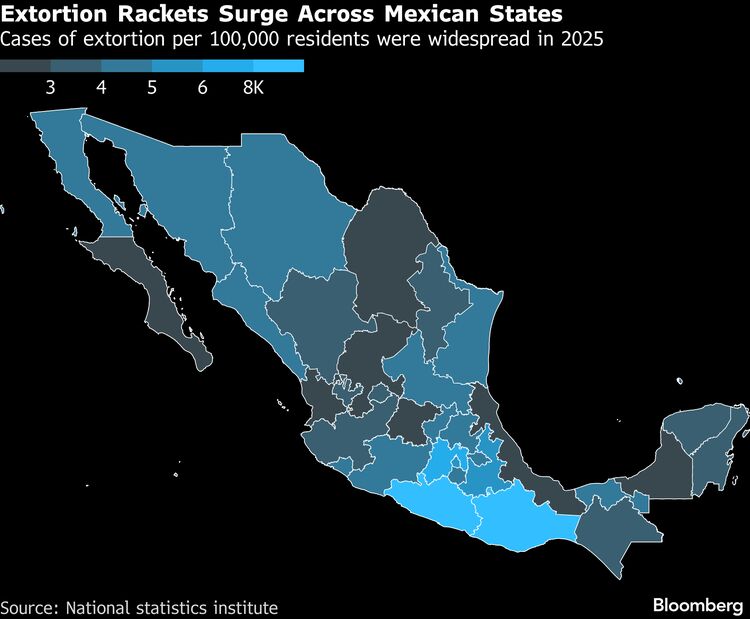
The head of the country’s top business lobby singled out lawlessness, especially costly extortion rackets, as a major drag that President Claudia Sheinbaum must address.
“In some regions of the country, extortion has evolved to take over the distribution of goods,” Medina Mora said in a recent interview. He pointed to border states like Sonora, Colima on the Pacific coast, and avocado-producing powerhouse Michoacán.
He described how criminal groups have moved beyond demanding protection payments to controlling product deliveries, inserting themselves between suppliers and customers. Companies that supply construction materials, for example, are forced to sell to criminal intermediaries, which then resell the products at a 20% markup, Medina Mora said. Similar practices affect other goods, including beer, shrimp and avocados.
The problem has become so widespread that one in two companies reported being the victim of a crime over the past year, he said, adding that merchandise theft was the most common offense, followed by extortion, vehicle theft and cybercrime.
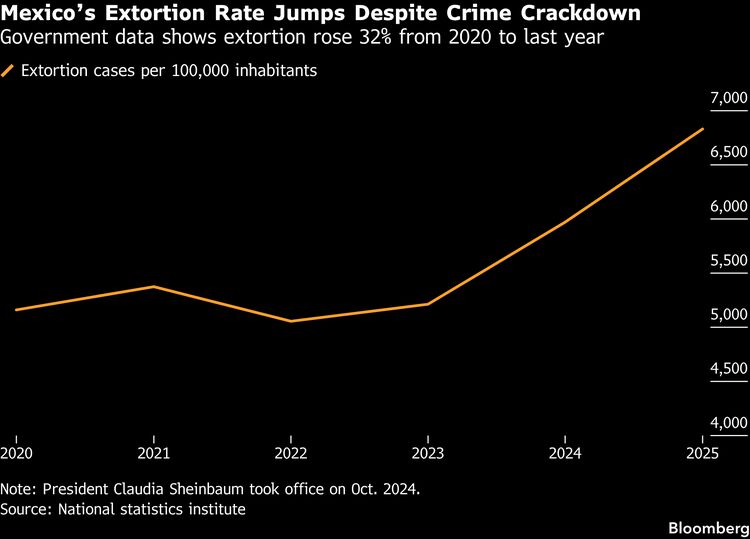
Now in her third year in office, Sheinbaum points to a plunging homicide rate as a topline crime-fighting success, down by about half since 2020, part of a broader crackdown that prioritizes intelligence gathering. On extortion, her government has reported more than 2,000 arrests since it issued a new plan to tackle it last year. The plan also created a new nationwide extortion reporting hotline and pledged to add more specialized investigators.
While Medina Mora gives Sheinbaum credit for reducing some categories of crime, he cited Mexico’s two-year-old judicial reform as another sore spot for domestic companies. The constitutional overhaul replaced appointed judges with elected ones, including on the Supreme Court. But he acknowledged that international investors who previously expressed deep concerns over the change, now tend to see an imperfect system but no clear bias against foreign companies.
“We believe there’s been progress, but we’re far from the Mexico of security, justice and peace that we want,” he said.
The founder and chairman of information technology company CompuSoluciones, Medina Mora also sees tax disputes as an obstacle holding companies back.
A CCE review of stalled investment projects during the first quarter identified conflicts with Mexico’s SAT tax authority as a recurring barrier. Businesses along the border reported cases of double taxation, while others faced retroactive tax claims.
The SAT’s push to restrict tax deductions is pressuring companies as they contend with weaker market conditions, such as higher energy costs. Medina Mora argued that declining income tax receipts alongside rising value-added tax revenue is evidence that consumption remains resilient even as corporate profitability deteriorates.
“The drop in income tax revenue reflects the fact that companies are earning lower profits,” he said.
A government proposal before Congress would further tighten income tax deductions, which has drawn criticism from some businesses.
Read More: Sheinbaum’s Tax Overhaul Seeks $8.2 Billion in Revenue Next Year
Beyond the domestic concerns, Medina Mora urges action on so-called Section 232 US tariffs. He wants the duties reduced, blaming them for hurting local automotive, steel and aluminum industries. Mexican exporters face less favorable treatment than Japan, South Korea and the European Union on cars, he said, while being at a disadvantage on sending steel to the US market compared to Vietnamese competitors.
“We have kept pressing for those tariffs to come down, and I would say the winds in Washington are now favorable toward Mexico for a negotiation that lowers them,” Medina Mora said.
As for a long-term deal to extend the USMCA trade pact that underpins tariff-free access to the US for most Mexican goods, the CCE chief preaches perseverance.
“We have to be patient. We’re in no hurry,” he said. “There will probably need to be a change in the US presidency for the agreement to be renewed.”