
India’s inflation accelerated to an almost two-year high in September, nearing the top of the central bank’s 2% to 6% tolerance band and reinforcing its decision to lift interest rates last week for the first time in almost four years.
The consumer price index rose 5.54% last month from a year earlier, the highest since late-2024 and up from a revised 4.83% in August, data released Monday by the Ministry of Statistics and Programme Implementation showed. That was broadly in-line with the 5.58% median estimate in a Bloomberg survey of economists.
Indian government bonds held onto losses after the release, with the benchmark 10-year yield trading around 10 basis points higher at 7.40%. The rupee is up 1% on Monday though it remains one of the worst-performing currencies in Asia to-date.
The combination of rising inflation and a weaker currency is particularly challenging for the country’s central bank as a falling rupee makes imports more expensive just as price pressures are broadening. The RBI expects inflation to average 6% in the three months through December and raised its full-year forecast to 5.2%.
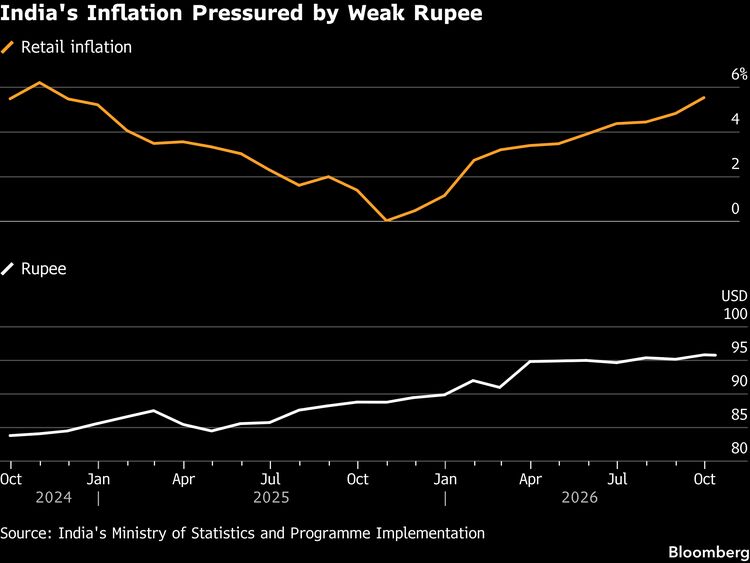
Monday’s reading comes just days after the Reserve Bank of India’s monetary policy committee voted unanimously to raise its benchmark rate by 25 basis points to 5.50% and shifted its stance to “calibrated tightening.”
“Amid continued stickiness in commodity prices, and rising global yields, we expect RBI to continue to remain firmly on path of rate hikes,” said Garima Kapoor, economist at Elara Securities. She sees two more rate increases by end-March.
September’s acceleration was driven largely by food inflation, which climbed to 7.74% from 5.97% in August. The category makes up more than a third of the retail inflation basket, and deficient rainfall is expected to add to price pressures in coming months.
Read more: A Dozen Ingredients Show India’s Mounting Food Inflation Risk
Elevated global oil prices remain a worry. The government has largely shielded consumers from the increase at the pump, raising retail fuel prices only modestly in May even as crude has climbed back above $100 a barrel.
Businesses have still felt the squeeze. Higher food and energy costs have raised their expenses and eroded margins, with producers so far absorbing much of the increase rather than passing it on to consumers.
“A broad-based food shock is more persistent and carries a greater risk of feeding into household inflation expectations than a temporary increase in vegetable prices,” said Kunal Kundu, economist with Societe Generale, in a note.
Monday’s figures also showed:
- Transport costs climbed 5.01% from a year earlier, compared with 4.6% in August.
- Restaurant and hotel prices rose 9.36%, compared with 8.38% a month earlier.
- Personal care prices advanced 13.75%, compared with 15.17% in August.