For years, banks in the United Arab Emirates were flush with cash as a domestic economic boom and geopolitical uncertainty elsewhere drew in strong capital inflows. Now, many are competing more aggressively for new deposits as a lending surge collides with a liquidity squeeze.
Amid the regional war, now in its eighth month, demand for credit is surging, fueled by a multibillion-dollar infrastructure push dubbed “Zero Hormuz” to bypass the crucial waterway. Substantial outflows from non-resident Indians, spurred by a special program to attract dollar deposits, have added to the pressure.
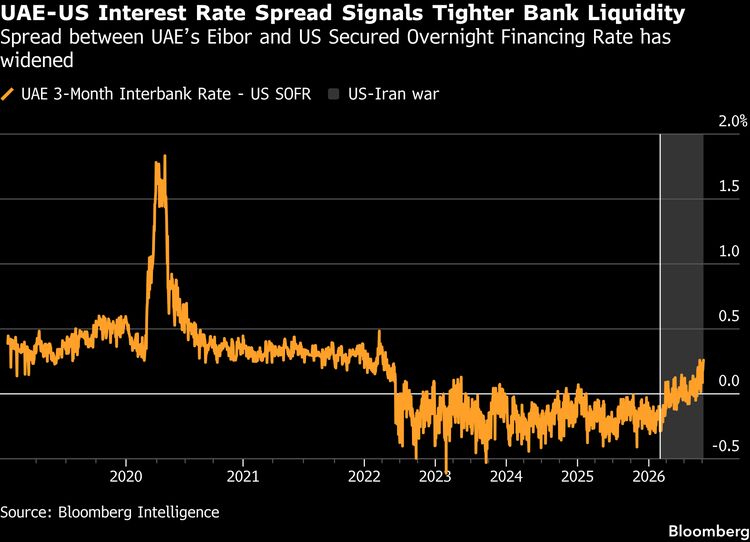
The spread between the three-month Eibor, the benchmark for interbank lending in the UAE, and US rates offers a window into tightening liquidity. After mostly staying in negative territory over the past two years, it ticked up after the conflict began in late February.
Read More: Abu Dhabi Crown Prince Spends Billions to Bypass Hormuz
Against that backdrop, the country’s biggest lenders have rushed out attractive rates of interest.
First Abu Dhabi Bank PJSC , the UAE’s largest bank by assets, has offered 5.6% on new funds deposited into savings accounts between September and December this year, with no minimum balance requirements or restrictions on withdrawals, to UAE residents. Its previous campaign offered 4% and ended on Aug. 31.
Dubai’s biggest bank Emirates NBD Bank PJSC has advertised as much as 5.5% on some larger new deposits during a three-month promotional period between October and December. To be sure, some banks were offering high rates even before the recent push such as Mashreqbank PSC, for example, which advertised 6.25% on savings accounts.
Those offers are significantly higher than the benchmark. The UAE Central Bank raised its base rate by 25 basis points to 3.9% in September, mirroring the US Federal Reserve’s decision, since the dirham is pegged to the dollar.
The country’s monetary base has declined about 13.5% since the start of the US-Iran war, according to Naresh Bilandani, managing director and Jefferies’ head of equity research for the region.
“If we see this tightening alongside the ongoing strong credit momentum, largely led by growing capex-driven credit opportunities from UAE public sector entities and continuing retail lending demand, then this is a perfect recipe for banks paying up for deposit costs to fund credit growth,” Bilandani said.
Credit growth has significantly outpaced growth in deposits this year, with lending to the government and public sector outperforming the broader market. Lending surged 18.1% while deposits grew around 14% year-on-year in the second quarter, according to central bank data.
The widening gap has pushed the loans-to-deposits ratio to over 80% currently, from around 77.7% in 2025, according to central bank data. Still, the ratio remains well within regulatory comfort zones and below levels in some regional peers, including Saudi Arabia.
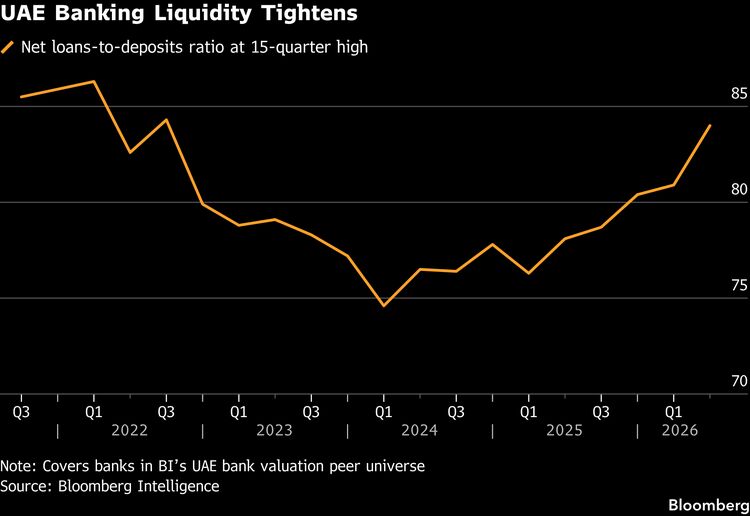
Bloomberg Intelligence analyst Edmond Christou said competition for fresh deposits was significant as central bank liquidity support measures announced early in the war were due to expire in September, requiring UAE banks that tapped the facility for up to 30% of their cash-reserve requirements to repay the funding.
“At the same time, regional conflict may be weighing on capital inflows, leaving less new money entering the system than last year,” he said.
The central bank did not respond to a request for comment. Emirates NBD declined to comment. FAB and Mashreq did not immediately respond to requests seeking comment.
Read More: UAE Liquidity Costs Rise as Saudi Premium Stays Elevated
“Banks see a strong pipeline of credit demand,” said Monica Malik, chief economist at Abu Dhabi Commercial Bank, including from government-related entities that are progressing with infrastructure and other projects.
UAE banks faced a further drain on deposits earlier this year. A majority of the roughly $130 billion placed in foreign-currency deposits through a special facility for overseas Indian citizens came from the Gulf, people familiar with the matter told Bloomberg News.
While a breakdown by country is not available, UAE banks participated in the offering, with First Abu Dhabi Bank offering up to $1.5 billion in funding to non-resident Indians investing in the program, Bloomberg News reported. The UAE accounts for a significant Gulf-based Indian population, supplying one of the most important remittance corridors globally.
Read More: India, UAE Central Banks Said to Hold Talks on FX Deposit Issues
UAE banks’ efforts to attract deposits at the current time could test market confidence and uptake.
Jefferies’ Bilandani said that it would be hard to see new money come in, especially from corporates, given the growing working capital needs in the aftermath of the war.
The combination of stronger competition for deposits and weaker new-money inflows means “banks are paying a liquidity premium,” according to Bloomberg Intelligence’s Christou.
Get the Mideast Money newsletter , a weekly look at the intersection of wealth and power in the region.