The Indian rupee strengthened the most in six months after the central bank took some of its strongest measures to bolster the currency since the 2013 taper tantrum.
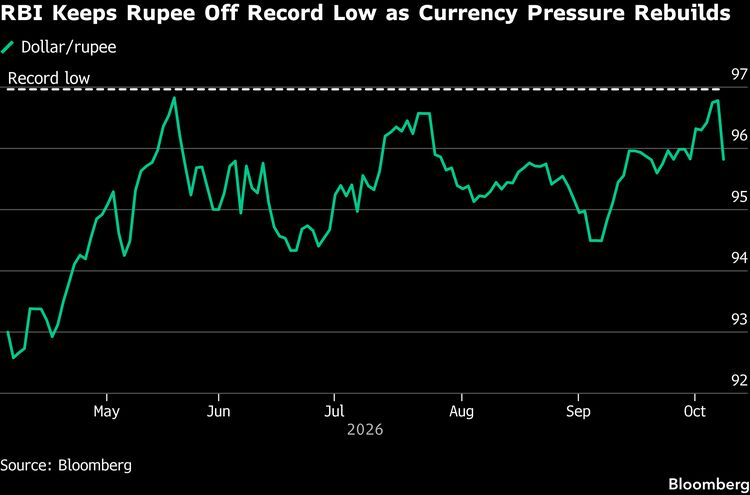
The currency gained 1%, its biggest jump since April, to 95.7575 per dollar on Monday. Bonds fell, with benchmark 10-year yield rising as much as seven basis points to 7.37%, the highest level since October 2023.
The Reserve Bank of India is making it harder to bet against a currency that’s dropped more than 6% this year, unveiling measures Saturday to steady the rupee after it neared a record low of 97 per dollar. The steps include a special window to meet state-run oil companies’ dollar needs and a reserve requirement on certain foreign-exchange derivatives.
While the moves offered the rupee some reprieve, sustaining the bounce will be harder as elevated oil prices, persistent foreign capital outflows and a widening external deficit continue to weigh on the currency. The RBI, which raised interest rates last week and signaled it was open to further tightening, again intervened in the onshore market Monday to support the rupee, traders familiar with the matter said.
“These are tactical fixes, not structural solutions,” said Madhavi Arora, lead economist at Emkay Global Financial Services Ltd. “On face of it, the measures should constrain speculative positioning, raise hedging costs, tighten banking liquidity and provide some near-term rupee support,” she said.
The RBI has already taken several steps to bolster its foreign-exchange resources. Its diaspora deposit program raised a record $133 billion, swelling its forex reserves to nearly $800 billion in early September. But the pressure to defend the currency has since drained $51 billion from reserves in the past four weeks.
The rupee is one of the worst performers in Asia this year. RBI Governor Sanjay Malhotra said it was undervalued on some gauges, and that markets can be irrational in the short term.
The issue is “mostly due to lower inflows into India on account of global geopolitical risks and higher global yields,” YES Bank economists wrote in a note. It’s unlikely that these steps “will lead to any sustenance of rupee appreciation, and we expect the range of 96.75-97.25 for USD/INR by end-March 2027.”
The latest steps target demand in the foreign-exchange derivatives market. For the first time, the RBI introduced a foreign-exchange risk reserve, requiring lenders to hold with the central bank the rupee equivalent of 20% of the notional value of each derivative transaction above $2 million. The People’s Bank of China has a similar tool to manage pressures on the yuan by varying the reserve requirement on forward contracts.
“I have to say that one of the measures the RBI has announced is quite outlandish,” said G. Mahalingam, a former RBI executive director, referring to the introduction of the foreign exchange risk reserve. “That means you are imposing a cost even on genuine hedging deals so that pressure on the rupee reduces. This contradicts the RBI’s earlier stance of encouraging hedging.”
| Read more on the Indian rupee: |
|---|