
When Goldman Sachs Group Inc. buys boutique ETF provider Neos Investments, it’ll acquire not only some of the hottest derivative-income funds around, but also products that are testing how decades-old laws are applied to Wall Street’s new generation of tax-optimizing strategies.
Neos has made its mark with copycat versions of popular funds from JPMorgan Chase & Co. that combine a bet on a stock index like the S&P 500 with a steady stream of income generated from selling options on that holding.
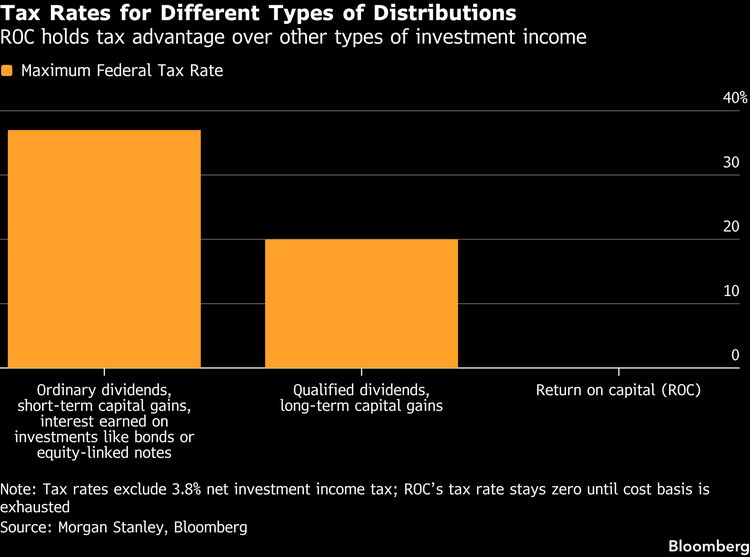
The big difference: In a JPMorgan version, much of the payout is taxed at an investor’s ordinary income rate — 37% for top earners. But in the Neos funds, clever financial engineering means most of the income distributed doesn’t have to be taxed immediately, and when it does it’s usually at a lower rate.
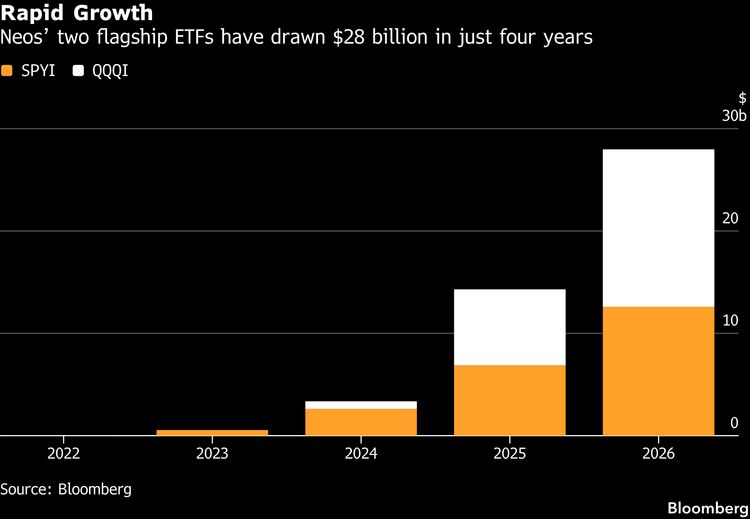
That’s a significant advantage for Americans with plenty in their taxable investment accounts, and the two flagship Neos vehicles have lured $28 billion between them in four years. They’ve been so successful that JPMorgan introduced its own tax-friendly income ETFs earlier this year in response, and Goldman announced in August it’s buying Neos for as much as $2.25 billion.
Yet in corners of the $195 billion market for derivative-income products, the Neos funds are seen as pushing the boundaries of tax rules that often predate the internet — just as Washington takes a broader look at how ETFs are being used to cut tax bills. Multiple industry professionals, including tax attorneys and some competing fund issuers, told Bloomberg News they struggle to reconcile Neos’ unusually strong tax results with their own interpretation of how to apply the Internal Revenue Code to such funds. They asked not to be identified discussing a specific company in their industry.
The issue highlights how differently firms can interpret the same long-standing rules when it comes to new products. In this case, the divide stems from two areas in particular: the tax benefits a portfolio enjoys when it is betting both on and against the same securities, and how it should treat gains that it realizes using the trading mechanism underpinning ETFs.
Wall Street tax-optimization strategies are under rising scrutiny after their surging popularity drew the attention of the US Treasury Department. Last month, officials issued a ruling intended to curb one popular ETF maneuver for deferring capital gains tax, and a notice warning there may be action on a slew of other approaches. While derivative-income funds are not specifically in focus, the list includes some tactics which avoid ordinary income distributions — a characteristic shared by the Neos products.
A spokesperson for Neos said by email that there is no single approach in this segment of the ETF industry.
“Derivative income funds are specialized strategies that vary significantly; there isn’t a single uniform practice across the category,” the spokesperson said. “We continually evaluate our approach and are guided by independent advisors, to ensure we are doing what is best for our fund shareholders.”
A spokesperson for Goldman Sachs, whose asset management unit is purchasing Neos, also noted the range of practices used for these “specialized products.”
“Our investment process is driven by delivering what is best for our clients and guided by our policies,” the spokesperson said. “In partnership with Neos, we will remain relentlessly focused on delivering strong investment results for fund shareholders.”
Straddle Rule
The boom in tax-optimized derivative income ETFs began with the JPMorgan Equity Premium Income ETF (ticker JEPI), which is now the world’s second-largest active ETF with $46 billion in assets.
JEPI runs what is called a covered-call strategy, buying stocks and then selling bullish options to collect premiums which allow the fund to make regular payments to its holders. Investors effectively give up some of the potential upside of the equities in exchange for receiving that income.
JEPI’s success inspired a number of copycats , including the Neos S&P 500 High Income ETF (SPYI), a tax-efficient version launched in 2022. That was followed two years later by the Neos Nasdaq 100 High Income ETF (QQQI), a tax-friendly take on the JPMorgan Nasdaq Equity Premium Income ETF (JEPQ).
To create tax-optimized iterations like this, firms including Neos deploy an accounting maneuver that relies on “return of capital,” or ROC.
When a fund pays out more than the investment profits and dividends it has accumulated, it can classify that portion of the distribution as ROC. For tax purposes, ROC is treated less like regular income and more like giving an investor some of their original investment back. That means it generally isn’t taxed when received. Instead, it reduces the investor’s cost basis (their original purchase price) and pushes the potential tax bill into the future when the ETF shares are sold.
Once an investor’s basis reaches zero, any future distributions they receive will be immediately taxable — but potentially at the long-term capital gains rate, a comparatively favorable 20%.
The upshot is the higher a fund’s ROC, the lower an investor’s potential tax burden.
To appeal to tax-sensitive investors, funds like those offered by Neos typically seek ways to make the ROC larger by minimizing realized capital gains, such as by delaying the realization of profits or harvesting losses to offset the gain. In contrast, a product like JEPI gets all its options exposure from structured notes, the income from which cannot be treated as ROC.
The first difference between the Neos funds and competitors relates to the straddle rule, to which any covered-call strategy using ROC must adhere.
The straddle rule is part of the tax code that says if an investor is long and short the same securities, they can’t use the losses from one of those legs to offset gains elsewhere in the portfolio (up to the amount of any unrealized gains in the other leg). Investors in a straddle also can’t treat dividends as “qualified” — a designation which carries a lower tax rate.
The rule came about in the early 1980s to stop investors from being long and short the same asset, harvesting the loss on one side and holding onto a winning position for a long-term capital gain on the other, according to Andie Kramer of ASKramer Law, who specializes in financial product taxation.
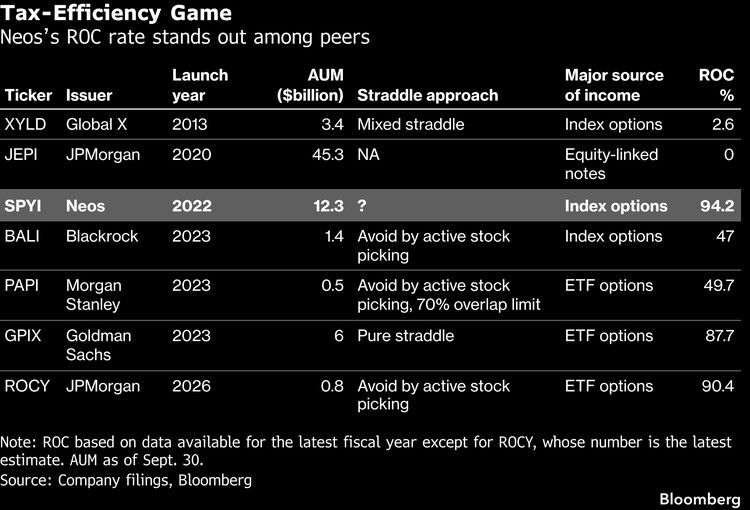
On a practical level, many firms interpret the rule as meaning that there is a limit to how much the two sides of a portfolio can overlap if they want to harvest losses. Other issuers offering tax-optimized derivatives income ETFs — among them JPMorgan, BlackRock Inc. and Morgan Stanley — deliberately replicate only part of the index underlying each product, with the limit often considered to be a 70% overlap.
In SPYI and QQQI, Neos holds nearly all the stocks of the underlying indexes. Given that the funds also sell calls on the indexes, that puts them at risk of being in a straddle.
Yet the firm’s founders have repeatedly said on various investment podcasts that Neos harvests losses from the option positions. The funds also classify all their dividends as qualified, an indication that the company takes the view they are not in a straddle.
“It’s not clear how Neos is treating all of its dividends as qualified dividends, given that the stocks positions and SPX options are clearly offsetting positions,” said Jeffrey Colon, a law professor at Fordham University who is a longtime critic of the tax benefits of ETFs.
Vague Definition
At the heart of the matter may be the vague definition of a straddle, which the Internal Revenue Code describes as having an offsetting position that represents “a substantial diminution of the taxpayer’s risk.”
“Nobody knows what a substantial diminution of your risk of loss is, and you don’t know that because it’s not defined in the code or the regs for straddles probably on purpose,” said Kramer.
While it’s clear-cut that buying all the S&P 500 stocks while shorting the index would constitute a straddle, it’s less straightforward with options, according to Thomas Brennan, a professor at Harvard Law School.
“The tricky question is, you haven’t gone short the S&P 500 entirely,” he said, commenting generally on the tax principles rather than any particular fund. “You’ve just sold a call option on it, which is to an extent going short on it.”
Whether the option position is a hedge to the stock portfolio will likely hinge on the details. SPYI and QQQI typically write seven-week options, rolling at the end of each month, that are slightly out of the money. Those options don’t fully cover the entire equity portfolios, leaving a portion of the cash holdings exposed to the market. In certain circumstances, Neos would buy call options to participate in potential equity rallies.
Several funds that closely resemble SPYI and QQQI take a different approach to that used by the Neos products. Global X Management also offers covered call ETFs that fully replicate their underlying indexes, but the firm makes what is called a mixed straddle account election. That’s a tax choice that organizes gains and losses a different way under another set of regulations. In the last fiscal year, it resulted in an ROC rate of just 2.6% in the Global X S&P 500 Covered Call ETF (XYLD), compared with 94% for SPYI.
Meanwhile, Goldman Sachs itself considers both the Goldman Sachs S&P 500 Premium Income ETF (GPIX) and Goldman Sachs Nasdaq-100 Premium Income ETF (GPIQ) to be in straddle because each seeks to nearly fully replicate its index while selling options on ETFs tracking it. Under the straddle rules, realized losses can’t be used immediately for a tax reduction up to the amount of any unrealized gains. For the two funds, which run $12 billion in total assets, such “straddle loss deferrals” amounted to $135 million at the end of last year.
“Funds running similar covered-call strategies treat the straddle rules differently,” said Brent Sullivan, who runs the popular Tax Alpha Insider blog. “Some elect into special straddle accounting, some report deferred straddle losses, and some build portfolios that track the index less closely. Those differences suggest there’s no industry consensus on how these rules apply.”
Realized Gains
For any fund using ROC, there is also a lack of clarity about how it intersects with the creation-redemption process underpinning ETFs.
That mechanism is one of the big reasons ETFs are so tax-efficient and popular. In short, ETFs don’t buy and sell the securities they hold — they swap them with a type of market maker in a non-taxable “in-kind” transaction. It means they can offload appreciated assets without triggering a capital gains tax bill.
The question is, should such a gain be included when calculating ROC? For example, if a fund realized $3 in capital gains using the redemption process and then paid out $10 to its investors, is the ROC $7 or $10? Given the superior tax treatment of ROC, it can make a big difference.
In the six months through the end of 2025, QQQI realized $164 million in gains through the in-kind mechanism and SPYI realized $90.6 million. Their ROC payouts were $412 million and $361 million, respectively.
The overall approach to tax by the Neos funds has helped deliver impressive performance. SPYI’s one-year tax cost ratio is 0.20%, based on a Morningstar Inc. measure that tracks how much a fund’s annualized return is reduced by the taxes investors pay on distributions. That compares with 0.29% for the largest S&P 500-tracking ETF (VOO).
In other words, a fund paying regular distributions to its investors delivered a better tax outcome than a fund that’s only required to pay dividend income.
The JPMorgan Equity Premium Yield ETF (ROCY) and JPMorgan Nasdaq Equity Premium Yield ETF (ROCQ) launched in March and have so far attracted a combined $1.5 billion in assets. Both products engage in active stock-picking, which helps them avoid being in a straddle and thus enables them to harvest losses and benefit from qualified dividends. ROC was estimated to make up at least 90% of the total payout in the latest distributions, though the exact figures won’t be finalized until year-end.
Given that the rules being applied to innovative new Wall Street products are often decades-old, differences of opinion over tax treatment seem inevitable. Yet official guidance does eventually tend to catch up.
A Sept. 28 notice from the Internal Revenue Service said the government is considering issuing guidance or taking further action on a slew of strategies that “purport to produce tax results that may be inconsistent with the purpose and proper application of the relevant federal tax rules.” These included ETF tactics that use the in-kind mechanism to avoid distributing ordinary income.
“The creation of new derivatives and new derivative structures has always moved faster than the IRS,” said Jeff McClean, co-founder of Solidarity Wealth and a former tax attorney. “For those creating new structures that glide in between and out of the gray area, you’re going to have a five- to 10-year runway before the IRS would change the rules.”