A crypto bro seeking to reinvent finance from first principles? That is nothing new. Many in the blockchain world want to loosen Wall Street’s stranglehold on wealth creation. But when Hyperliquid Labs Chief Executive Jeff Yan spoke on that topic in Singapore last week, there was a catch. That morning, the Financial Times had run an article on how the Asian city-state was trying to distance itself from the new-age bourse and its most revolutionary offering: perpetual futures, or perps, which the newspaper described as the “most dangerous product in crypto.”
Perps are highly leveraged gambles on equities, commodities, interest rates, crypto, predictions … practically anything with a price tag. Unlike standard futures, they never expire. Nor do they transfer ownership on any underlying asset. Traders can jump in and out in minutes or hold positions forever. On a decentralized exchange like Hyperliquid , there’s no broker or clearinghouse holding the user’s cash. An algorithm simply locks the collateral in smart contracts to ensure losers automatically pay winners. Those who run out of capital are liquidated.
I imagine that the sheer techno-anarchism of Hyperliquid, which has made Singapore its home according to the FT, presents a unique challenge to the city. In June, the Monetary Authority of Singapore added the bourse to the “investor alert” list of companies that may be perceived to be regulated by it when they aren’t really. “We are not aware that Hyperliquid is regulated in any major jurisdiction,” the MAS told the FT.
But so what? Any local investor who has access to a 1:1 dollar stablecoin like USDC can bet on crude oil prices over weekends when war news breaks — often courtesy of US President Donald Trump’s pronouncements — while traditional commodity exchanges remain shut.
Therein lies the tension. Singapore once aimed to be Asia’s digital-asset hub, but scaled back after 2022. The collapse of Sam Bankman-Fried’s FTX empire — where state investor Temasek Holdings Pte took a bath — was a wake-up call . Authorities still wanted innovation, but the bar for touching local mom-and-pop investors went up. Crypto ads were banished from the city's marquee Formula One night race.
Still, Singapore can’t afford to sit out the future. Since 1968, when it beat Hong Kong to set up a market for dollar-denominated assets during Asian hours, the city has been a big beneficiary of the “follow-the-sun” model of traditional trading. But the blockchain is threatening to end that advantage by being always awake. While Singapore must embrace 24/7 markets, hosting Yan and his team invites uncomfortable questions about competition for Singapore Exchange Ltd.
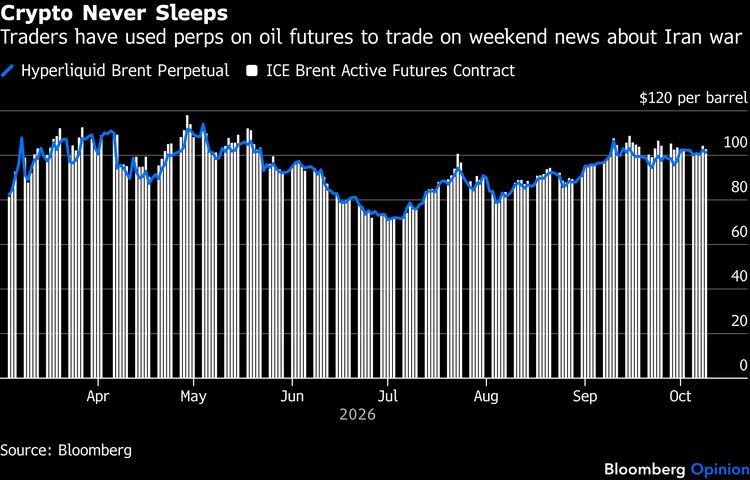
SGX, the local exchange, launched its own perps on Bitcoin and Ethereum last year for “accredited, expert, and institutional investors.” (It now wants to offer these instruments to US institutional investors .)
Yet SGX perps merely borrow the math of their blockchain cousins and wrap it around traditional dollar-settled contracts. Funds must still flow through standard bank accounts. That appeals to global institutions seeking crypto exposure without having to transact with counterparties whose wallets may have been used for money-laundering and sanctions-busting activities.
However, for retail investors, decentralized trading venues like Hyperliquid offer something traditional exchanges never will: instant gratification. Free from identity checks and regulatory gatekeepers, Gen Z traders can stake HYPE tokens to spin up new trading pairs and speculate on Anthropic PBC’s market value long before traditional investors have even seen a draft prospectus.
Is such unbridled democratization the future of finance, or is this a return to a past riddled with lawlessness?
Sir Stamford Raffles, who landed in the fishing village of 200 people in 1819, hoping to establish a rules-based British state on the Malayan peninsula, was annoyed by the cock fights he encountered. As Singapore grew, unregulated gambling became a major menace until 1968, when Prime Minister Lee Kuan Yew consolidated lotteries under state control. “Over my dead body,” Lee famously warned Macau tycoon Stanley Ho about opening a casino.
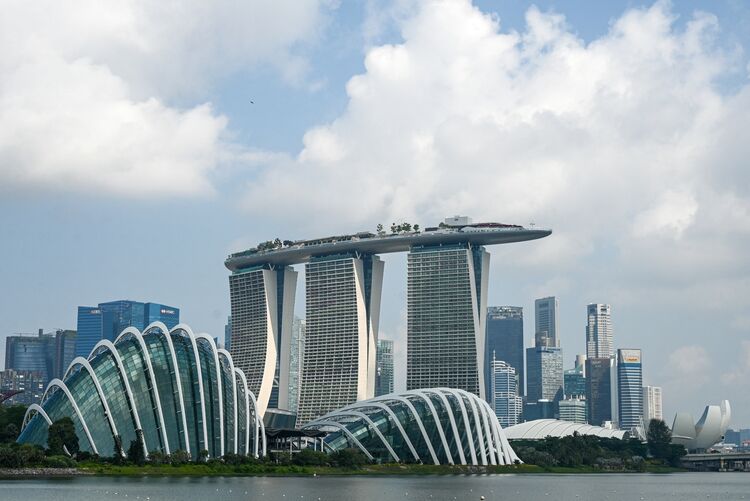
Decades later, Singapore reluctantly permitted two casinos as part of integrated resorts to promote tourism. One of them — Marina Bay Sands, with its iconic ship-shaped roof straddling three towers — was Yan’s stage last week. Standing in the heart of a tightly regulated gambling complex, the CEO pitched his permissionless betting engine. With perpetual futures having already become the hottest thing in crypto trading, his next goal, he said, was to offer options .
That’s the vexing part: Singapore’s third casino — one it never allowed and can’t regulate — promises to keep growing. The city’s conservative financial mandarins will be hard-pressed to keep any control on these modern-day cock fights.
More From Bloomberg Opinion:
- Matt Levine's Money Stuff: Pre-IPO Perpetual Futures Swap ETF
- Real Danger of Perpetual Futures Is Being Ignored: Aaron Brown
- Bitcoin Is Boring. Bring on AI, JGB Tokens : Andy Mukherjee
Want more Bloomberg Opinion? OPIN <GO>. Or you can subscribe to our daily newsletter .