Critics of wealth taxes say they are fiendishly difficult to administer and politically perilous. Britain’s Labour government was hoping to avoid both pitfalls when it came up with a lighter alternative, but the so-called mansion tax is still at risk of a messy start.
Tax lawyers and councils in affluent areas warn that the launch of the levy in 2028 will be hit by a wave of appeals that overwhelms officials. The policy — a charge on homes deemed to be worth more than £2 million ($2.6 million) — has been pounced upon by opposition parties, with the Conservatives pledging to scrap it alongside other property taxes if they beat Labour at the next election.
“This new tax has all the ingredients of a disaster waiting to happen,” said Tim Stovold, head of tax at Moore Kingston Smith, an advisory firm in London. “This is a tax that is forecast to lose the Treasury money in its early years and, even when it does deliver some positive tax collection, the cost of administering the tax looks like it will remain high, with appeals taking more than a year to collect £2,500 of tax.”
Critics predict problems in the valuation of properties that are unusual or haven’t been sold in decades, as well as lengthy delays that leave homeowners on the hook while they await decisions on appeals. HMRC is gearing up for what could be a rocky launch with extra resources set to be deployed and up to 200 staff expected to work on its delivery, according to a person familiar with matter.
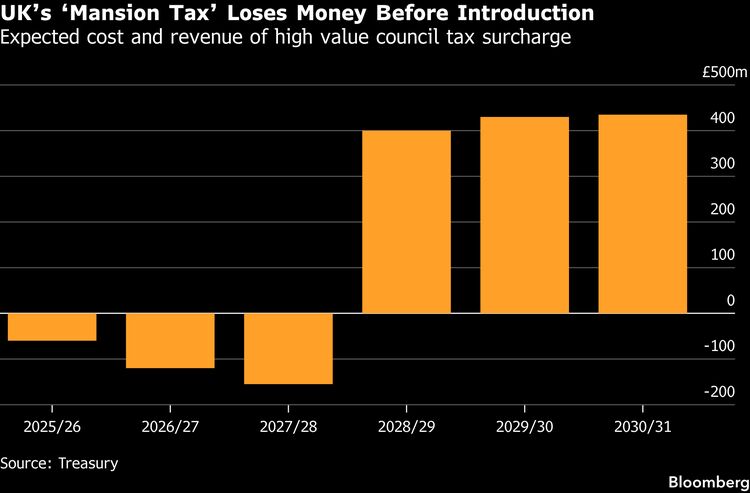
Former Chancellor of the Exchequer Rachel Reeves announced the surcharge at the 2025 budget amid pressure to target wealth from the left of the party and Labour grandees such as ex-leader Neil Kinnock. It starts at a £2,500 for homes above £2 million, rising to £7,500 for properties worth more than £5 million. The levy is expected to raise £400 million in 2028/29 after causing an initial loss in the years before its introduction. The predicted income is tiny compared with the £1.3 trillion of tax revenue projected for 2028/29.
Reeves’ successor as chancellor, John Healey, is expected to leave the policy as it stands in his budget on Oct. 28.
Threshold
Some of the most-affected London councils have said the new levy is as badly thought out as Britain’s infamous window tax of 1696 — which led to homeowners bricking-up windows.
A list of properties affected by the mansion tax will be released next autumn, giving homeowners around six months to appeal before it comes into force, according to HM Revenue & Customs. An estimated 135,000 homes are expected to be levied.
Peter Graham, a Conservative who’s cabinet member for finance on Wandsworth council, said the levy is a “big headache.”
“You’ll get all kinds of challenges to valuations; you’ll get people playing games,” he said. “They will make physical alterations or make legal changes to the status of their properties, simply to avoid being caught.”
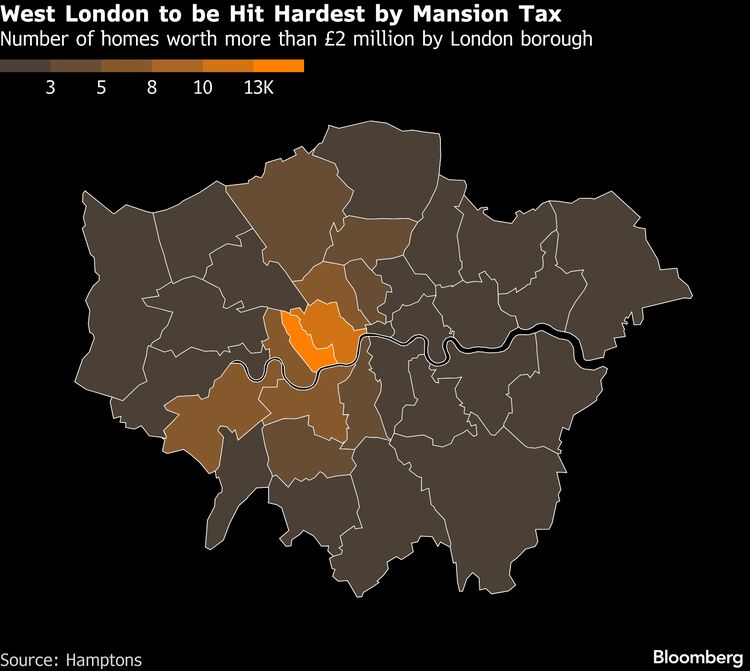
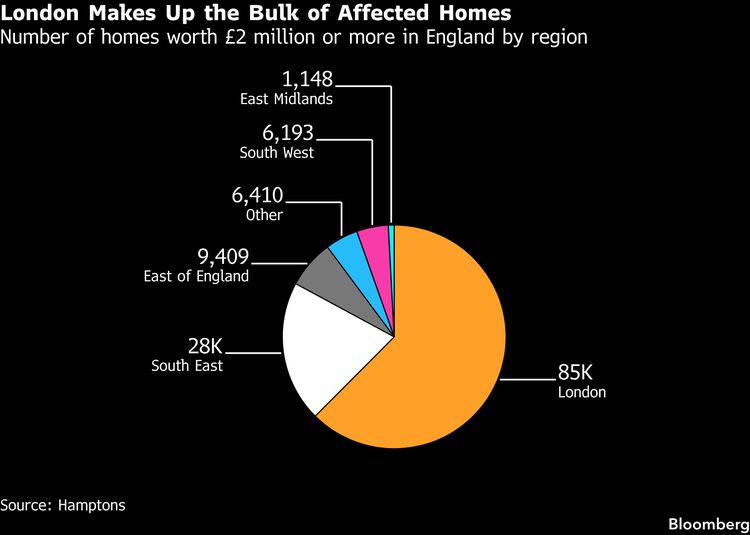
Just under two-thirds of affected homes are expected to be in London, according to estimates by estate agent Hamptons, and the government has said it will use a home’s size and nearby sale prices nearby to judge the value of a property.
Estimating valuations could be more tricky outside London where expensive properties are rarer. Research by Tax Policy Associates, a think tank, shows that in swathes of the country there are only one or two properties likely to be caught up, meaning nearby sales data of comparable homes is scant.
“People are going to appeal this, and six months is extremely optimistic to expect people to have that sorted in that time,” said Neal Groves, partner at Beavis Morgan. “They’re all likely to be individual style properties. A lot of these are going to need appeals and they’re going to need people to come and visit the properties.”
Still, not everyone agrees. Arun Advani, director of the Centre for the Analysis of Taxation, another think tank, said the policy has been designed to simplify the process.
“On valuing the properties, I don’t think that’s impossible at all — we already did it for council tax,” he said. “We don’t even need to know the exact value to the pounds and pence. We just need to work out: is it roughly in this band.”
Advani believes only properties close to the edge of each valuation band will end up in dispute, and the Treasury can cope with a lot of these falling into a lower band. Yet he warns of another problem. “It does seem administratively like a pain that the councils have to go figure out who the actual owner is of the property, just for the bit of the high-value council tax surcharge.”
An HMRC spokesperson also said expert valuers will use “well-established methods” and that additional staff will “ensure we value and band these properties effectively and respond efficiently to appeals.”
Landlords, Not Tenants
While the tax is described as a council tax surcharge, it is very different in who it is targeting.
Local authorities currently collect council tax but that is levied on those living in the property, including private renters, rather than just the owner, as will be the case with the mansion tax. That is likely to cause complications in houses where there are multiple tenants living in a large property that is above the £2 million threshold.
Jim Millard, lead member for finance and resources at Richmond upon Thames council, warned the tax “creates a significant administrative complexity” for councils and will require extensive data sharing with central government.
“This isn’t simply another line on your council tax bill,” he said. “Anyone who is a tenant, this is not applicable to them, and actually, in those properties, we need to identify ownership, which is a new piece of work and can be very complex.”
Elizabeth Campbell, council leader of Kensington and Chelsea, said it will need “to develop systems and processes to collect it on the government’s behalf, but we don’t yet know what that will involve.”
Home Visits
HMRC has said home visits to determine valuations will be a last resort, though homeowners may insist on it to plead their case. Homeowners will still pay the tax if it’s due while they wait the outcome of any appeal.
“There’s a whole army of valuers that will have to go into people’s properties,” said Graham. “What will people do to make their properties look like they’re worth less than they are? The government is inviting that kind of behavior because their design is so crude.”
If unhappy with the outcome of initial appeals, property owners could go one step further to the Valuation Tribunal for England. However, the VTE currently has a nine-month wait time on council tax appeals, longer than the roughly six-month lead-in time envisaged for the mansion tax. It cleared less than 1,000 council tax valuation appeals in the second quarter, a figure that could be dwarfed by those challenging mansion tax decisions.
“There will be an immediate inflow of new appeals,” said Stovold. “This means the nine-month waiting time is likely to stretch beyond a year and this is only after the local authority has dealt with the first stage of the appeal.”