Equity option traders will be looking for the market to break out of its inertia as tech company earnings collide with a Federal Reserve meeting and US midterm elections.
For traders following dispersion strategies, where long single-stock volatility is offset by an index position, the week or so when some of the biggest semiconductor and artificial intelligence firms report profits will be key. It’s a window that typically brings bigger swings in single stocks as results and outlooks for individual companies outweigh the dominant macro themes around interest rates and oil prices, increasing dispersion within baskets of US equities.
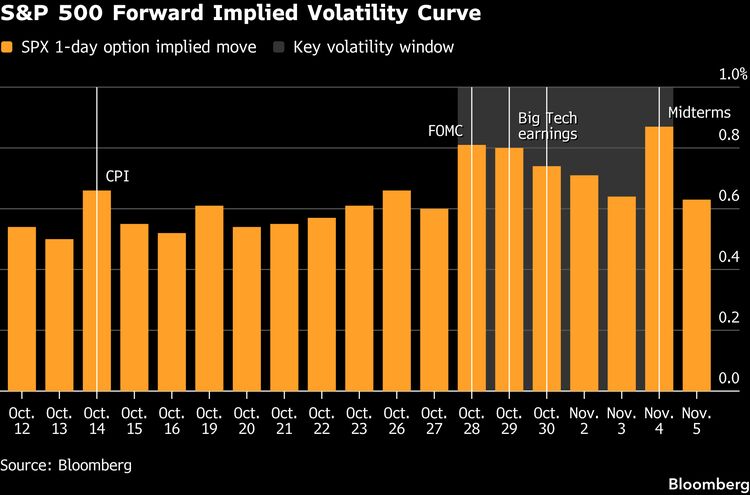
This season is a particularly fraught one for some dispersion traders, who have seen the mark-to-market performance of their positions draw down sharply as single-stock volatility slumped. They will be anxiously awaiting the latest updates on AI demand and semiconductor capital expenditures, looking for surprises that will cause shares to gyrate.
“The dispersion trade had exceptional momentum heading into July, and incentive structures at many funds strongly encourage adding to trades that have performed well recently,” said Alexis Maubourguet, chief investment officer at Adapt Investment Managers. “We therefore saw substantial rebuilding of dispersion positions following the July pullback associated with the Situational Awareness unwind. These positions are now underwater.”
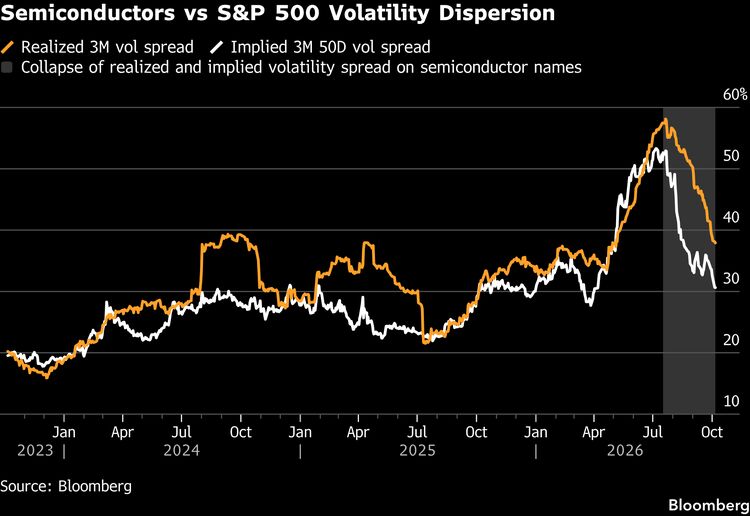
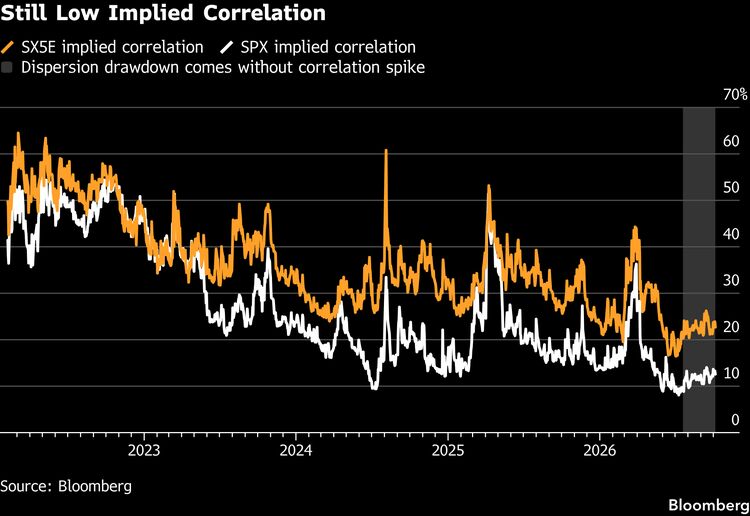
More worrying for the traders is this: The recent narrowing of semiconductor firms’ implied volatility premium over the S&P 500 Index has come with a similar drop in realized swings. Meanwhile, correlation has remained subdued, unlike in recent drawdowns that followed major macro events.
That may be especially concerning to risk managers at hedge fund pods. The dispersion drawdown following the US-Israeli attack on Iran was driven in large part by a spike in implied correlation, while the realized part of the trade remained resilient. That provided strong justification for risk managers to allow positions to run and not force a liquidation.
“The unwavering conviction that justified price-insensitive buying, including paying 100 vol for upside calls in the hope that these tech names would double or triple over the medium term, seems to have faded,” Maubourguet said. “Consequently, the standard dispersion trade has suffered as both implied and realized volatility spreads have compressed.”
Read more: Worries Grow That Hedge Fund Crowding May Amplify Risk in Crisis
In the current climate, it may be harder to justify keeping the trade on the books. That makes this earnings season potentially even more important for semiconductor and memory stocks to provide sufficient earnings-related volatility.
While the blowout realized moves seen during first-quarter results may be very difficult to repeat, options are nevertheless pricing in the biggest one-day reactions to earnings since Covid, with the largest moves as usual priced for tech stocks, according to UBS Group AG derivatives strategist Kieran Diamond.
That expectation for bigger earnings-related moves in tech stocks is likely to keep hedge funds invested, even after giving back a chunk of their early-year gains over the past few months. For some, the drop in equity volatility has even offered a better entry point for the trade.
Read more: Tremors From AI to Oil Boost Popular Hedge Fund Dispersion Trade
“Investors suffering a drawdown on tech-heavy baskets within volatility dispersion are likely to wait through earnings season to see how the trade carries over that period before tweaking exposure,” said Herve Guyon, head of flow strategy and solutions at Societe Generale SA. “Players are still actively looking for opportunities within the dispersion space, for example via the palladium structure playing AI winners vs losers.”
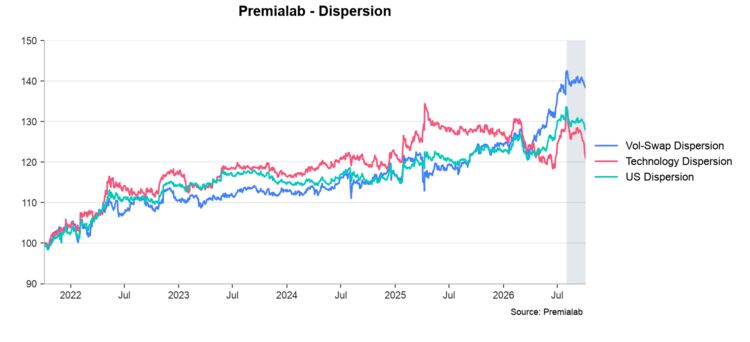
Tech-focused QIS dispersion strategies have been hit the hardest, according to Premialab, which aggregates industry data.
“This indicates that some of the recent mark-to-market pressure is specific to technology-heavy baskets rather than reflecting a broad deterioration across all systematic dispersion implementations,” said Adrien Geliot, chief executive officer at Premialab.
If a major macro shock — such as an expansion of the US-Iran war, or a bond or currency market upset — were to cause stocks to move in lockstep, the performance of dispersion baskets could suffer even more. That would arguably make the risk-reward on reverse dispersion — selling single-stock volatility, buying index — look far more compelling.
Traders focusing on Cboe Volatility Index strategies will also be closely watching how the dispersion trade plays out, as any forced unwind will likely result in bigger moves on the gauge. Recently, investors were hedging US midterms with November VIX call spreads.
“Lower single-stock volatility was the first shoe to drop,” Maubourguet said. “If the second shoe drops through a rise in index volatility, for example triggered by a 3% daily decline in the S&P 500, we will see unwinds.”