Warsaw-listed electronics distributor Asbis Enterprises Plc is prioritizing sales to data centers and artificial intelligence infrastructure projects to sustain its breakneck stock rally.
The strategy follows a near six-fold rise in Asbis shares this year, which has lifted the company’s market value above $2.5 billion. The surge has put the little-known firm on the radar of larger international investors, drawn by revenue growth that has far outpaced most European IT resellers.
Known for distributing consumer products, including Apple Inc. devices across harder-to-serve markets such as Ukraine and Kazakhstan, Cyprus-based Asbis has leveraged its relationships with key US producers to broaden its product mix. In recent months, it has emerged as a major beneficiary of surging investments in data-center infrastructure.
The demand is coming from “all over the place, and we see no sign of it cooling down,” according to Deputy Chief Executive Officer Constantinos Tziamalis, who added that Asbis is getting orders from western Europe.
“We see a pipeline of six months down the line, and we see that the order book is full,” he said in an interview. “There is no stoppage of the hyperscalers in terms of investments.”
Hyperscalers are major cloud computing and infrastructure providers, such as Amazon.com Inc., Microsoft Corp. and Alphabet Inc., that operate massive data centers capable of scaling services dynamically to meet demand.
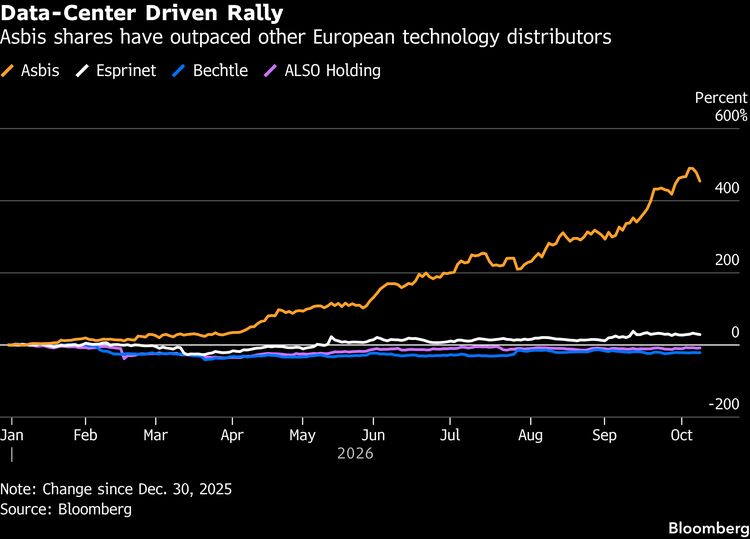
Asbis is betting that winning large data-center customers now will allow it to deepen those relationships over time, to sell a broader range of products and ultimately to improve profitability. Management has signaled it is unwilling to protect short-term margins if that means missing out on the current wave of demand.
The company has distributed core data-center equipment for decades, including graphics processors, chips, server blocks, racks, storage and power systems. It began by working with Seagate Technology Holdings Plc and later expanded its roster of vendors to include Super Micro Computer Inc. and Nvidia Corp. This year, sales in its server business surged about 180% from a year earlier, accounting for 43% of total revenue in the second quarter.
Asbis is also pursuing acquisitions in markets and segments where a target could add complementary products, expertise or earnings.
“Our investors expect faster growth because they see the opportunities in the data centers,” Tziamalis said. “If we hook the customers, if we prove ourselves as a proper distributor, a proper partner to them, we will know that we will add on more products.”
Difficult Geographies
The ballooning valuation has also widened an investor pool that was historically dominated by Polish asset managers. Tziamalis said the company has attracted growing interest from funds in the US, London, Frankfurt, Dubai and Scandinavia.
Meanwhile, its Warsaw listing has appealed to frontier-market investors seeking exposure to faster-growing economies through a regulated European market. The shares slid 0.1% as of 11:04 a.m. in Warsaw.
Beyond AI infrastructure, Asbis expects Africa, where it opened its first major distribution center in 2023, to become its next significant growth pillar. Annual revenue from the region could potentially exceed $1 billion in about five years, Tziamalis said.
The African push reflects a long-standing willingness to operate in difficult markets. Asbis traces its roots to a business founded by Belarus-born radio engineer Siarhei Kostevitch in 1990 as the Soviet Union was breaking apart, giving the company decades of experience navigating challenging business environments.
Tziamalis added that Kostevitch, 62, appears to have no interest in reducing his 36.84% stake following the rally.
Sanctions Checks
Asbis says it has strict safeguards in place to prevent products sold in former Soviet markets from reaching Russia, which was its largest market before the 2022 invasion of Ukraine.
Tziamalis said the company screens customers through multiple layers of ownership and can trace sensitive equipment by serial number.
Data-center products such as graphics processing units and memory modules are registered with US vendors and, in some markets, require approval before shipment. Consumer devices like iPhones are often sold through installment plans, giving Asbis additional visibility into end buyers.
“For Asbis, it would be catastrophic to take such risks,” Tziamalis said. “We are 100% certain that the goods we sell to these markets stay there.”