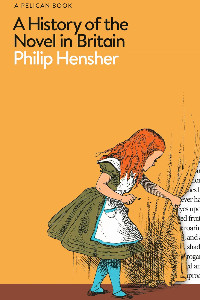
How do you tackle a subject as vast and varied as “the novel in Britain”? For Philip Hensher, author of 12 novels of his own, it’s simple: read lots (and lots) of novels, sorting good from bad. His journey through the twists and turns of an ever-evolving genre encompasses more than 1,000 titles, from Robinson Crusoe (1719) to White Teeth (2000), avoiding any structuring theme or thesis to instead rely on critical instincts sharpened over some 35 years as an unsparing book reviewer.
His invigoratingly blunt survey makes room for genre classics — Tolkien, le Carré, Ballard — alongside syllabus stalwarts, while also unearthing dozens of long-forgotten writers, never hesitating to tell us when it wasn’t worth the bother (witness the “utterly untalented” Algernon Gissing, brother of New Grub Street novelist George, whom Hensher rates little better).
He sidesteps the pitfall of dullness — one précis after another — by being unfailingly opinionated. The British novel from 1830 to 1914 was “one of the most glorious phenomena in world history” until modernism came along. Boo to Virginia Woolf’s The Waves (1931), in which “six characters only monologize about their perceptions”; three cheers for Charles Dickens, who understood that “human beings are most themselves in their externals, and not in what they happen to be thinking”.
Hensher revels in nuts-and-bolts quiddity: when he says Thomas Hardy’s Far from the Madding Crowd (1874) “achieves plausibility through dense arcana” about sheep shearing and “abstruse botanical surveys”, it’s meant as high praise. The brilliance of Arnold Bennett’s 1908 novel The Old Wives’ Tale (“probably the closest thing in English to Thomas Mann’s Buddenbrooks . . . perhaps even to Tolstoy”) is manifest in the minutiae of a restaurant scene set in 19th-century Paris: only a true master, says Hensher, would know the cutlery “ought to be steel, and not silver”.
By contrast, Agatha Christie’s Appointment with Death (1938) is mocked for a plot involving “a room in an English country house [being] plunged into impenetrable darkness at 6.30pm during British Summer Time by the lights being turned off”. Jane Austen’s Emma (1815) names a Yorkshire estate Enscombe; but place names in Yorkshire, where Hensher grew up, “end -thwaite or -gill”.
If reading fiction this way feels a little like going to a disco and refusing to dance, the fastidiousness yields insight. George Eliot’s Daniel Deronda (1876) turns on the hero’s discovery that he’s Jewish; Hensher asks, “How was he not reminded of this every morning in his bath?” It highlights the extent to which Victorian novels appeased prudish circulating libraries, their key market.
Hensher’s superhuman endeavour means he can be forgiven for showing off. When he writes that Kate Roberts’s “gritty” Welsh novel Traed mewn cyffion (Feet in Chains, 1936) “is to be admired” — with no more said — the purpose seems less to inform us about Roberts than to underline his own expertise. When he occasionally notes of some especially obscure title that it went unread “by the present author”, it’s a roundabout reminder of just how many lesser-known works he did plough through, even if only to dismiss them in a footnote as “legendarily tedious”, as with the Victorian novels of Geraldine Jewsbury.
His scorn is hardly reserved for the long dead. Kazuo Ishiguro’s “best novel”, The Unconsoled (1995), is “boring”; Jonathan Coe’s anti-Tory satire What a Carve Up! (1994) is “witless”. “Britain had a Conservative government for most of the period 1979-2024 without fiction acknowledging that anyone of any intelligence or personal morality supported such a thing,” he writes.
In this nitpicking mood, Hensher makes glorious company on the page, yet his conclusion is jarringly naive. Novel-reading, which once had “few hard limits of class, income, age or education”, is now a niche bourgeois pursuit, he fears. Just as he’s completing the book, a 14-year-old boy is murdered on a London bus; the boy had been facing charges of carrying a machete. Neither the victim nor his killer ever read any novels, Hensher guesses: read fiction, he says, and it’s “impossible to bring a machete down upon the face of another human being . . . You would not do it.”
Well, murderers do read novels: think of Ian Brady or Anders Breivik. And I wonder if Hensher’s faith in fiction as some sort of magical and innately benign empathy machine (a widely held view) isn’t actually a symptom of precisely the redundancy he regrets. In the 19th century — his golden age — politicians worried about children reading too many racy French novels; right now, there’s a government inquiry into why some children aren’t reading at all. Times change, but if the best we can say for novels is that they teach compassion, perhaps no one can really be shocked if more of us don’t come rushing to eat our greens.
A History of the Novel in Britain by Philip Hensher Pelican £25, 704 pages, to be released February 2027 in the US by Princeton University Press $35
Join our online book group on Facebook at FT Books Café and follow FT Weekend on Instagram, Bluesky and X