
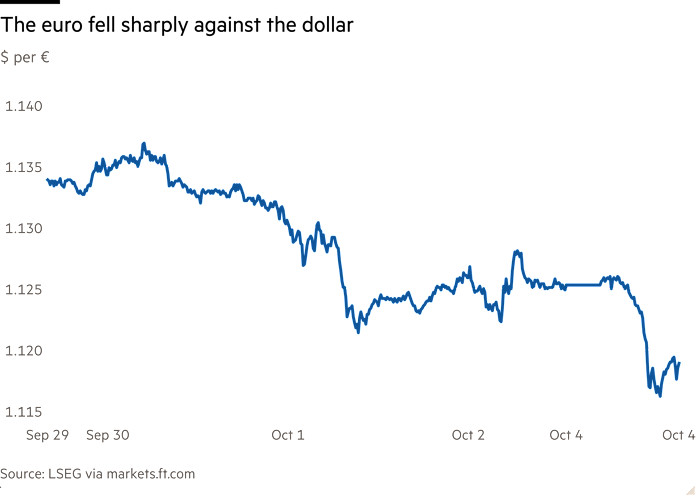
The euro fell to a 17-month low against the dollar on Monday, as a sell-off in French debt sent a shudder through Eurozone markets already under pressure from higher oil prices.
The euro weakened as much as 0.8 per cent against the dollar to $1.116 during morning trading in London. It was later at $1.121. The single currency is down 4.5 per cent against the dollar this year.
The euro’s slide was “driven by intensifying fears over the destabilising financial conditions in the Eurozone triggered by the sharp sell-off in French government bonds”, said Lee Hardman, senior currency analyst at MUFG.
A sell-off in French debt deepened last week, driving yields on 10-year government bonds close to 5 per cent. French yields have risen the most out of any G7 bond market since the Iran war began, up from 3.2 per cent in late February.
Having risen again in early Monday trading, they then drifted back down to 4.86 per cent, flat on the day.
France has suffered particularly in the global bond sell-off as the march higher in yields has combined with worries over the government’s failure to bring the country’s deficit back down to within 5 per cent of GDP.
The worry started to weigh on the euro last week and hit other Eurozone government bond markets, especially Italy’s, prompting speculation that the European Central Bank would have to respond to stop France’s debt problems spilling into the wider euro area.
“The unfavourable developments have triggered fears over the re-emergence of fragmentation risks in the Eurozone that could impede the transmission of monetary policy,” said Hardman.
Investors are worried that the rise of populist parties ahead of France’s presidential election next year could worsen the outlook further.
The announcement of a snap election in Spain, after Prime Minister Pedro Sánchez had a flagship housing bill rejected last week, has also injected further uncertainty.
“The politics of Europe are really starting to deteriorate,” said Eric Robertsen, head of global research and chief strategist at Standard Chartered, highlighting the French bond market in particular. “France does not appear to have either the will or the ability to get its fiscal house in order.”
Investors have also shifted back their expectations of when the ECB will increase interest rates, removing some support from the currency. With the deteriorating political and fiscal backdrop in France, traders are now expecting only two further quarter-point rate increases from the current 2.5 per cent ECB rate over the next year. A couple of weeks ago, three were expected.
“French yields are already tightening financial conditions and should make it progressively harder for the ECB to deliver the hikes markets had been pricing,” said Jim Reid of Deutsche Bank.
US fund manager Vanguard last week sounded the alarm over France’s “degrading” creditworthiness, with the country becoming the centre of market concerns about European debt sustainability.
In a sign of the Eurozone wobble spreading deeper into FX markets, the euro has also tumbled 1.6 per cent against the Swiss franc this month, to SFr0.932, on course for one of its biggest monthly drops in recent years.
Peter Kinsella, head of investment services UK at Swiss private bank UBP, said the move “once again” highlighted the franc’s safe-haven properties, and had returned attention to a currency pair that was the “FX market’s preferred proxy for intra-Eurozone spread risk” during the 2010-12 crisis.
Analysts said the comparisons with the Eurozone crisis were overdone. “We are cautious on the euro’s performance but comparisons to 2012 are well off the mark,” said Geoffrey Yu, a senior strategist at BNY.
Deutsche’s Reid said the “big question is whether this is the start of a new euro sovereign crisis or whether markets have already overshot . . . my bias is towards the latter”.