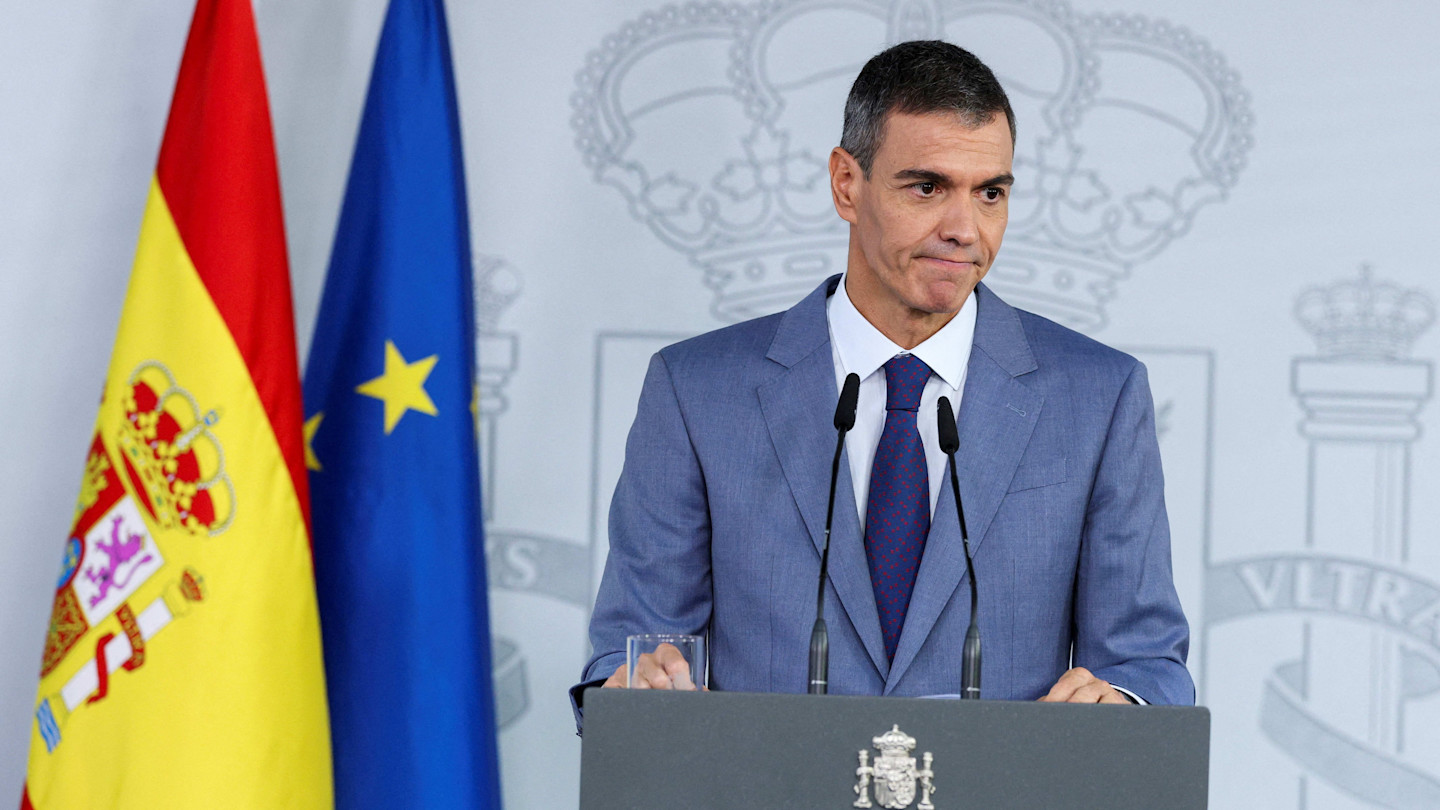
Spanish prime minister Pedro Sánchez has made a career out of high-stakes gambles. His latest is to call snap elections for November 29, seeking to use a housing crisis that has prompted mass protests as an opportunity to face down his rightwing opponents. Opinion polls suggest it could be his last.
Sánchez’s Socialist party (PSOE) on 26 per cent is well behind the opposition People’s Party on 32 per cent and its probable coalition partner, the rightwing populist Vox, on 18 per cent. PSOE’s far-left allies Podemos and Sumar, both in single figures, are divided and rudderless, weakened by Sánchez talking the language of the populist left.
This is a fight not just for the direction of Spain but also for the future of the left in Europe. Spain had become a “global reference point for peace, feminism and prosperity”, Sánchez boasted on Monday. He is a lonely progressive standard-bearer in the EU: pro-immigration and tech regulation, sceptical on rearmament, and staunchly anti-Trump. His defeat could usher in another centre-right/nationalist-populist coalition — which could spell trouble for the EU.
Sánchez has never had a parliamentary majority since becoming prime minister in 2018. His latest administration has turned into a zombie government, largely unable to pass major legislation, buffeted by events and mired in corruption scandals. The prime minister frequently warns of the dangers to democracy from an authoritarian right, but has increasingly resorted to rule by decree. It is good for Spain to have an earlier-than-scheduled chance at a parliamentary reset and at least the possibility of a more stable government.
His conservative opponents have long questioned Sánchez’s mandate to govern. He has led a series of minority governments since 2018 when the PSOE united the opposition, including nationalist parties, against the PP premier Mariano Rajoy in a no-confidence motion. After snap elections in 2023, the second-placed Socialists formed a weak minority government with the support of the Catalan pro-independence parties in return for an amnesty for people convicted of offences during the illegal Catalan secession attempt.
The amnesty has been the government’s main legislative achievement. It helped achieve détente in Catalonia, defusing tensions. But it was deeply contentious in Spain and, to Sánchez’s critics, looked like a self-serving partisan arrangement.
The prime minister’s latest sharp manoeuvre is to try to harness the outpouring of anger over Spain’s housing crisis and the eviction of an 87-year-old woman from her Madrid flat. He is presenting himself as a progressive champion of tenants’ rights against a conservative opposition — which last week voted down two emergency bills on housing from Sánchez’s government — that he says is protecting the interests of an exploitative elite.
Sánchez has a record of outfoxing flat-footed opponents, but his latest gambit seems a stretch even for him, given that the housing shortage has worsened during his eight years in power, aggravated by mass immigration. His populist answer, aimed at curbing soaring rents and preventing evictions, does little to address the root causes.
The Spanish premier has a decent record on the economy. But the twin motors of EU pandemic funds and unbridled immigration are ending or reaching the limit of public acceptance. Government drift and allegations of graft involving members of the prime minister’s inner circle have left their mark
In a polarised and highly charged political system, Sánchez’s critics have often vehemently questioned his legitimacy. But Sánchez himself is not afraid of polarising the debate by playing up the dangers of the far right, when it turns attention from his own performance. This time it may well not be enough.