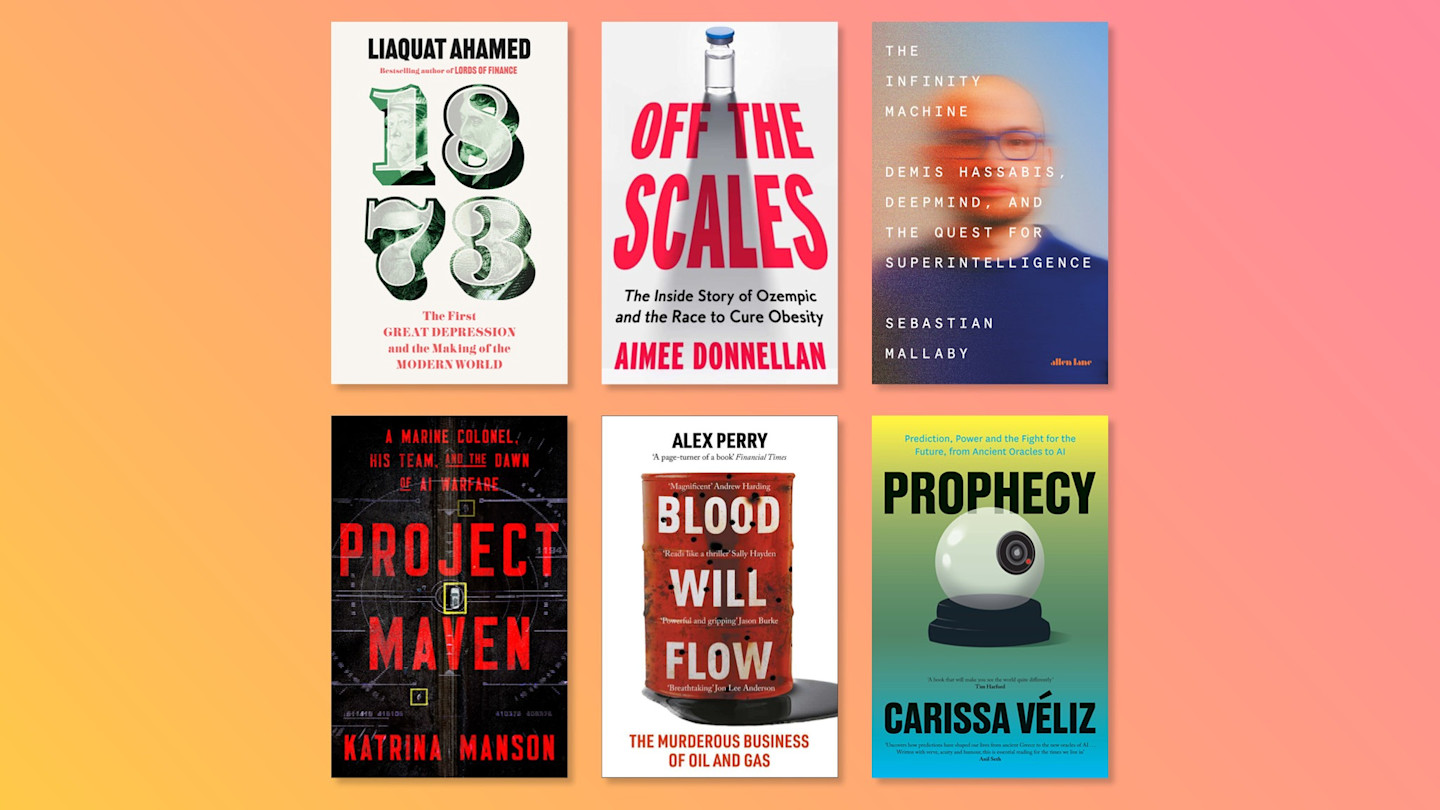
The profound disruptive challenges posed by AI dominate the shortlist of this year’s Financial Times and Standard Chartered Business Book of the Year Award.
Three of the six finalists tackle the risks and opportunities of AI — as a powerful general-purpose tool, as a weapon, and as an algorithmic forecasting engine.
The list, announced by FT editor Roula Khalaf on October 6, includes books by two former winners of the award, Liaquat Ahamed and Sebastian Mallaby.
Khalaf praised the “impressive breadth and depth” of the field, which also includes titles on the anti-obesity drug revolution, the damage caused by the fossil fuel industry and lessons from the first global financial crisis. “The authors dig deep, ask the big questions, and provide compelling insights into business, leadership and how to navigate uncertainty,” she said.
The finalists are:
1873: The First Great Depression and the Making of the Modern World by 2009’s winner Liaquat Ahamed, who recounts and analyses a global turning point with suggestive parallels with the geoeconomic tensions of today.
Off the Scales: The Inside Story of Ozempic and the Race to Cure Obesity, Aimee Donnellan’s examination of the discovery of GLP-1s and the creation by Novo Nordisk of the weight-loss drug Ozempic.
The Infinity Machine: Demis Hassabis, DeepMind and the Quest for Superintelligence by Sebastian Mallaby, a winner in 2016, who through interviews with the DeepMind co-founder explores the past, present and future of the company and the implications of AI.
Project Maven: A Marine Colonel, His Team, and the Dawn of AI Warfare by former FT reporter Katrina Manson traces the dramatic tale of a secret Pentagon plan to bring AI to the battlefield with the help of Silicon Valley.
Blood Will Flow: The Murderous Business of Oil and Gas by Alex Perry uses a deep investigation into an Islamist attack in Mozambique to shed light on the dangerous consequences of oil and gas exploration.
Prophecy: Prediction, Power and the Fight for the Future, from Ancient Oracles to AI by Carissa Véliz exposes our longstanding obsession with forecasting and forecasters and the implications for industries from insurance to technology.
This year’s award is the 22nd edition of the prestigious FT prize and is worth £30,000 to the author of the winning book. The prize, which is also supported by FT owner Nikkei, will be presented in London on December 2, along with the Bracken Prize for Young Authors. Authors of each of the shortlisted books will receive £10,000.
In an indication of how far technology is dominating both business leaders’ agendas — and those of publishers — five of the last six FT awards have gone to books on technology. Last year’s prize was won by The Thinking Machine, Stephen Witt’s exploration of the rise of chipmaker Nvidia and its chief executive Jensen Huang. The 2024 winner was Parmy Olson’s Supremacy, about the rivalry between AI pioneers.
For more about the book award, visit www.ft.com/bookaward