British food producers have criticised the “huge uncertainty” created by Conservative Party proposals to rip up any UK-EU deal to remove post-Brexit trade barriers affecting the food and agriculture sectors.
Andrew Griffith, shadow chancellor, said his party would scrap any deal struck by Andy Burnham’s government to liberalise agrifood trade, on the grounds that it would leave the UK having to copy and paste Brussels rules.
Conservative leader Kemi Badenoch also said she would rip up a deal because “I’ve had farmers tell me that some of the things that they’re negotiating . . . are going to be a problem”.
The position of the Conservatives, the official opposition party, has caused concern in the food and drink industry, which fears being cast into a chaotic situation where it may be forced to comply with different regulatory regimes every few years.
In Brussels there are also concerns about doing deals with Britain, when the political situation is so volatile and where Labour’s two main rivals — the Tories and Nigel Farage’s Reform UK — both remain strongly Eurosceptic.
Ten years after Brexit, the EU is demanding that the UK sign a “Farage clause”, which would commit London to paying compensation to rebuild border infrastructure in case a future British government pulled out of the deal.
Burnham’s government has so far refused, according to people briefed on the talks.
An accord on food and drink is at the heart of the deal Burnham hopes to strike with the EU at a summit in Brussels in November; the prime minister will cast a deal as good for growth with the prospect of lower food prices in the shops.
Karen Betts, chief executive of Food and Drink Federation, an industry body, said: “Overall the industry is supportive of realigning with the EU because it will remove an amount of friction and barriers.
“However, political parties are creating huge uncertainty for the industry and it will be hugely disruptive if the rules keep changing. If we have to comply with the rules and then they change again, the industry will feel very hard done by.”
Griffith made it clear at the Tory party conference in Birmingham that he would rip up an agrifood deal if — as expected — it required Britain to “dynamically align” with EU rules, adopting new laws passed in Brussels.
“We’re all in favour of reducing frictions, but we’ve said very clearly that is a red line,” Griffith told reporters. “I’ll say it again today: a red line is becoming a rule-taker from Brussels.”
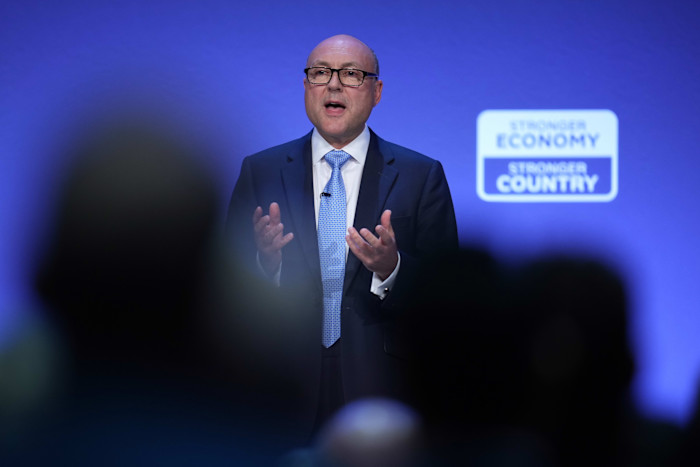
He added: “That would not be something that we would find acceptable.”
Some parts of the food industry say a “SPS” — or sanitary and phytosanitary — — accord with the EU would undermine UK trade ties with the rest of the world.
Nigel Jenney, chief executive of the Fresh Produce Consortium, which represents fruit and vegetable importers, said goods from the rest of the world arriving in the UK had since 2021 been subject to less stringent border checks.
“The government is knowingly compromising trade with the rest of the world. We [the UK government] will make it easier to trade with the EU, but make it far harder for the rest of the world to trade with the UK,” he said.
The Agricultural Industries Confederation, which represents animal feed and fertiliser producers, said that while a deal with the EU was likely to bring trade-offs, a predictable regulatory environment was important for businesses.
“Alternating between alignment and divergence with the EU only adds to this uncertainty at a time when we need greater inward investment,” said Ed Barker, AIC head of policy.
One EU diplomat said the Conservative move would “confirm to many people in Brussels and European capitals that there is no point in entertaining thoughts of the UK rejoining the EU at this stage”.
At Labour’s annual conference in Liverpool last week, Burnham opened the door to a national debate on Britain’s future relations with the EU, including the possibility of rejoining the bloc.
“This won’t affect the will to engage constructively with the British government,” the EU diplomat added.
A Labour spokesperson said: “The Tories’ message to business could not be clearer: they want to put back up the barriers that this Labour government is busy tearing down, making it harder to trade with our nearest neighbours.”