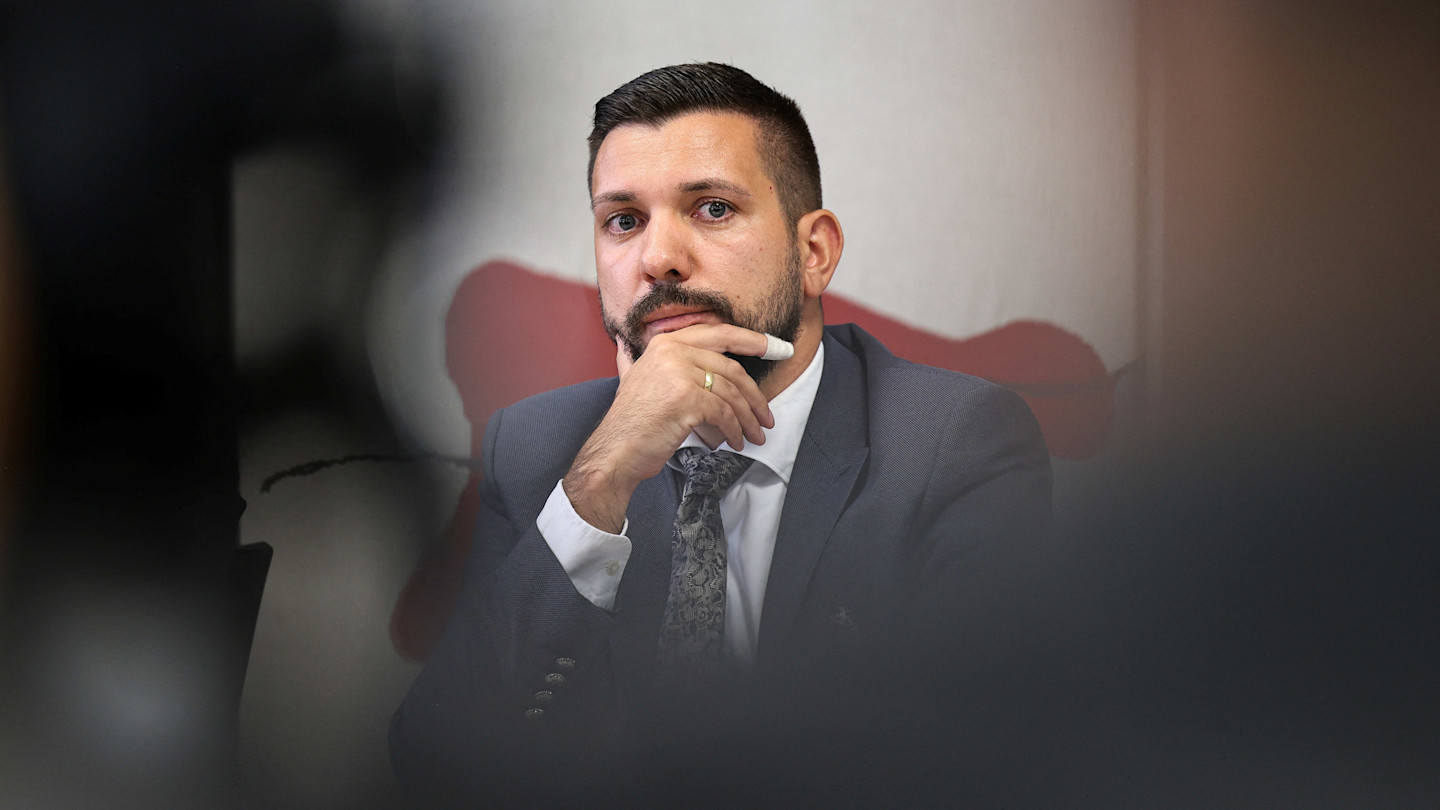
The far-right Alternative for Germany is set to secure its first-ever president of a regional parliament on Tuesday after its landslide election victory in the state of Saxony-Anhalt.
The AfD has nominated Tobias Rausch, a 35-year-old real estate manager who was at the centre of a recent nepotism scandal, as its candidate for the role as the parliament convenes for the first time since elections last month.
Rausch is expected to be elected as president — a role akin to that of speaker in Britain’s House of Commons — with the help of the hard-left Bündnis Sahra Wagenknecht (BSW).
The BSW, founded just under three years ago, is the only political party that is openly willing to work with the far right.
All other parties have ruled out co-operating with the AfD, which has been officially designated as rightwing extremist by Germany’s domestic intelligence service.
The AfD won almost 44 per cent of the vote in regional elections in Saxony-Anhalt on September 6 after campaigning on a hardline platform that railed against “culturally incompatible” foreigners and promised to deepen ties with Russia.
The record result for the anti-immigration AfD was hailed as a triumph by the party’s national leadership and sent shockwaves through Germany’s political establishment.
But with 39 seats in the Landtag, or regional parliament, the AfD fell just short of the 42 needed for a working majority.
The AfD’s lead candidate in Saxony-Anhalt, the former room-fragrance salesman Ulrich Siegmund, is now seeking to secure the votes needed to become the party’s first ever premier of a German state. That would give him real power over education, policing and some aspects of migration policy.
Siegmund and other AfD officials have been holding talks with the BSW, which has said it would be willing to co-operate on some issues — but would not be prepared to elect him as state premier.
Instead, the BSW has said it would abstain in the critical third round of voting on the choice of premier, when a simple majority would be enough to elect Siegmund.
But Siegmund, 35, said last week that he was confident that he would be elected in the first round of voting “with a significant majority”, adding that he planned to hold the vote in December.
He declined to provide details about how he would achieve that, and his comments fuelled speculation that he could secure votes from the centre-right Christian Democratic Union led by Chancellor Friedrich Merz.
That would pile further pressure on the deeply unpopular Merz, who is contending with growing discontent within CDU ranks following setbacks in several regional elections. These include the small north-eastern state of Mecklenburg-Vorpommern, where the CDU last month recorded its worst result in a state poll in postwar German history.
Tuesday’s convening of the Saxony-Anhalt parliament for the first time since September’s vote will be a hugely symbolic moment for the AfD.
Founded in 2013, the party has surged from being a fringe movement to an insurgent force that is now leading national opinion polls.
In the Saxony-Anhalt regional assembly, the AfD will sit for the first time in the centre of the semicircular seating arrangement — reflecting its newfound position as the largest party.
Police said that they were expecting demonstrations against the prospect of the AfD holding the parliament’s presidency, including protests organised by the centre-left Social Democrats, the anti-capitalist Die Linke and the Greens.
Rausch, the AfD nominee for president, will be the state’s highest-ranking representative in protocol terms, representing it externally at ceremonies and events.
He will also be in charge of running plenary sittings in the parliament, calling speakers and enforcing rules.
He himself is a contentious figure. He was caught up in the nepotism scandal that involved a string of senior AfD officials in Saxony-Anhalt using an elaborate system to employ each other’s relatives using public funds.
Three of his siblings were employed in the Bundestag office of an AfD member of parliament from the region — an arrangement that he said he had no involvement in.
It emerged in February that Rausch’s office in the Saxony-Anhalt parliament employed at least four members of a local football club that he chaired.
He defended their part-time contracts, saying that the players helped with distributing AfD newsletters and other promotional material, adding: “These people are motivated, athletic and can reach as many households as possible.”