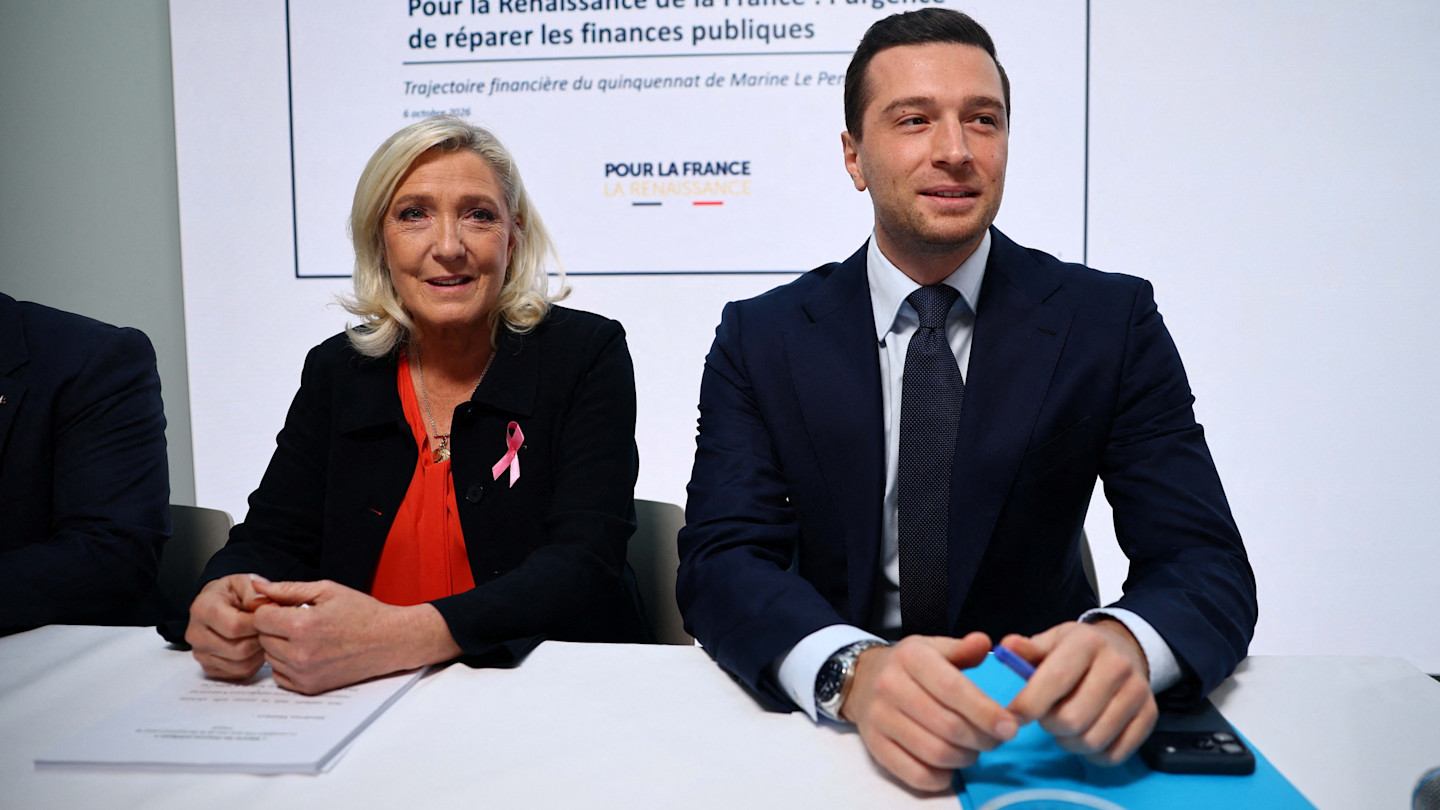
French far-right leader Marine Le Pen has promised to drastically cut public spending and to cap future borrowing if elected president next spring, in a bid to bolster her economic credentials and calm jittery markets.
Le Pen, who is leading opinion polls ahead of her fourth bid for president, on Tuesday proposed a “golden rule” to cap national debt at 60 per cent of GDP and to reduce the public deficit each year by 0.5 per cent to reach “close to a balanced budget”.
She said she would put the move, which would mirror the German “debt brake” that was enshrined in that country’s constitution until last year, to voters in a referendum.
In a news conference, Le Pen blamed President Emmanuel Macron’s economic management and profligate spending for pushing the deficit to 5.4 per cent of GDP this year.
“The parties that are part of the system put us in the hands of debt holders but I refuse to lie to the French by saying this all will not have consequences,” she said.
Le Pen hopes her economic plans will convince voters she can be entrusted with power and also reassure investors who have sent French borrowing costs soaring.
However, Allianz chief economist Ludovic Subran called the proposals “voodoo economics” and noted that some of the ideas, such as cutting benefits for foreign nationals, would require constitutional reforms. Unilaterally halving France’s contribution to the EU budget was also unrealistic, he said.
“The RN now presents itself as the party of fiscal rectitude, but the route to its targets is unclear. The savings figures are disputed,” he said. Delivering the announced savings would be impossible unless the RN reversed tack to lower the retirement age, Subran said.
Le Pen’s pitch comes as France is at risk of falling into a debt crisis, having been singled out by markets as a weak link in the Eurozone. Investors see next year’s presidential election as a risk that may worsen chronic political gridlock and prolong profligate social welfare spending in the country.
French borrowing costs have soared higher than Italy’s and Greece’s in a reversal of fortunes since the Eurozone sovereign debt crisis of the early 2010s.
Macron’s bet that business-friendly reforms on labour and tax would deliver enough of a growth boost to solve France’s chronic deficits has not paid off. Governments have struggled for decades to rein in public spending, posting deficits every year since 1974.
Le Pen unveiled detailed plans of her €140bn package of spending cuts and tax changes she would make over five years, which is more ambitious than an earlier goal of €125bn.
Long a champion of big-state spending to protect the working class, Le Pen in recent months has swung behind the idea that France needs a major clean-up of its degraded public finances.
Her party, Rassemblement National (RN), also pledged tax cuts in what it said would be a fully financed “competitiveness shock” from 2027.
Yet the RN did not detail other aspects of its plans, such as a claim that its approach to pensions would save €15bn to €20bn by correcting “unjust or inefficient measures” in the current system. Economists said this was unlikely given that Le Pen has pledged to reduce retirement age from 62 to 60 for those who begin working at a young age.
RN said state spending curbs would deliver €71.5bn in net savings in 2027, while a wealth tax, a tax on share buybacks and controls on money transfers to third countries would bring in more revenue.
Some €12bn in savings will come from cutting immigration and €9bn from reducing EU contributions, while more would come from eliminating government agencies.
The plan stoked a rally in French bonds after a brutal rout that pushed the country’s benchmark 10-year borrowing costs close to 5 per cent last week.
Ten-year yields fell 0.12 percentage points to 4.75 per cent on Tuesday as the price of the debt rose. Yields on Italian bonds, which had also been caught up in the selling, also fell in a broader move helped by falling oil prices.
“It is definitely better than [the] worst fears on fiscal, but markets are still waiting for detail,” said Ales Koutny, head of international rates at Vanguard.
RN officials hailed the market reaction, pointing out that it contrasted with the ambivalent response to the government budget, which promised €43bn in savings and tax rises for 2027.
Le Pen’s pledges come as her lieutenant Jordan Bardella, who leads the RN and is lined up as her future prime minister, has been engulfed in an antisemitism scandal. Bardella again denied the allegations on Tuesday, and Le Pen said her government would still be led by him if she were elected.
Le Pen called on the European Central Bank to step in and help “lighten the heavy interest burden” as soon as France “takes back control” of its finances.
“By intervening, the ECB could free up tens of billions of euros across Europe,” Le Pen said, without detailing what shape the intervention could take.
Finance minister Roland Lescure told journalists that France was nowhere near needing ECB help and that financial market pressure was helping the government make its case to parliament. He ironically noted Le Pen’s attempt to pivot on public spending: “I have the impression that she has converted to fiscal discipline.”