
The Northern Irish writer Eoin McNamee — less well known than he should be — has a distinctive voice and a distinctive vision. His prose is concentrated and stylised, and his novels are mostly based on real crimes (though his 2007 novel 12:23 was about the death of Princess Diana). In both respects there is a lineage with the works of James Ellroy and David Peace, though stylistically McNamee’s writing is closer to the biblical cadences of Cormac McCarthy.
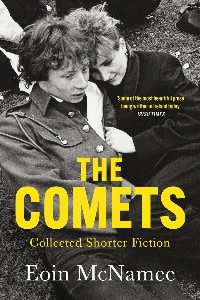
After a career encompassing novels, children’s fiction and pseudonymous thrillers (written under the name John Creed), The Comets is McNamee’s first collection of short fiction, and includes two novellas and 15 punchy shorts, mostly a dozen pages or less. Despite their brevity, McNamee’s condensed style means these intense shots of fiction capture a world efficiently — and most do seem to take place in the same seedy, down-at-heel universe.
The setting is not always specified but usually sounds like Belfast or County Down, in a representation at once realist and otherworldly. In the title story, at a fairground dodgems ride, “poles struck blue fire from the roof grid and the comets blazed across the rink”. In several stories an abandoned aerodrome acquires a sinister, Ballardian quality. (McNamee grew up in the fishing village of Kilkeel, County Down, near the decommissioned wartime airfield RAF Greencastle.)
Often the characters are on journeys, but resolution is refused by the circular or frustrated nature of their quest. In “Walking North, Walking Home,” a woman, adopted in childhood, sets out to find her biological mother, but finds instead a kindred spirit in a taxi driver cast out by his in-laws. “Ellen nodded. Such things happened. Generations were laid waste in the badlands of family.” The two encounter a woman even more desperate, wandering along the middle of the road. “They knew that the woman would never be hit by a car. That an uncomplicated fate did not await her.”
In “The Road Wife”, journeys are repeated for a long-distance truck driver, who is made a blunt offer by a colleague. “I got something to keep you warm. I got a girl in the cab.” The driver, Coyle, succumbs almost reluctantly — “I suppose men like me like to talk.” “No,” the girl said, “they like to have sex” — and finds himself taking responsibility for her when he discovers she’s pregnant.
The doomy atmosphere in McNamee’s world exerts a hold on the reader through the spellbinding intensity of its delivery. In “The Limekiln Road”, which reads like a precursor to his 2019 novel The Vogue, a woman with dementia loses her language. “There was some urgent telling she couldn’t get to.”
But occasionally something lighter breaks through without losing the weirdness. In “The Lion Alone”, a Belfast man keeps a lion at the rear of his house, with a comic twist. There is more experimental stuff too, with “Corpse Flowers” (a very McNamee title) telling the story of a missing girl through a series of images of her seen on security cameras. “The very fact that you are on camera makes you look furtive, up to something.”
The novella “The Last of Deeds” might be the highlight of this potent collection. It’s no less succinct than the shorter stories (one character is encapsulated thus: “[he] came home every night from the pub using both sides of the road”), but the length gives the story more breathing space, as well as the scope for a truly Shakespearean body count.
The story is about a young Catholic man who gets involved with a Protestant girl, to the fury of her community: “this is our town, kid, and she belongs to us”. Mayhem in both directions ensues, awful for everyone involved except the reader. At one point, during a burial, the grave fills with water “and then the coffin began to rise again”. It says that here, in McNamee’s brilliant and terrible world, even death is not the end.
The Comets: Collected Short Fiction by Eoin McNamee Riverrun £20, 224 pages
Join our online book group on Facebook at FT Books Café and follow FT Weekend on Instagram, Bluesky and X