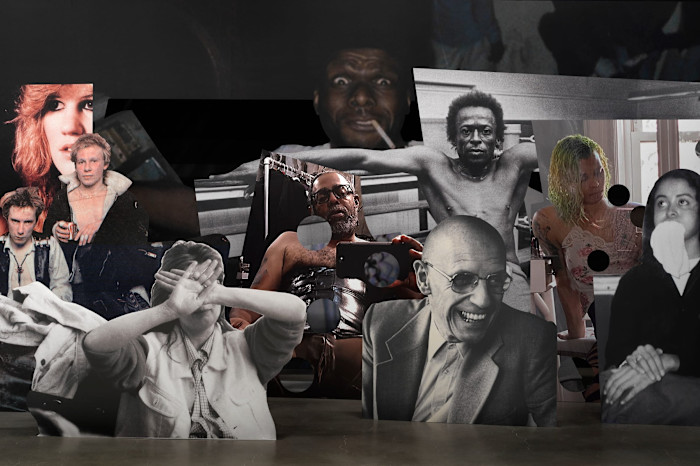
Arthur Jafa is drawn to the difficult and disquieting. “If something disturbs me, first and foremost, I’m fascinated by why I’m disturbed by it,” he once said. Which means that visitors to I Am Tony, the New Museum’s multitudinous Jafa retrospective, should be willing to linger on their own unease. The effort brings rewards.
Jafa has spent decades obsessively cutting out photos from discarded magazines and reassembling them into darkly poetic notebooks that he shares with friends. In this twisty, discursive exhibition, he transposes those private musings into wall-size photos and videos that seduce through the combination of adorable and horrific imagery. The half-hour montage “SloPEX” (2022) flicks through shots of celebrities sweating, smoking and singing, intermingled with frames from animated movies, balloons on parade and glimpses of bodies that have been tied up, mutilated and burned. Almost every second, “ooh” gives way to “oof”.
The exhibition begins with a sense of muffled shock. “Pledge of Allegiance” (2017), a grainy photo blown up to mural scale, shows a crowd of Black schoolchildren giving a straight-armed salute to the Stars and Stripes, held by a tiny flag-bearer. Maybe it’s just my AI-induced scepticism kicking in, but I thought at first that Jafa had doctored the image to conjure a nightmarish nation of Black baby Nazis. But no.
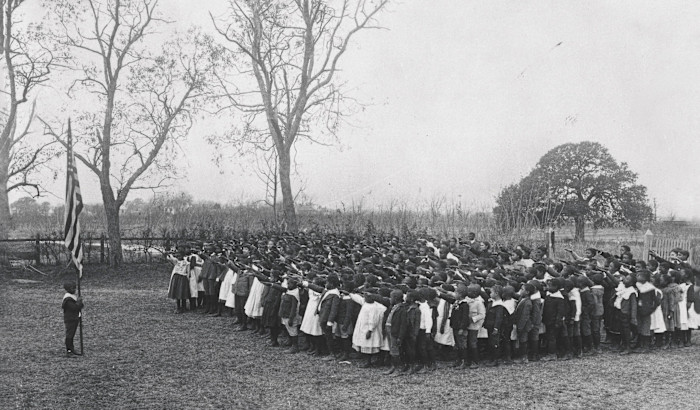
The original dates from 1899, when saluting the flag with one arm extended, palm facing down, was still an untainted custom. Only when the US entered the second world war did the resemblance to a fascist gesture become so obvious that the flag code had to be formally changed. Yet the scene has lately acquired a strange new power, as we learn more about the Nazis’ admiration for Jim Crow racial laws and cope with white supremacists who trace their lineage to both movements.
Jafa distributes his unsettling creations around an inky warren of black-painted galleries and long, blind corridors. Often, the work comes in the form of paired archival photos: a young James Baldwin, crisply illuminated and formally dressed, alongside a spectral Miles Davis — just his eyes glowing against a murky background. Jafa’s juxtaposition is a study in opposite modes of Black expression: Baldwin’s verbal pyrotechnics confront Davis’s cultivated reticence; urgent clarity versus muted mood.
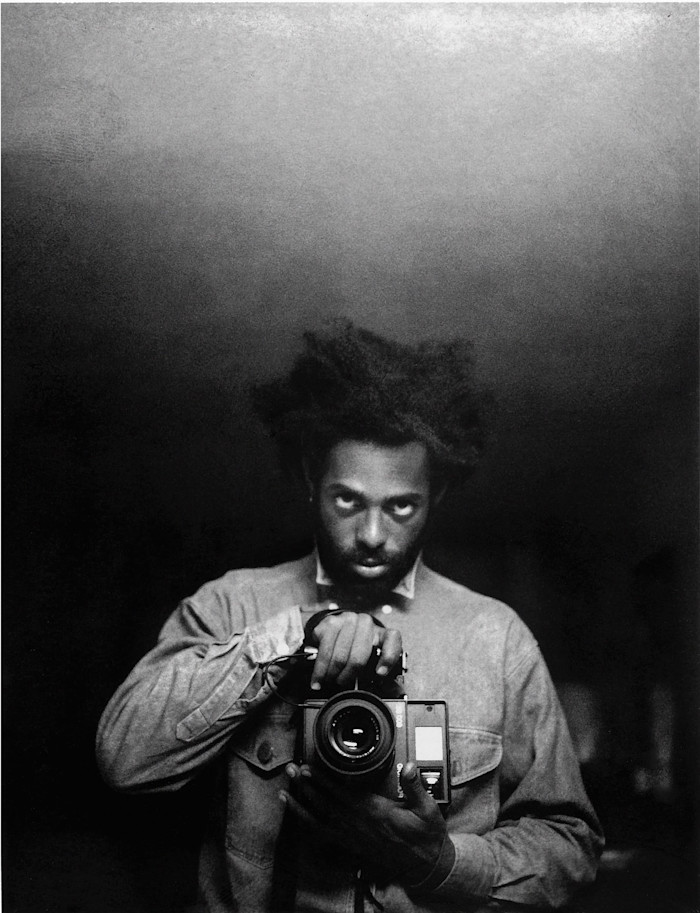
The artist, now in his mid-sixties, meandered into his career. Born in Tupelo, Mississippi, he went to Howard University where he began studying architecture before shifting to film. He served as cinematographer on his then wife Julie Dash’s 1991 Daughters of the Dust and Spike Lee’s Crooklyn, and also worked on Stanley Kubrick’s Eyes Wide Shut. Commercial movies felt creatively constrained, though, and he eventually discovered that galleries and museums were the natural habitat for his short films. Several appeared in the 2000 Whitney Biennial and in international group shows, but Jafa soon pulled away from the art world, frustrated by its undiluted whiteness.
He sprang back into prominence in 2016, thanks to “Love Is the Message, The Message Is Death”, a sensational eight-minute montage of found and personal footage that powers the whole New Museum show. In the video, we see Black people, famous and not, living and past, experiencing spasms of ecstasy, terror, tenderness and rage, while Kanye West delivers “Ultralight Beam” in that erotic, reverential croon.

Jafa cuts at high speed between scenes of dancing, celebrating, orating, brawling, sobbing, dunking baskets and getting shot by police. You will recognise James Brown, Nina Simone, Serena Williams, Biggie Smalls, Barack Obama, Angela Davis and Mahalia Jackson as they flash by, but many others just happen to be living their anonymous private dramas on camera. There’s no explicit political lesson here: “Message” is an open-ended mash-up of intensely emotional moments.
After that electric intensity, other pieces can feel subdued. In the follow-up “The White Album” (2018), Jafa applies his signature collage method to the topic of whiteness, but the result is limp rather than bracing. We see white people as perpetrators (Dylann Roof entering Emanuel African Methodist Episcopal Church to commit mass murder), victims (the truck driver Reginald Denny being beaten by rioters during the 1992 Los Angeles riots) and self-appointed experts on race.
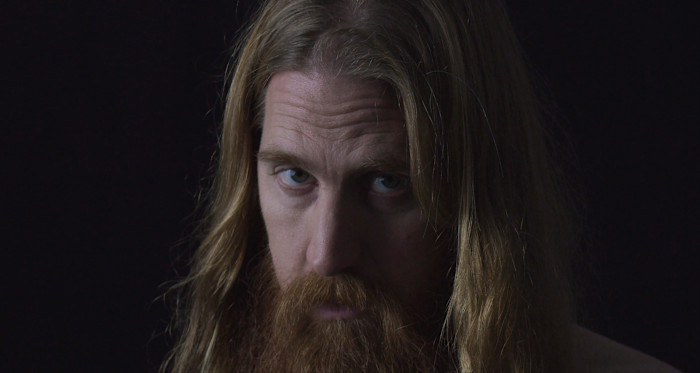
Here, syncopations don’t click and provocations don’t provoke. Instead of the panoply of “Message”, we get a thesis that never gets past generalities of alienation, grievance, violence and self-absorption. Maybe that’s an intentional demonstration of the weakness of white supremacy, both as a cause and an aesthetic project. In any case, the 2019 Venice Biennale jury loved it, awarding Jafa the Golden Lion.
I Am Tony is part of the first round of shows to go up since the New Museum’s longtime artistic director Massimiliano Gioni took over the institution. And, like New Humans: Memories of the Future, the extravaganza that reopened the expanded museum in the spring, it reflects his all-embracing sensibility, his interest in ideas that travel across generations, surreal juxtapositions and creative imperfection. Jafa is the perfect Gioni artist.
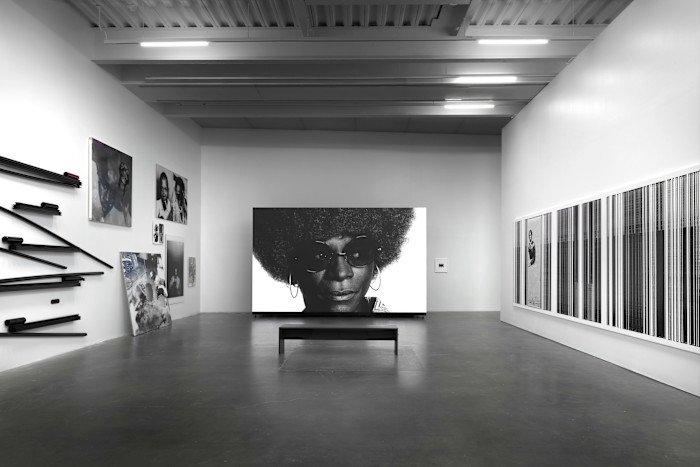
The exhibition is broad and bold enough that individual pieces are bound to be uneven, and even some of the misfires are instructive. Jafa’s technique of pairing disparate images yields both duds and revelations. He forms a sunset-red diptych by joining one of Andy Warhol’s gruesome car-crash silkscreens with a dusky late Rothko abstraction, for instance, and though the mixture of sublime melancholy and mechanical destruction should have produced something volatile and potent, it winds up feeling inert.
“Mickey Mouse Was a Scorpio” (2017), on the other hand, sets off a genuine depth charge. On the left is a classic black-and-white drawing of a smiling Mickey, hips cocked and paws akimbo. On the right is a photo of a masquerader at the Notting Hill Carnival, a Black man in skull-like whiteface with checkerboard lips set in a grim expression.
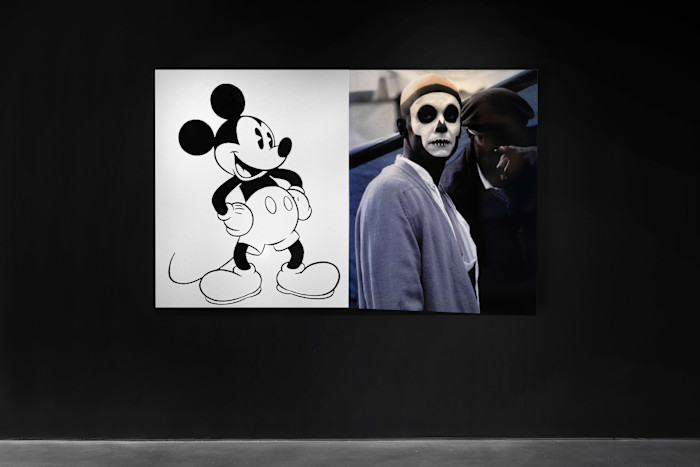
The resonance is immediate and uncanny — even the big dark circles around the mummer’s eyes echo Mickey’s circular ears. Suddenly, the animated character looks like a masked celebrant of some sinister ritual, and the serious man in the white shirt and cardigan has an oddly cartoonish air. Each makes the other stranger. The resemblance isn’t just an artistic conceit: scholars have traced Mickey Mouse and other early comic strip characters back to the conventions of blackface minstrelsy, so what seems at first like a light-hearted visual pun packs on a load of racial history. That’s Jafa’s virtuosic sleight of hand: smuggling a heavy thought into an image that registers in a flash.
To January 4 2027, newmuseum.org