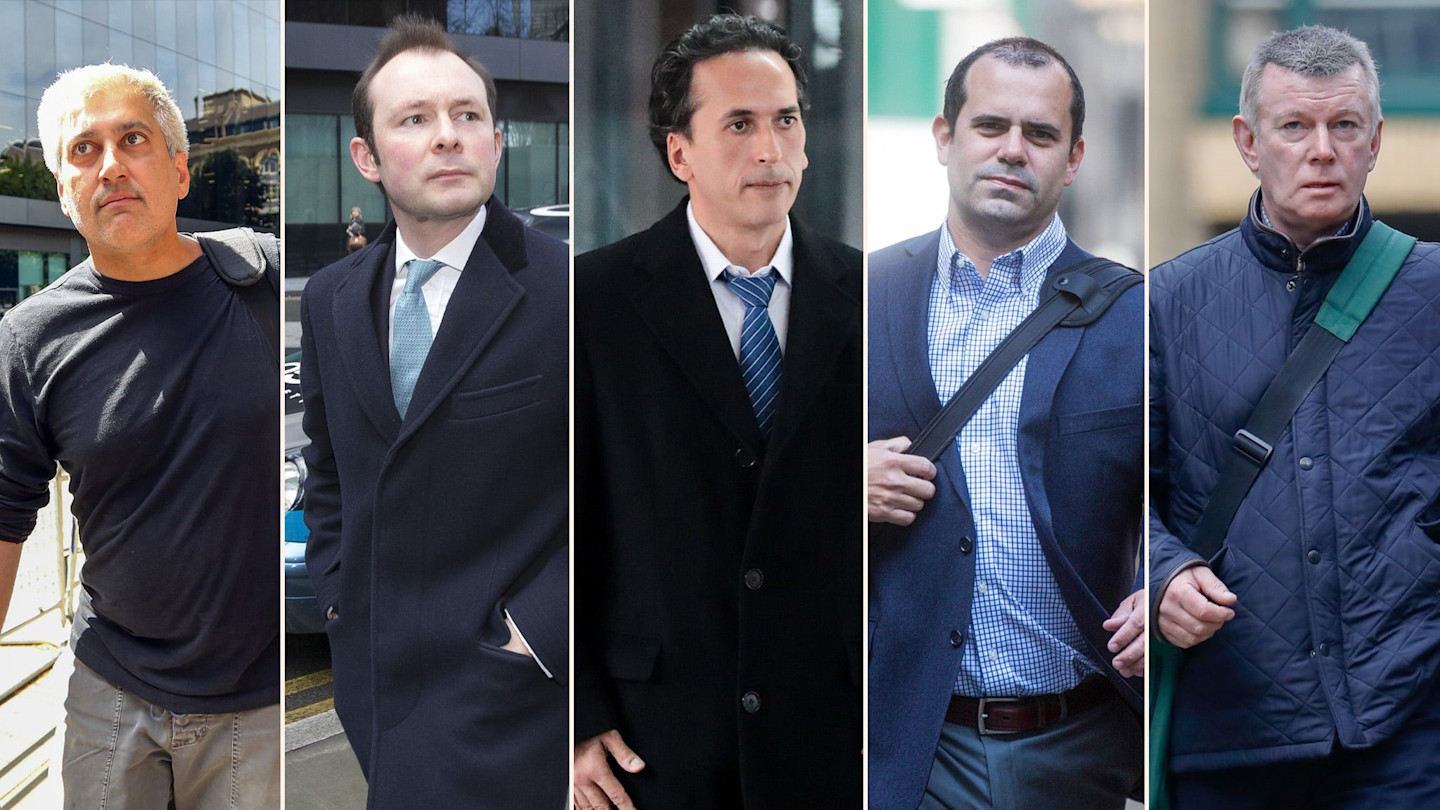
Five ex-Barclays traders sentenced to prison for manipulating key interest-rate benchmarks have had their convictions overturned, in the latest unravelling of the UK’s Libor-rigging prosecutions.
The Court of Appeal on Wednesday quashed the convictions of Jay Merchant, Jonathan Mathew, Philippe Moryoussef, Alex Pabon and Colin Bermingham after a landmark ruling last year cast doubt on whether their guilty verdicts should stand.
Mathew, Merchant and Pabon were convicted a decade ago of rigging the now-defunct London interbank offered rate [Libor], a key benchmark that underpinned trillions of dollars’ worth of financial contracts. Moryoussef and Bermingham were found guilty of manipulating the euro equivalent, Euribor, in 2018 and 2019 respectively.
Wednesday’s ruling comes after the UK Supreme Court quashed the conviction of Tom Hayes, the former UBS and Citigroup trader who became the first to be found guilty by a jury for Libor rigging, in July 2025.
The convictions of Hayes and other bankers for rate-rigging became a lightning rod for public anger over the global financial crisis, and the Libor scandal resulted in banks paying billions of pounds in fines and settlements. But prosecutions have subsequently unravelled on both sides of the Atlantic, with more than a dozen convictions now having been overturned.
Although its ruling was not a complete exoneration of Hayes, the Supreme Court found that directions the original judge had given to the jury in 2015 were “inaccurate and unfair”, ultimately depriving him of a fair trial. Hayes spent five-and-a-half years in prison.
The UK’s highest court also quashed the conviction of former Barclays trader Carlo Palombo for manipulating Euribor.
On Wednesday, Lord Justice Edis said the Supreme Court had identified a legal error in Hayes’ trial that was “directly replicated” in the ex-Barclays bankers’ cases. He added that Bermingham had been convicted in the same trial as Palombo on the same jury directions.
“For the last 10 years, the stain of a criminal conviction has been a burden I have carried every minute of every day,” said Mathew, who cheered and hugged his lawyers and supporters after the ruling was handed down.
“Having this conviction quashed is not simply about correcting the record, it’s about finally having validation that this is an injustice that never should have happened.”
The five cases were referred to the court in January by the Criminal Cases Review Commission — a body responsible for investigating miscarriages of justice. The UK Serious Fraud Office, which prosecuted the cases, did not contest the appeals.
The court will also consider later this week the case of ex-Deutsche Bank trader Christian Bittar, who pleaded guilty to manipulating Euribor in 2018 and was jailed for more than five years.
“The Supreme Court found that there was ample evidence on which a properly directed jury could have convicted Tom Hayes and Carlo Palombo. We deemed it was not in the public interest to seek retrials of these two individuals,” said Jason Williams, head of fraud and corruption at the Serious Fraud Office.
The prosecutor added: “After carefully considering this judgment and the full circumstances we [did] not oppose the appeals of five individuals convicted by juries in relation to Libor and Euribor.”