
Picture some cars racing to win a trophy: the British market. The stakes are high. Ranked by value, Britain is the third largest vehicle importer in the world. The contest is relatively open. Unlike the French who favour Renaults or the Germans who value Volkswagens, Britons are unpatriotic car buyers. And increasingly, the competition is dangerous. Given the backdrop of geoeconomic tension, the participants will be lucky to avoid a crash.
For years, the EU was the undisputed champion of the UK market, at least when judged by where its cars were made. (Most of the US, Japanese or South Korean brand cars sold in the UK come from factories on the continent.) But since the pandemic and Brexit, the bloc’s dominance has waned. Whereas in the 2010s it contributed some 90 per cent of UK vehicle imports by value, over the past year its share has been below 70 per cent.
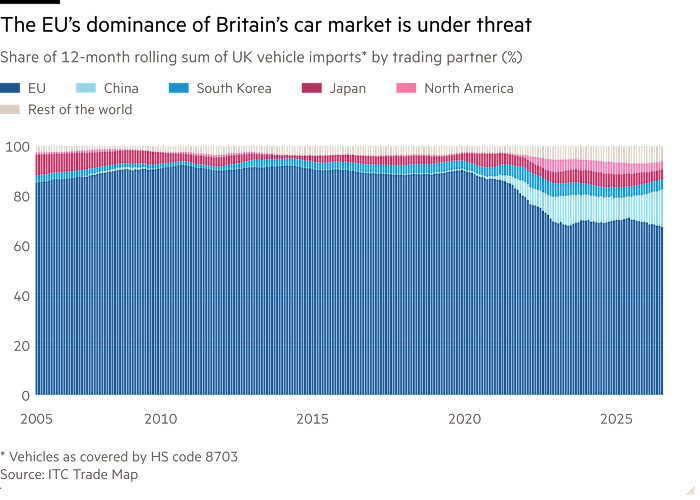
The EU is in no mood to lose this race. The UK has become the top destination for its vehicle exports since President Donald Trump’s tariffs crushed US sales. Germany is particularly keen to win, having seen its share of exports to the UK fall by more than the EU average since the pandemic. Its sector has been struggling with a years-long downturn, stoking fears of deindustrialisation and diminished economic strength.
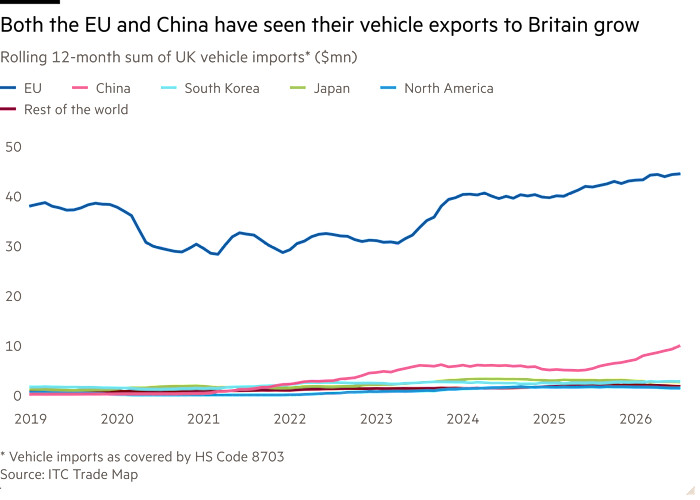
The main challenger is, of course, China. After years of cut-throat competition and muscular industrial policy, its carmakers can produce vehicles with tech that makes YouTube reviewers swoon, and batteries for 35 per cent less than Europe. These competitors are also hungry for business given their massive capacity and terrible home demand. Over the first half of this year, car sales in China dropped by 20 per cent year on year. Over that same period, its vehicle exports to the UK grew by over 80 per cent.
It’s worth noting that others have it worse than the EU. The value of vehicle imports into the UK from the bloc has grown over the past year, so China has only limited some of the EU’s post-pandemic recovery. Over the same period, imports into Britain from Japan, South Africa, Turkey and North America all fell, though from a lower base.
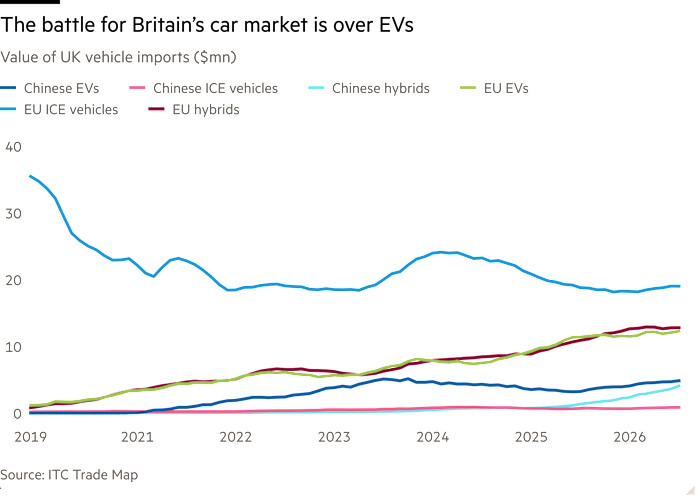
But this won’t make anyone in the EU feel better. Coming at the same time as the transition away from internal combustion engine vehicles, this is a race for the future. Splitting the contest by vehicle type, China’s export surge has most momentum in the category of hybrid vehicles — which is where EU exports have plateaued.
The bloc has had enough, and wants Britain to intervene. They have asked for tariffs to offset the advantage Chinese producers have had from domestic industrial policy over the years. But even without any “unfairness”, there is an argument for pushing back against Chinese dominance of car production, given its habit of weaponising supply. (Chinese makers already dominate parts of the battery supply chain.)
The British government is mulling tariffs, but is in a tricky spot. It’s possible the public could be persuaded. While on a fellowship at the University of Oxford, senior civil servant Jenny Bates told me about her research based on a focus group suggesting voters might accept higher costs if it made the country more secure. But it’s also possible that the public really likes cheap cars kitted out with massive flat screens.
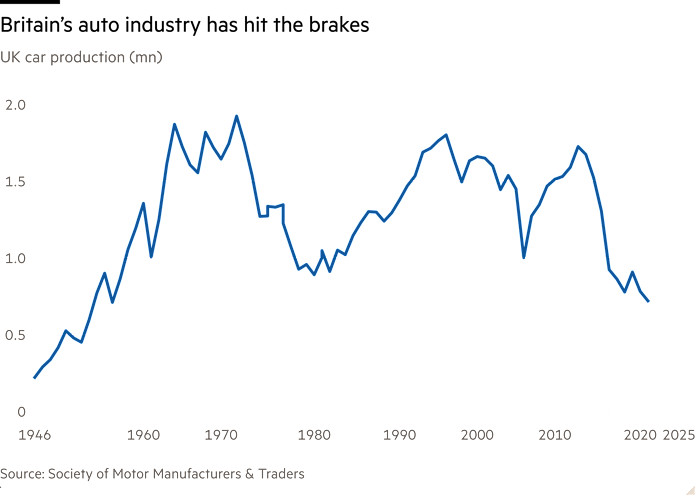
The plight of Britain’s sputtering car industry doesn’t simplify the choice. Production has shrunk from 1.7mn vehicles in 2016 to just 0.7mn in 2025. But since most of this output is exported, the UK industry seems less interested in protection from Chinese competition than in lobbying for lower energy costs and less ambitious green targets, and in attracting Chinese investment.
The EU is pointing to a different race as an incentive for the UK to take action. The bloc’s Industrial Accelerator Act is a policy in development, aimed partly at strengthening the European auto industry. If the UK stays open to Chinese cars, it risks being shut out. Given that the EU is the UK’s biggest export destination, that would hurt.
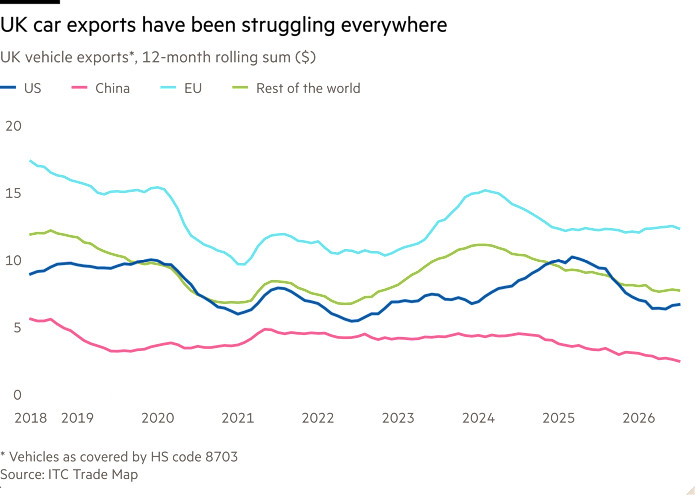
Forced into a stark choice between the EU and China, geography, history and ideology all push the UK towards its neighbour. But next time there are demands for tariffs, I would recommend asking a question. What happens if China retaliates by shutting off its market, or worse, its supply chains? The EU is invested in this race. But if there’s a crash, will it help to clean up?
[email protected], @SoumayaKeynes
The Economics Show with Soumaya Keynes is a podcast from the FT bringing listeners a deeper understanding of the most complex global economic issues in easy-to-digest weekly episodes. Listen to new episodes every Friday on Apple, Spotify, Pocket Casts or wherever you get your podcasts