This story begins, unfortunately, with Mark Zuckerberg. The year is 2021, and Zuck has just announced that he’s changing his company’s name from Facebook to Meta. He’s betting that the future is the metaverse: a video game-like online space where people will log on and build a new digital society.
It doesn’t pan out. Meta’s virtual platform, Horizon Worlds, turns out to be a bland corporate wasteland. These days, the company has basically abandoned the idea and pivoted to AI. The metaverse has been consigned to the garbage heap of tech flops alongside NFTs, Segways and Quibi.
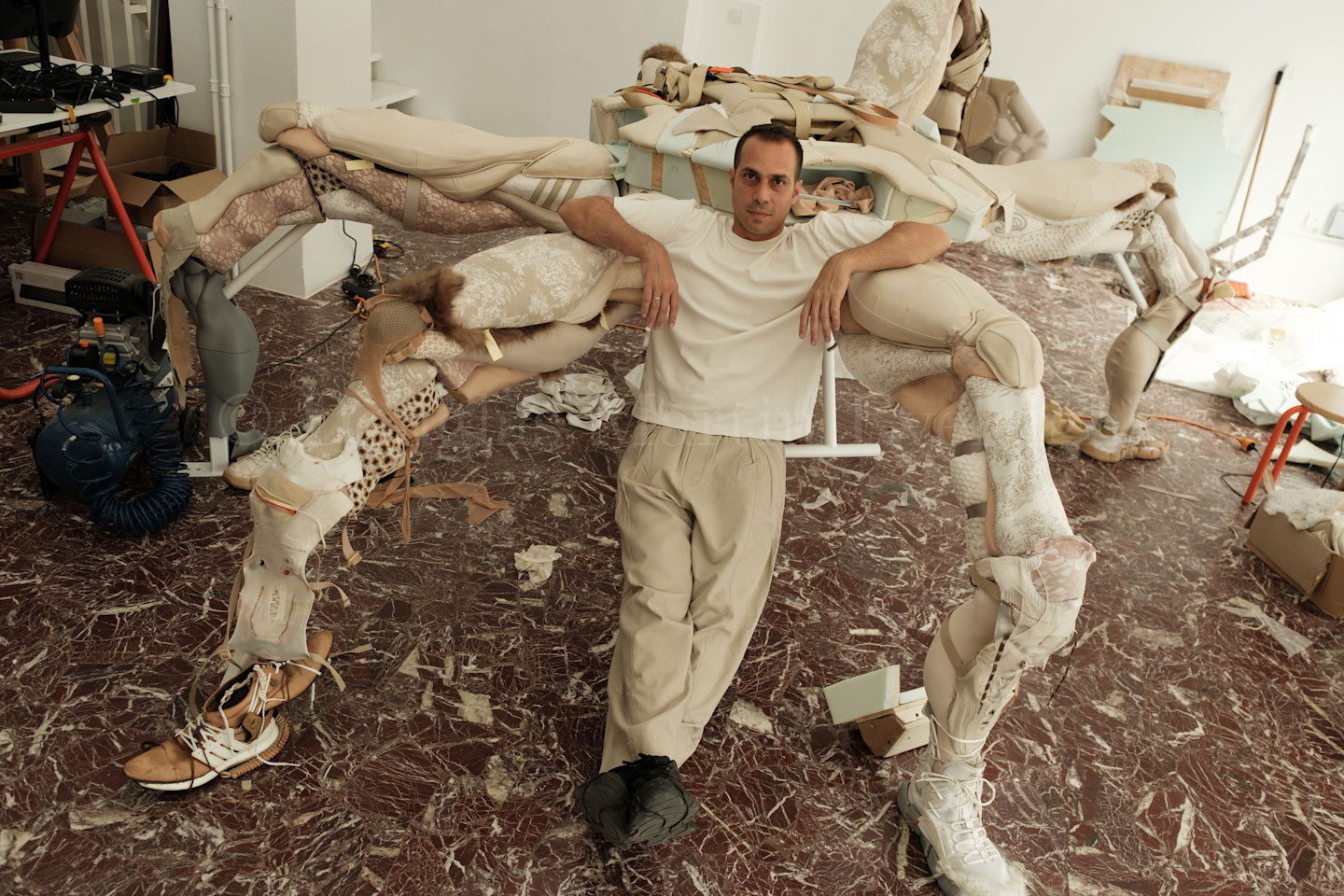
“Zuckerberg’s vision of the metaverse was a total dystopian nightmare,” Theo Triantafyllidis, 38, tells me over a video call from his studio in Athens, clean-shaven in a white T-shirt. His new artwork, “Feral Metaverse (Spider)”, which he will show at Frieze London after receiving the Frieze Artist Award, began as a counter-argument to Zuckerberg. It takes the form of a multiplayer video game, where players have to work together to escape a cave.
While the algorithms of Meta’s platforms like Facebook and Instagram have amplified extreme and divisive content, Triantafyllidis asks what an online space might look like if it was built around co-operation and care.
His art uses video-game technology to create dark, satirical portraits of our society which explore where we went wrong, and how we might do better. This work is the third part of his ongoing Feral Metaverse project. In the game, characters must climb on each other’s shoulders, balancing carefully and avoiding the web-slinging of a giant spider, to reach a trapeze near the roof and escape. “The game is asking players to co-ordinate, collaborate, scream at each other and teach each other the goal,” he says. “To understand that it is basically them against the game, and the only way to beat it is to really work closely together.”
Triantafyllidis is a sober conversationalist, but his work is streaked with humour and absurdity. The game’s characters are animalistic humans who run on all fours and communicate in screams and grunts: the troglodytes that we imagine lurking in online comment sections, forced to collaborate. He calls the game “a more primal, embodied, visceral way of being together online”.
But it’s not easy to get gallery audiences to start playing a video game, he says. “They realise that games are such a gigantic producer of visual culture and language that they’re impossible to ignore, but you need an icebreaker to even ask an art audience to touch a gamepad.”
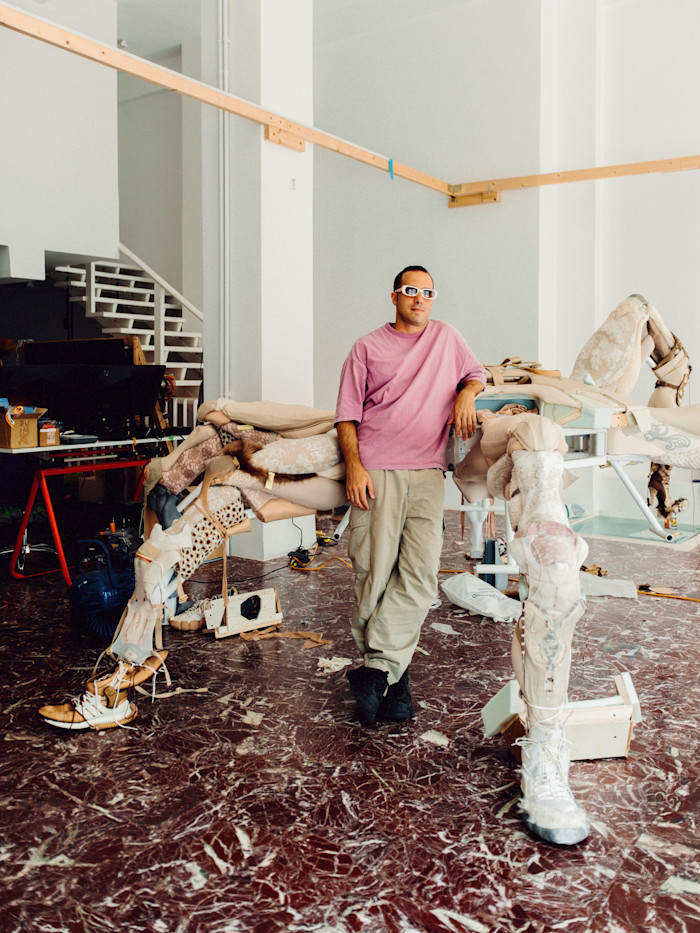
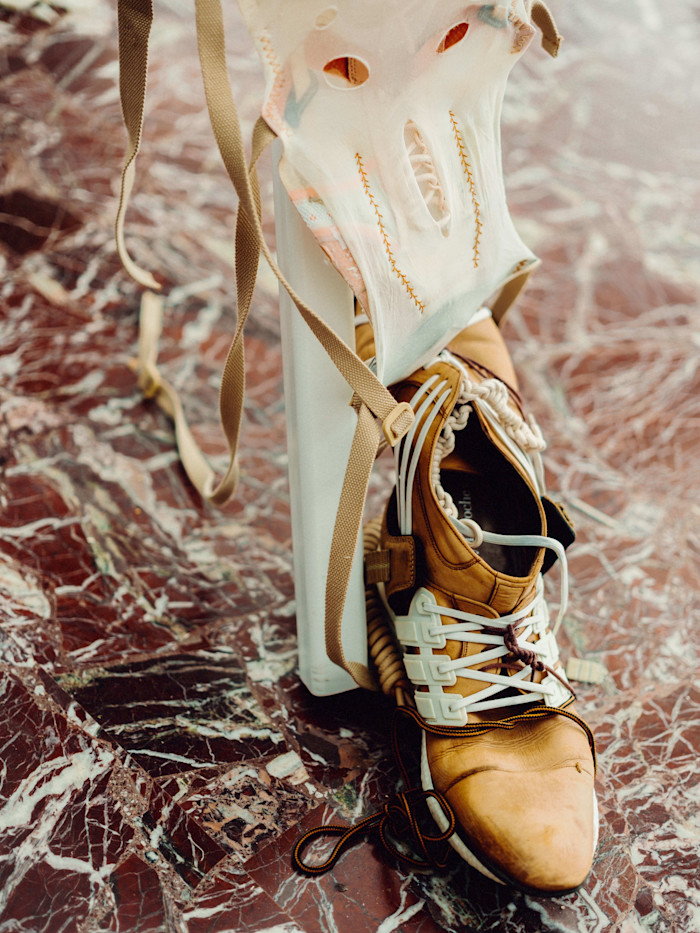
This is where the spider comes in. In order to play the game, visitors must climb on a large sculpture of a white spider, a replica of the game’s antagonist made of foam-covered wood and steel, whose articulated legs end in combat boots. Six screens are embedded in its body where audiences can access the game. He calls the sculpture “a lure” that encourages visitors to communicate, loosen up and shake free of the typical gallery froideur.
“I want them to climb on the sculpture and remember how awkward their bodies are, then through the game to start being playful. Perhaps even to forget their performative personas within the fair.” He smiles, relishing the idea of Frieze attendees clambering clumsily over his giant spider.
Over the past decade, video-game production software has become more accessible, ushering in a fresh generation of artists seeking to define the possibilities of a new artistic medium, including Lawrence Lek, Lu Yang and Ian Cheng. In last year’s exhibition The Delusion at the Serpentine Gallery, Danielle Brathwaite-Shirley used game technology to similar effect, connecting visitors and encouraging them to discuss social topics.
“Curatorially and in art theory, games are not yet integrated, so there’s an outsider feeling to them,” says Triantafyllidis. “All of us are trying to figure out: OK, what is my artistic voice within this technology? What can I say with this medium that was not possible to say before?”
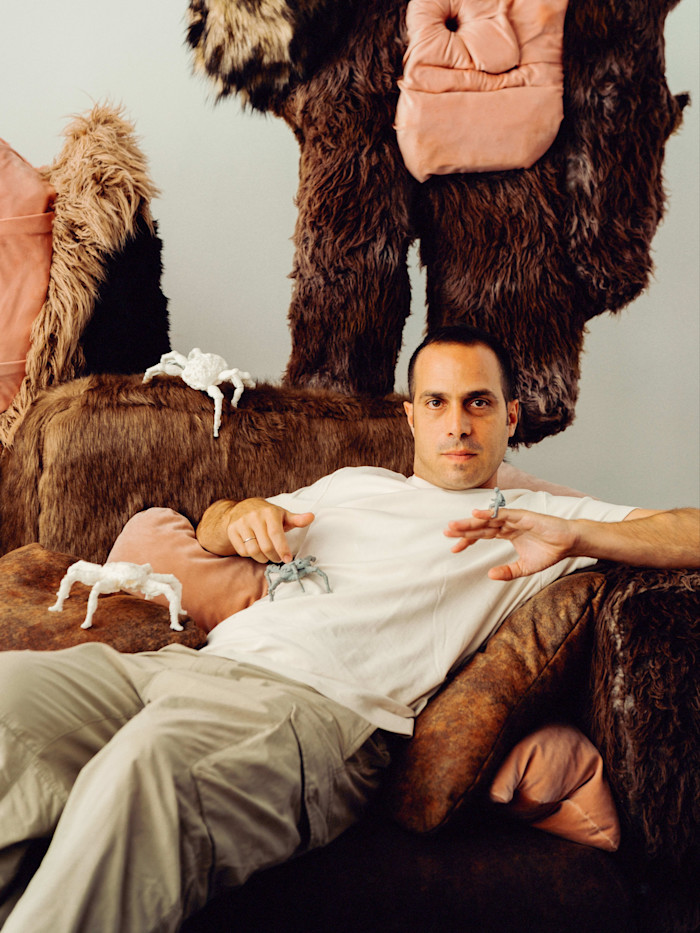
Born in 1988, Triantafyllidis studied architecture in Greece and graduated in 2012, straight into the Greek debt crisis. He worked as an architect in China for two years, before getting involved in an online community of internet artists and moving to study design media arts at the University of California, Los Angeles, where he lived for six years. At the time, the internet seemed like a force for good, allowing him to meet friends and discover exciting new artists. “It was a more pleasant moment in social media history,” he reflects.
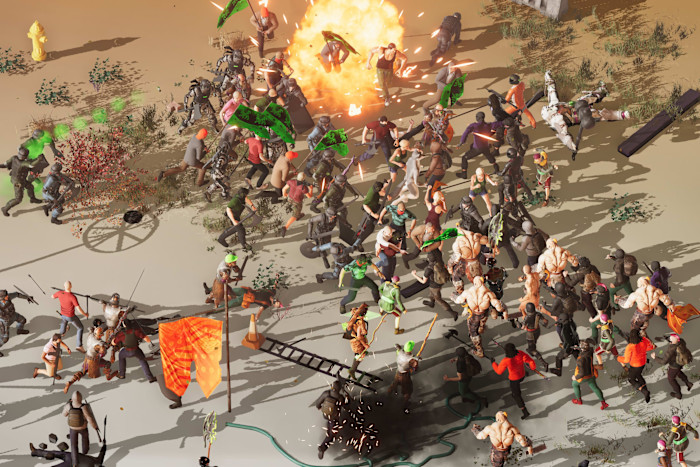
The landscape of social media has changed dramatically since then. Triantafyllidis’s 2021 work “Radicalization Pipeline” is a commentary on the toxic state of modern online discourse. It’s a pitched battle staged inside a video-game engine which looks halfway between a round of Fortnite and a riot in the American streets. Characters ranging from white nationalists to armoured police to fantasy orcs wage an unending war, dying only to respawn at the edge of the battlefield and start all over again. Bickering in online comment sections turned into a full-blown war. Just as vicious. Just as pointless.
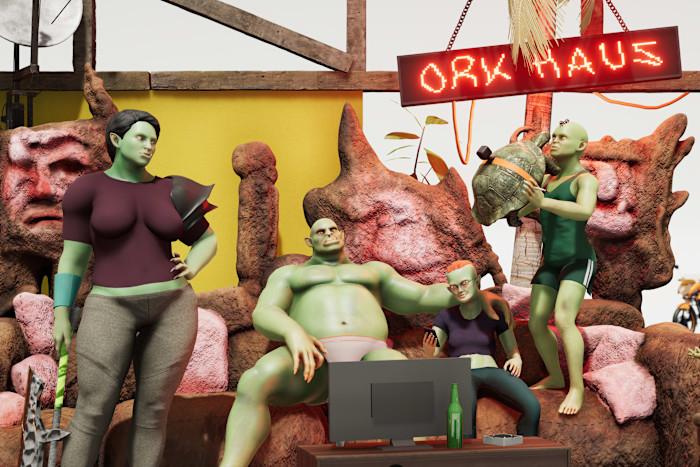
Meanwhile, 2022’s “Ork Haus” is a dark commentary on family life during the Covid-19 lockdowns, imagining a game of The Sims populated by antisocial orcs in the midst of a pandemic. In a hallucinatory working-from-home nightmare, the dad sits on the couch in his Y-fronts, zoning out on his VR headset. The mum meditates in the lotus position on her bed, while her baby screams in a nearby crib and a literal hurricane tears through the house. A household “connected” by technology, but utterly alienated from one another.
These works are not pre-recorded videos, but live simulations — digital environments with characters whose behaviour changes in real time, governed by specific rules. Triantafyllidis believes this approach makes video-game technology more legible for conventional art audiences, who don’t need to handle a game controller or follow a narrative with a fixed beginning and end. He says you can look at them as you would a painting, just stand back and let your eyes wander.
Some of his most engaging live simulations portray ecosystems of interdependent critters living in miniature worlds, like living snow globes. “Drift Lattice” (2025) is an underwater world where crabs, fish and birds move among corals polluted by plastic waste and fishing nets, while drones buzz around trying to clear up the rubbish. The simulation’s behaviour is influenced in real time by data from global climate monitoring networks. “Game engines are a fitting medium for examining ecosystems,” Triantafyllidis says. “I’m fascinated by the depth and complexity of the systems that have emerged in nature.” These works are intended as “a way to train the audience’s eye in observing subtle relationships between parts of ecosystems. To cultivate a sense of understanding and observation.”
His upcoming work “Funny Weather”, commissioned by Factory International, which will debut in November in Manchester, is a live simulation that shows a sky populated by birds, kites and textiles, influenced by real-time weather and amateur birdwatching data. “It’s speculating about climate change as we enter an era where the weather is becoming a main character,” he says. “The weather is becoming so capricious and unpredictable, even in a 24-hour scale. It’s going to drastically affect our lives on a day-to-day basis.”
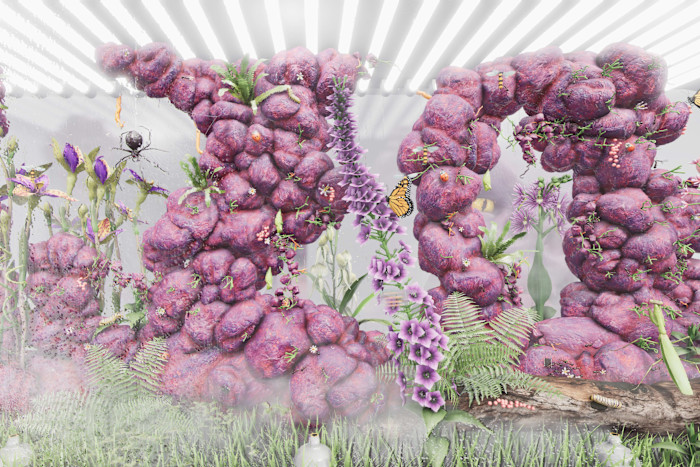
Each of Triantafyllidis’s works is a provocation, showing a facet of our world in miniature, which confronts audiences with tricky questions about how we live together — both with other humans and the natural world. “BugSim (Pheromone Spa)” (2022), on display at the Whitney in New York earlier this year, shows a vivarium where a microscopic colony of ants tries to repair a damaged environment, while bees, spiders and mantises each play their own roles in the ecosystem. In the background lurks a shadowy, monstrous figure, with glowering yellow eyes and slit, serpentine nostrils, who watches the insects intently.
Triantafyllidis’s art reflects the world we’re ushering into existence, where our delicate ecosystems, both natural and digital, are breaking down. With that unreadable gaze behind the glass, he asks a question: what are we going to do about it?
October 14-18, frieze.com
Find out about our latest stories first — follow FT Weekend on Instagram, Bluesky and X, and sign up to receive the FT Weekend newsletter every Saturday morning