In a nondescript laboratory on the island of Kinmen, thousands of human eggs are stored in cylindrical containers that resemble oversized propane gas tanks. Extracted from women who travelled here from China, the eggs are suspended in liquid nitrogen, their future uncertain.
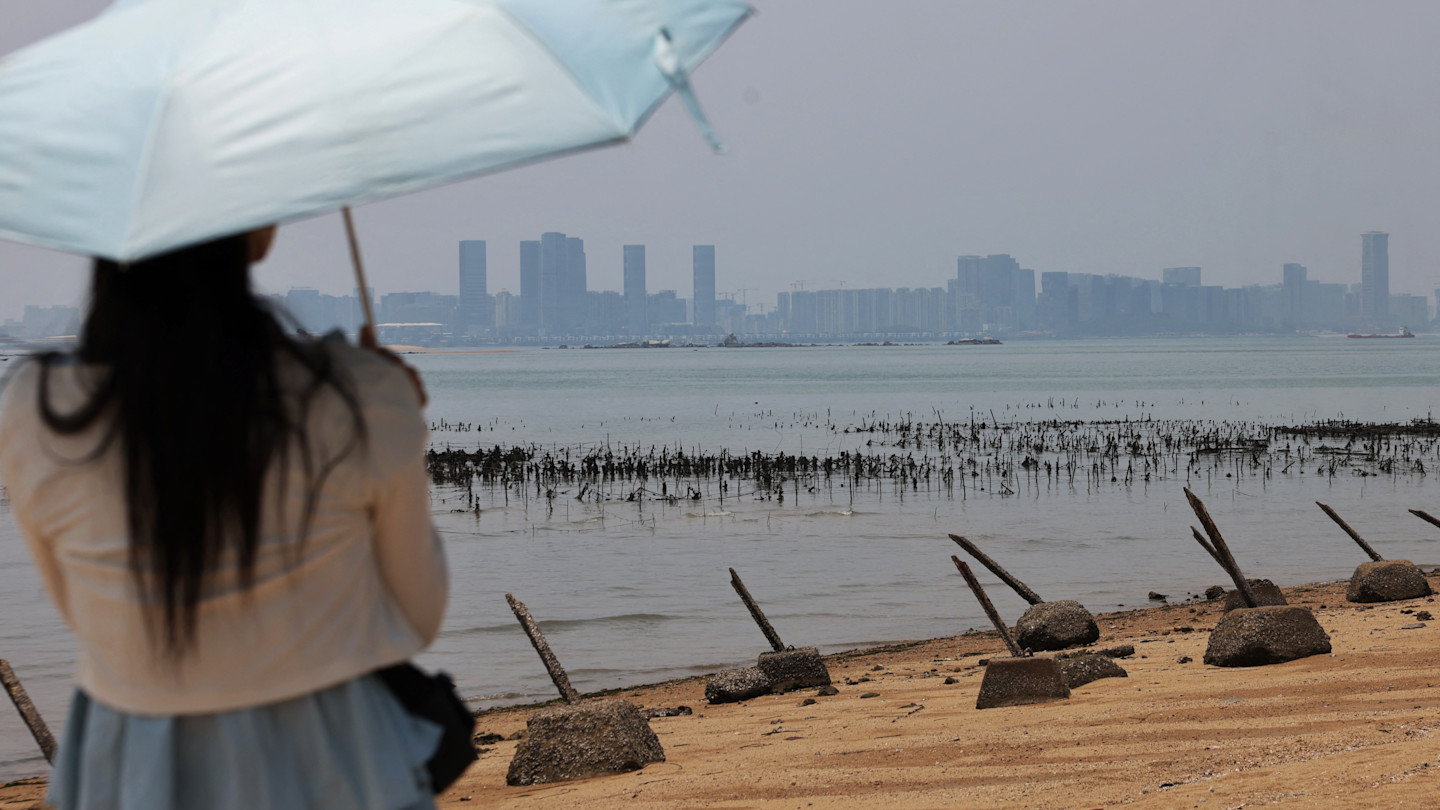
Forming part of a small archipelago, the island lies just a few kilometres from China’s coast. From its rocky shoreline, the glittering skyline of the port of Xiamen is clearly visible across the water. Yet despite its proximity to the mainland, Kinmen is part of Taiwan, putting it squarely on the front line of tensions with Beijing, which regards the island as a breakaway province. In recent years, pressure on the administration in Taipei has intensified; Russia’s invasion of Ukraine in 2022 stoked fears that China could make a similar move on its near neighbour. For Taiwanese entrepreneurs such as James Su, however, Kinmen’s location represents an opportunity too good to miss.
Over the past four decades, Kinmen has had a front-row seat to the rapid modernisation of Chinese cities such as Xiamen. As skyscrapers and factories emerged, people’s lifestyles also changed. Women started marrying and having children later, if they had them at all. In other countries like Japan, governments have responded to the baby bust by subsidising egg freezing for single women, seeking to extend their fertility window. In China, unmarried women are still barred from accessing the procedure, except in limited medical circumstances. That’s where Su comes in.
An energetic 30-year-old, Su belongs to a long tradition of Taiwanese entrepreneurs, or Taishang, who make money bringing goods and services to a much larger market. The Kinmen Reproductive Centre, founded by his mother in 2016, identified an arbitrage opportunity to provide Chinese patients with reproductive services not readily accessible at home.
When I visited the centre, Su, who joined the family business five years ago and leads the clinic’s business development, exuded the practised confidence of a salesman. He peppered his patter with automotive metaphors and strategic eye contact. Much of his time is spent travelling around China striking deals with hospitals that send patients to Kinmen. While on the road, he lives out of a silver Rimowa suitcase that contains his essential items. These include high-protein snacks and several Rolexes, which Su wears in rotation. Business is good.
The clinic in Kinmen shares the third floor of the Golden Lake Hotel with a children’s playground, which features child-friendly, military-themed activities such as a “battlefield maze” that draws on the archipelago’s long military history; for decades, it was a front line in the Chinese civil war, as Nationalist troops sought to repel attacks by the insurgent People’s Liberation Army under Mao Zedong. The PLA saw the islands as an important stepping stone for any operation to capture the Taiwanese mainland. Some fear that history could soon repeat itself.
It was a humid day, and I found Su dressed in a loose-fitting linen shirt. The ratio of buttons done to undone skewed heavily towards the latter. He started by taking me on a tour of the clinic, from the “semen-collection room”, decorated with a black-and-white poster of a nude Vogue cover model, to the laboratories where eggs and embryos are examined, the treatment room and finally the storage area with the frozen eggs and embryos.
In Su’s telling, a good clinic is like a Formula 1 team: “It’s about how good your lab and doctor is. You have to have a great car and a great driver.” Decades of accumulated knowledge among the lab practitioners, combined with a doctor able to retrieve eggs quickly and minimise their exposure to the outside in carefully controlled conditions, are, he said, what give his family’s clinics an edge. Su’s mother is a prominent Taiwanese fertility doctor who was an early practitioner of pre-implantation genetic testing in Asia.
The Kinmen clinic’s main business is IVF. But egg freezing has created another market. The procedure has risen in popularity in Taiwan, helped by government subsidies for single women. “The discussion of the low birth rate is very public,” Su said. Among mainland Chinese women, by contrast, the procedure remains niche and information spreads largely through word of mouth. With discussion online also limited by censors, the concept of egg freezing is largely popularised in private settings, with friendship groups in cities such as Beijing and Shanghai swapping notes on the best clinics and which territories outside China have the friendliest policies.
For Su, the question of where a woman stores her eggs is not so different from choosing where to keep her money. “When you pick a bank, you want to find a trusted financial institution that is more stable,” he said. And despite the cross-Strait tensions with China, Su believes Kinmen fits that role. Where others see the islands as a future battleground, Su offered a different take. Kinmen’s proximity to mainland China is what makes it safer, he argued.
“When Kinmenese buy their second home, it’s in Xiamen, not Taiwan,” he said. “There is a sense of security that if anything went wrong it would be between mainland China and mainland Taiwan. It’s not going to be here.”
Kinmen’s dependence on the southern Chinese province of Fujian, home to Xiamen, has undoubtedly grown. Its 140,000 residents get fresh water supplies through a pipeline that originates in Fujian, while many locals commute to Xiamen for better-paid jobs. The city’s skyscrapers are a constant reminder of the vast economy sitting almost within reach. China is also in the process of constructing a bridge across the narrow strip of water that separates Kinmen from the mainland, which Taiwan has condemned and said will not be allowed to land on its shores. Leaders in Taipei see the economic benefits bestowed on Kinmen as part of an influence operation by China to build support for unification among the island’s population.
Lin Bingqi brimmed with excitement as the ferry carried her from Xiamen to Kinmen earlier this year. She had visited the island once before and was charmed by the sleepy rural atmosphere. But this time around she was travelling for a different purpose. Lin, 34, works as a salesperson in Xiamen. She has a wry sense of humour and open manner. Growing up in Fujian, one of China’s more conservative provinces, she was encouraged to marry young. But she struggled to find a suitable partner, especially one she’d be willing to raise children with. “After 30, women’s marriage options are very depressing,” she said, cracking a laugh.
Lin’s desire for a family was reinforced by becoming an aunt to her sister’s kids. Children provide “great companionship”, she said. Though she would prefer to raise them with a partner, she didn’t want the diminishing prospect of conceiving naturally to dictate her marriage choices. “This is an important decision,” she said. “I don’t want my fertility to deteriorate just because of the passage of time.”
After her gynaecologist recommended egg freezing, Lin looked into options. Among the common locations chosen by Chinese women — the US, Thailand and Hong Kong — Kinmen was also mentioned. Lin sought advice on social media, where women swap information about their experiences of foreign clinics using coded language and egg emojis to evade censors. She opted for Kinmen.
Lin found that circumventing restrictions in China required surprisingly little disruption to her life. She administered hormone injections in Xiamen and had to travel to Kinmen only once, for the retrieval process. On the same day she arrived, a Taiwanese doctor retrieved 25 eggs in a procedure lasting about 15 minutes. At Rmb80,000 (£8,800) it was expensive but less than if she had travelled further afield. The next day she caught the ferry back to Xiamen. Her eggs remained behind.
For women in China, the intrusion of politics into intimate decisions about reproduction is hardly new. For decades, the state sought to limit births, enforcing quotas through fines and propaganda and, particularly during harsher periods of the One-Child Policy, forced abortions and sterilisation. Today, Beijing confronts the opposite problem. Birth limits have disappeared and officials exhort young people to marry and have children as the country’s population shrinks and rapidly ages. Despite its pro-natalist shift, however, the state maintains limits on the reproductive choices available to unmarried women.
Egg freezing is particularly thorny. In China, marriage and motherhood remain deeply intertwined. There is intense pressure on young people, women in particular, to find a marriage partner. From officials’ perspective, enabling egg freezing for single women could see a rise in one-parent families, something they appear keen to discourage, if not explicitly. Single mothers in China face deep social stigma and are routinely barred from accessing certain healthcare and education for their children.
Lin is happy with her choice to travel to Taiwan. She’s confident that one day she will have children. “I have the power to choose now and a sense of safety. In the future, if I want to become a single mother, I have that option,” she said.
She feels no rush to get back into the dating market. “I can sigh a breath of relief. It is not as urgent as before.”
On the day I visited the clinic in Kinmen, Su was also hosting a group of fertility-clinic operators who had travelled to Taiwan from Sichuan, a journey of almost 2,000km. After the tour, we joined them for lunch in the hotel restaurant, where they spent much of the meal negotiating the purchase of cases of vintage Kinmen sorghum liquor to take home as gifts. The bill ran to a couple of thousand dollars — still a bargain, I’m told, compared with high-end bottles of mainland China’s Maotai.
Afterwards, the sound of sirens wailed from the streets outside the clinic. Our phones lit up with a notice from the Taiwanese authorities that there was a military drill going on and people were not to go outside for the next hour. The locals at the table barely flinched. When the mainland visitors joked about the futility of such preparations in the face of Chinese military might, their Taiwanese hosts responded with polite laughter. The lunchtime entertainment went up a notch when we received another alert, this time about a stray American tourist found wandering outside during the drill.
It was an abrupt reminder of why, to many, Kinmen seems an unusual place to house precious personal assets. Lin told me that the possibility of worsening tensions between Taiwan and China was something she had given thought to. She asked the clinic what options were available if she could not return. They provided reassurance that her eggs could, if necessary, be transferred elsewhere. It was just one more contingency to consider as she, like the citizens of Taiwan, prepares for an unknowable future.
Eleanor Olcott is China correspondent for the FT, based in Beijing
Find out about our latest stories first — follow FT Weekend Magazine on X and FT Weekend on Instagram