This article is an on-site version of our FirstFT newsletter. Subscribers can sign up to our Asia, Europe/Africa or Americas edition to get the newsletter delivered every weekday morning. Explore all of our newsletters here
Good morning. The oil price is rising today on a report that Donald Trump is considering an attack on Iran before the midterms. Here’s what else we have for you today:
Big banks’ new relationship with Wall Street
China’s race to build data centres
What we know about the plague outbreak in Siberia
Why people choose not to have children
Before the financial crisis, Wall Street banks dominated trading and market making but tighter regulations since 2008 have shifted their relationship with equity and capital markets.
Hedge funds dominate trading and market making and there is now a new, inescapable reality on Wall Street: US banks are generating record trading profits. But they are not the ones doing the trading.
Hedge funds’ borrowing from banks has tripled since 2020. Revenues from equity and fixed income prime broking — two of the main ways that banks lend to hedge funds — are forecast to hit $47.9bn this year, according to an analysis by industry data provider Coalition Greenwich.
As banks have leaned into the trading boom, they have inextricably bound their fates with their biggest clients — giant multi-manager hedge funds such as Citadel, Millennium Management and Point72, and proprietary trading firms including Jane Street and Hudson River Trading.
The sheer size of the exposure has alarm bells ringing at regulators. Prime brokerage balances increased about 40 per cent over the previous year alone, the Bank of England said in July.
“It has just grown and grown and grown,” said one regulator.
Prime brokerages were long seen as an unglamorous and quiet part of banking that acted like a back-office function. That changed with the financial crisis and the subsequent regulatory overhaul, which curtailed the ability of banks to take risks with their own balance sheets.
Much of the speculative trading that once used to take place on banks’ prop desks migrated to the hedge fund industry, while market making became the purview of high-frequency trading firms and later specialist market makers. Read more on how a trillion-dollar hedge fund borrowing spree became Wall Street’s cash cow.
Here’s what else we’re keeping tabs on today:
Monetary policy: The European Central Bank releases the minutes of its September rate-setting meeting when it raised borrowing costs to 2.5 per cent.
Economic data: Mexico releases headline September inflation and, separately, Chile publishes consumer prices for the same month.
EU-China trade talks: The EU’s top trade envoy Maroš Šefčovič is in the Chinese capital for high-level talks a day after the FT reported that China rejected a request from Brussels to voluntarily restrict its exports of hybrid cars.
Nobel Prize: The award for literature is announced a day after the chemistry award was won by scientists who solved the mystery of asymmetry in living organisms.
What is driving the global bond sell-off? Alphaville editor Robin Wigglesworth and senior markets correspondent Ian Smith will answer reader questions in a live Q&A today at 8am ET. Submit a question here.
Five more top stories
1. Samsung Electronics, the world’s largest memory-chip maker, estimated its operating profit surged nearly ninefold in the third quarter. Strong demand for memory chips — a crucial component in the data centres that power AI — continues to drive industry-wide shortages.
2. Donald Trump has distanced himself from two campaign strategists, Chris LaCivita and James Blair, after it was revealed they had travelled to the Balkans to advise a pro-Russia government less than a month before the US midterm elections. The two men now work with Maga Inc, the Trump-aligned Super Pac with a $400mn war chest that is funding many Republican campaigns.
3. China is building data centres at rapid speed across its energy-rich hinterland, as Beijing seeks to turn abundant electricity and cheap land into an advantage in the global race to develop AI. The push is creating vast new computing hubs, such as Ulanqab in Inner Mongolia.
4. Kirkland & Ellis will stop sharing its financial figures with The American Lawyer, an industry magazine that has for decades relied on law firms to voluntarily produce their financial data for an industry ranking. Kirkland said it was no longer “appropriate or necessary” to provide the information.
5. New York’s iconic Chrysler Building is being taken over and upgraded as demand for luxury office space in the city booms. Commercial real estate company Tishman Speyer and investment partners have agreed a deal with private college Cooper Union for $235mn as well as ground-lease payments.
Why people don’t want to have children

Across the world, parenthood is on the wane. There are many factors behind the baby bust, but after five years of research Camilla Cavendish believes a form of social contagion is a key factor. In a world that appears to treat parents with hostility, where the advantages of raising children are obscured, remaining childless is easier if the same decision is made by everyone around you, she says.
We’re also reading . . .
US national debt: We need to have a conversation about US debt, writes ranking member of the House Budget Committee Brendan Boyle.
Who is the Flydubai attacker? The pilot who tried to hijack a flight to Tel Aviv did not listen to music and gravitated towards the “manosphere”, according to an FT analysis of his online presence.
Plague explainer: The death of a lab worker at an anti-plague institute in Siberia has spurred speculation that she contracted the infection. Here’s what we know.
Men and climate change: Research suggesting many men brush off the global warming problem for fear of seeming too feminine points to the need for rethinking the message, writes Pilita Clark.
Chart of the day
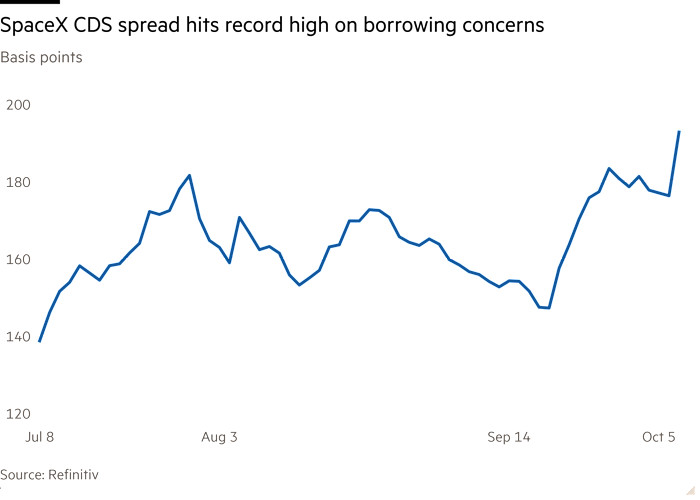
A measure of credit risk at Elon Musk’s SpaceX rose to a record high yesterday while its bonds dropped after the rockets-to-AI group’s new plans to raise $40bn in debt to buy Nvidia chips spooked investors. The spread on SpaceX’s five-year credit default swaps rose to 194 basis points after the FT reported on the fundraising plans, meaning it now costs $19,400 annually to protect $1mn of its debt against default. The CDS began trading in June at around 110bp.
Take a break from the news . . .
Does Victorinox’s pocket knife trump Alessi’s bird-whistle kettle when it comes to heritage credentials? Would Isamu Noguchi’s ethereal Akari lights outscore Arne Jacobsen’s sculptural Egg chair? Clara Baldock selected 14 design classics and compared the brands’ years in business as well as the longevity of their signature creations to create the “HTSI heritage score”.

You can also listen to today’s top news stories in the FT News Briefing podcast.
Thank you for reading and remember you can add FirstFT to myFT. You can also elect to receive a FirstFT push notification every morning on the app. Send your recommendations and feedback to [email protected]
Recommended newsletters for you
The State of AI — A series of conversations between the FT and MIT Technology Review on the geopolitics of tech. Sign up here