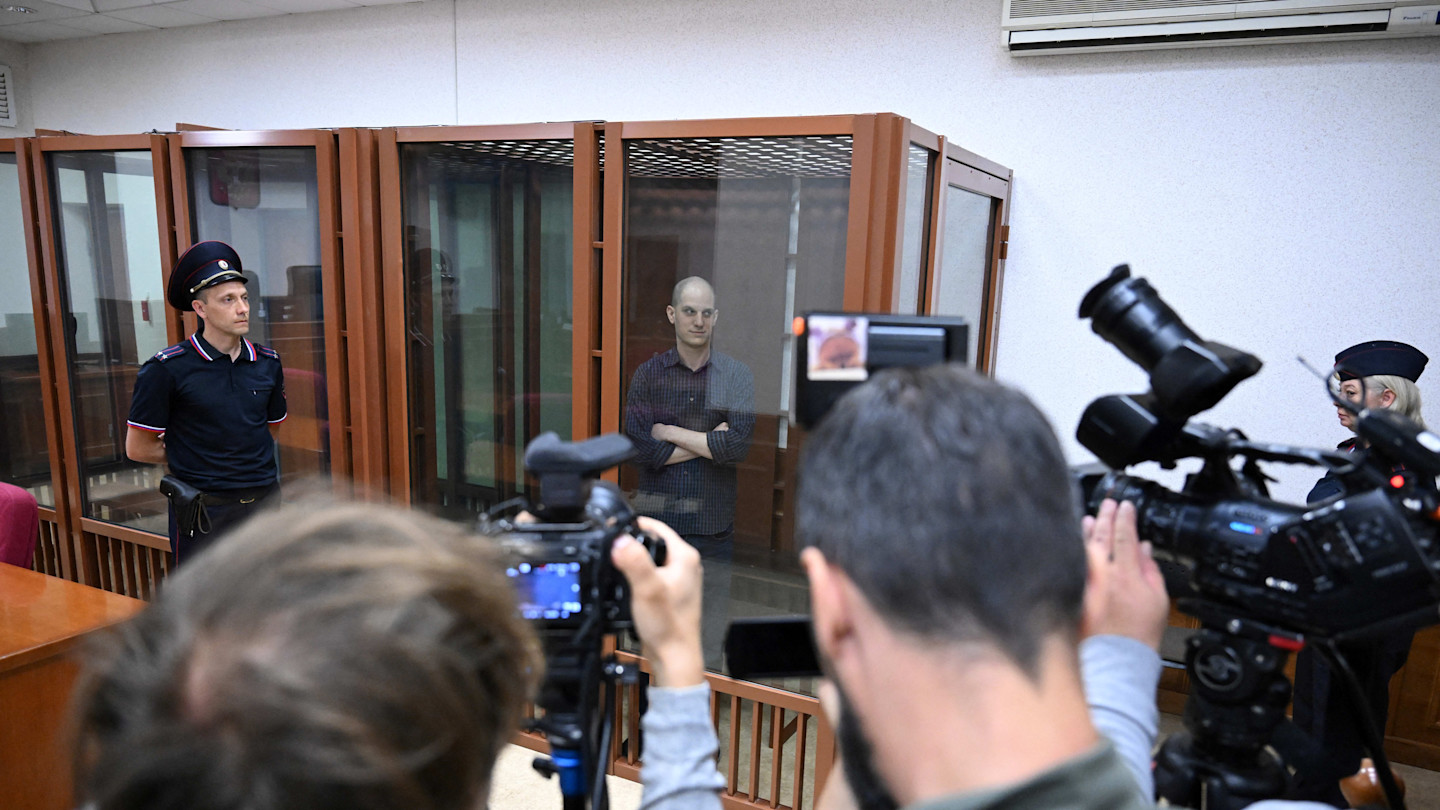
After his release from a Russian jail in a cold war-style prisoner exchange in August 2024, the US journalist-turned-celebrity prisoner Evan Gershkovich shunned the limelight. He did not speak to the media and wrote just a few articles. More than two years later, the publication of his captivating memoir This Cursed Beautiful Land (and the accompanying blitz of talks, interviews and events) marks his return to the public eye.
Gershkovich’s retelling of his life story (he is only 34) begins with his childhood in New Jersey, where he spoke Russian with his Soviet emigrant parents. In his mid-twenties, he moved to Moscow to be a reporter, rediscovering his family roots and falling in love with Russia.
His approach to journalism was traditional, even old-fashioned (“I viewed myself as an observer to history”) and when the Kremlin launched its full-scale invasion of Ukraine in 2022, he was among the few English-language journalists to remain inside Russia, “charging ahead” with reporting for The Wall Street Journal despite the spiralling risks.
At the time, Gershkovich was critical of foreign journalists who moderated their approach in order to avoid falling foul of the Kremlin. “If you stop yourself, then what’s the point of being here? That’s self-censorship,” he told a concerned editor. Being one of a select few still reporting from Russia, he admits, was also “intoxicating”. On a trip outside Moscow in 2023, he visited a mercenary recruiting centre, doorstepped relatives of dead soldiers and loitered outside arms factories to count those going in and out. Returning a few weeks later to meet a defence plant union representative who had promised him “state secrets”, he was arrested on fabricated espionage charges. The representative had been co-operating with the Federal Security Service (FSB).
Once behind bars, the young American became a bargaining chip for President Vladimir Putin, who was seeking to extricate Russian spies from western jails. Gershkovich eventually concludes that Putin (unlike senior FSB officers) genuinely believed he was a spy.
While Gershkovich’s political importance meant his prison experience was privileged and far from typical, he was nonetheless afforded a rare glimpse into a brutal and secretive system. He uses his prison diary to evoke the sights, smells and routines of Russia’s jails with gut-wrenching precision.
In total, Gershkovich spent 16 months in Russian prisons and detention centres (he was sentenced to 16 years) before being released in the prisoner swap and flown to the US, where he was met on the tarmac by then-President Joe Biden.
Incarceration provided plenty of time for reflection, and Gershkovich struggled with feelings of guilt about the pain he had caused his family. He also re-litigated past decisions (he wonders if his “ego” wanted him to get arrested, but takes comfort in a quote from writer Sergei Dovlatov that “no Russian intellectual who hasn’t been in prison is worth a damn”). And he describes the “cleaving” of his personality as his Russian identity (he was Vanya to Russian-speakers) squeezed out his American one.
At heart, Gershkovich’s book is a prison memoir — and this is where it is most powerful. His portraits of prison guards, FSB agents, investigators, bailiffs, prosecutors, informants, lawyers and inmates are empathetic, revealing and sometimes moving.
“Athletes, bandits, soldiers — we’re all one type,” an FSB investigator tells him. “We obey orders and don’t think too much about them.” One operative asks: “Is everyone gay in America?” And a prison official seeks an “honest” answer to the question: “Do you respect Putin?” Some of these people, who are the “nuts and bolts of the system”, see Gershkovich as the enemy, others are indifferent or even sympathetic. When one guard with a recording device on his chest says goodbye to Gershkovich, he mouths “good luck” and raises his fist.
The descriptions of his fellow inmates are particularly compelling. The reader is introduced to his heavily tattooed cellmate, Seryoga, for whom he develops a deep fondness. Another cellmate, the 20-year-old neo-Nazi Nikita, is later killed in Ukraine. In one prison, Gershkovich can stick his head out of the feeding hatch at night and converse with political prisoners in neighbouring cells who include victims of torture, Muslims accused of terrorism, soldiers who refused to fight in Ukraine, and opponents of the war. “Talking to them,” he writes, “felt like hearing the pleas of misery from the belly of the Russian dictatorship.”
This Cursed Beautiful Land echoes Soviet-era prison memoirs in casting Russia’s sprawling penitentiary system as a window on to the country as a whole: its politics, social mores, culture and even language. In Putin’s increasingly authoritarian Russia, this approach is once again deeply apposite. “I was looking at a microcosm of what Russia had become,” Gershkovich writes of his high-security Moscow prison. “A place where the trappings of modernity disguised stubborn old roots underneath.”
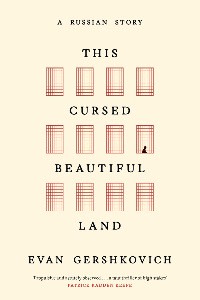
This Cursed Beautiful Land: A Russian Story by Evan Gershkovich William Collins £25/Crown $34, 432 pages
Howard Amos is author of ‘Russia Starts Here: Real Lives in the Ruins of Empire’ (Bloomsbury Continuum)
Join our online book group on Facebook at FT Books Café and follow FT Weekend on Instagram, Bluesky and X