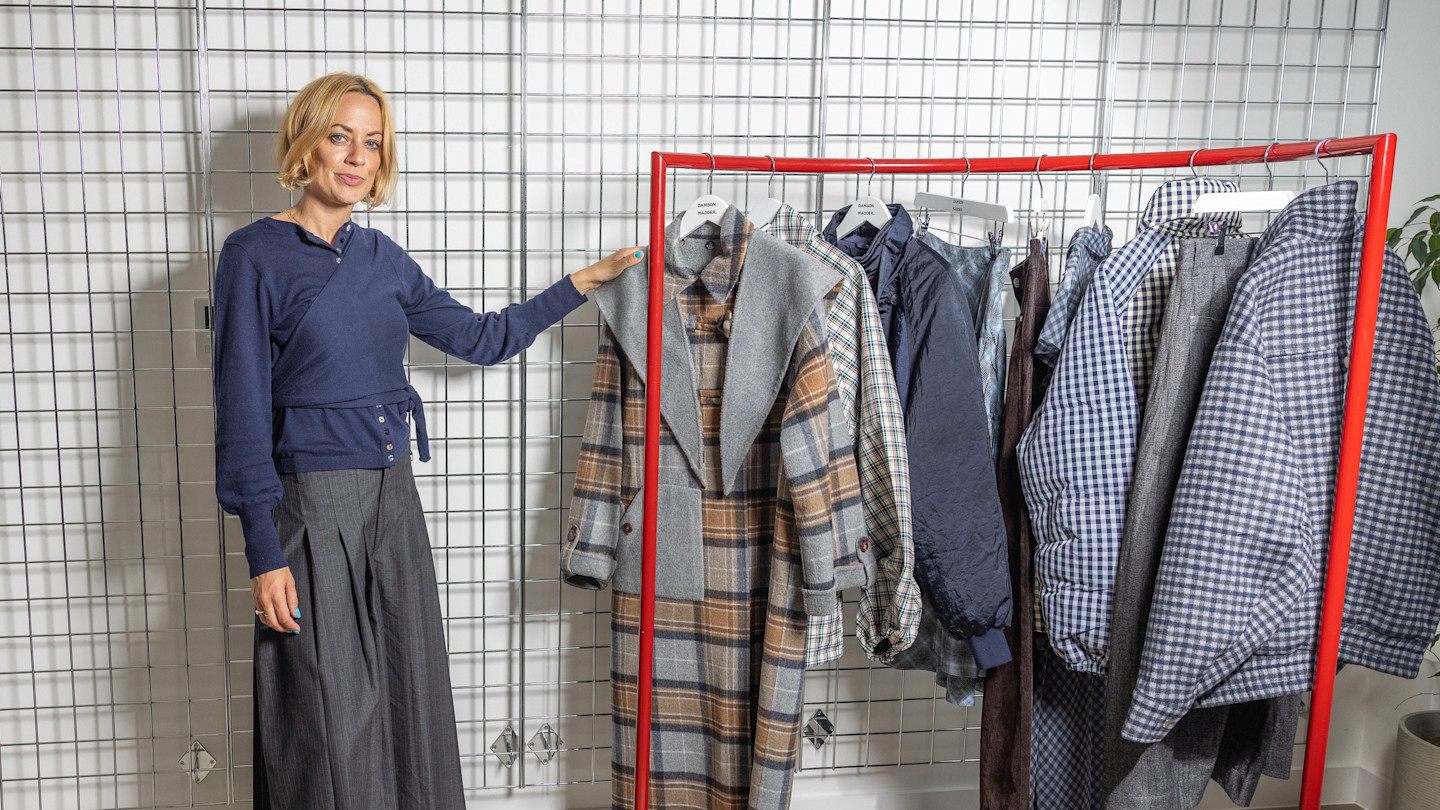
Emma Hill’s early life was shaped by bankruptcy. When she was eight, her father’s building firm went bust following the 1980s housing crash and the family home was later repossessed.
Hill, her mother and two siblings moved into social housing and her parents divorced. “I remember the electricity being on a pay-as-you-go key. Every so often it ran out in the evening, so we would have to light candles,” she recalls.
Hill spent a decade working in the fashion industry but branched out on her own after starting a family. In 2020, she co-founded Damson Madder: its name is a fusion of the plum-like fruit and madder, a plant whose roots are used as a clothing dye — both a nod to the brand’s sustainable aims.
Damson Madder does not have a physical store, selling directly to consumers online and through retail partners. The brand turned over £31mn last year, and is predicted to generate £40mn over the course of the current financial year. Its offices are based in Camden, London, and it employs 60 people.
CV
Born: Reading, 1984
Education: 2003-06: BA in Fashion Promotion and Communication, Southampton Solent University
Career: 2008- 18: Various fashion buying and product development roles
2019-present: Co-founder, Damson Madder
Lives: in Walthamstow, London, with husband and two children.
When did you decide to start your own business?
I’d been working for nearly a decade in various fashion buying and product development roles. I enjoyed aspects of it, but I knew it wasn’t what I wanted to do for the long term. I’ve always been entrepreneurial and I got to an age where I was thinking seriously about my career path because I wanted to start a family.
I realised my biggest strength was in fashion, and I’d always dreamt of starting my own brand. I reached out to my future co-founder Jacob Morris, a former colleague, and asked if he was interested in starting a brand. Thankfully, he was and we founded Damson Madder together in 2019.
How did you fund your business in the very beginning?
My co-founder, Jacob Morris, made an initial investment of £60,000 in the business. During our first year of operating, he invested an additional £80,000 to buy [clothing] stock and to facilitate our wholesale orders. We wanted to develop slowly and steadily rather than rely on bank loans, and we made back the initial investment within the first 18 months. We have not yet had to seek outside funding.
Early on, we relied on wholesale, working with a mix of small boutiques. The W Store in Walthamstow, where I live, was one of the first accounts. The beginning was all hustle: negotiating small orders with factories, asking favours of friends and family. My sister designed and built our first website for £300. My best friend did our PR in exchange for gifting. Everything was on a shoestring.
How did working in fashion buying prepare you for becoming a brand owner?
It taught me about products and what a factory can realistically achieve on quality, lead times and margins. And why fit, fabric base and detail matter more than anything on a mood board.
Also commerciality, how fast customer behaviour moves, how trends change, and the importance of creating exceptional products at a price that is fair, because competition can be tough.
It also gave me my network. Those I worked with, who were experts in their field, are some of the people I later employed.
What was the turning point for the expansion of Damson Madder?
In 2023, we had some very strong viral styles — the leopard cargo trousers, the leopard Tilly gilet — with waiting lists of more than 15,000 people. That gave us the confidence to move to a new advertising agency and invest properly in paid ads.
At the same time, we brought on a wholesale agency that helped us expand globally, mostly in the US, and we also moved into more premium stores: Selfridges, Liberty, Galeries Lafayette and Nordstrom. That changed the game for us. In 2024, our turnover more than tripled from £6mn to £19mn.
How did the pandemic change your business strategy?
We launched two weeks after the UK went into lockdown in March 2020. My friend Rachel Vasdekys had got a piece from our first collection featured in a clothing round-up in the Metro. I remember the day of publication, having the realisation that no one would be on the Tube to read it, imagining the papers blowing in the wind.
It was challenging, but there were good things about launching during lockdown. Our messaging of responsible, organic fabric bases and ethical ways of working resonated because people had time to look critically at what they were buying and wanted to make more responsible choices. On a simpler level, I think having playful, bold prints made our products stand out too.
How do you manage your own finances? Has this changed since becoming a business owner?
It’s really hard. I spent years burying my head in the sand about my personal finances. I was giving my business my all, coming home with just about enough energy to feed my children and put them to bed. I’d be doing profit and loss sheets at work, but then I wouldn’t look at my bank statements for months.
As my team has grown and taken more control of Damson’s finances, I’ve had more time for my own. I’ve recently set five-year financial goals, which I share with my husband, who keeps me accountable. One of these is planning for my children’s education and giving them the option of going to university, should that be the path they choose.
How did your upbringing influence your relationship with money?
From a young age I learnt that it was important to earn my own money, build my own security and not to have to rely on anyone. At 13 I got a job in my local chip shop, earning only £2.88 per hour. After that I got a job at Homebase.
My dad’s work ethic inspired me; he was a proper grafter — even though he lost everything, he showed me that success was still possible.
What is your biggest expense each month?
It’s definitely my home — mortgage, furnishings, bills. My upbringing has a big part to play in that. We moved into different rented properties five times in five years. It’s very important to me to have a solid base and a safe environment for my kids to grow up in, which they can call home.
I’m not very materialistic. I think it’s because I work in fashion and I know the cost of everything, so I don’t buy much for myself. But I love travelling and experiences with my two young children.
Do you have a pension?
I do now. For a while every spare pound went back into the business. It’s what most founders do and it’s not always the right call. Now that we are in a good place, I have set one up.
If I were advising another founder, I would say: do not leave it as long as I did. Your business is not a pension.
What financial lessons are you teaching your children?
Learn to do what you love. Security and money matter enormously, but how you live your life with that money is what actually counts. I would far rather help my children become people who can create wealth for themselves than leave them a large inheritance.
What advice would you give to other founders?
Obsess over making an exceptional product. Competition in fashion is tough; there are a lot of businesses making amazing things, so you’ve got to love your product, ensure it fits well and feels good. That’s just the baseline.
Protect the cash. Don’t overspend — there are ways and means of doing things without a massive budget. To me, it’s really obvious when a brand overspends on shoots, marketing or paid advertising. I think the customer is clever and can tell if you just throw money at something.
Lastly, play the long game, keep the faith and believe in what you are doing. Follow what you are passionate about and what feels right in your gut.