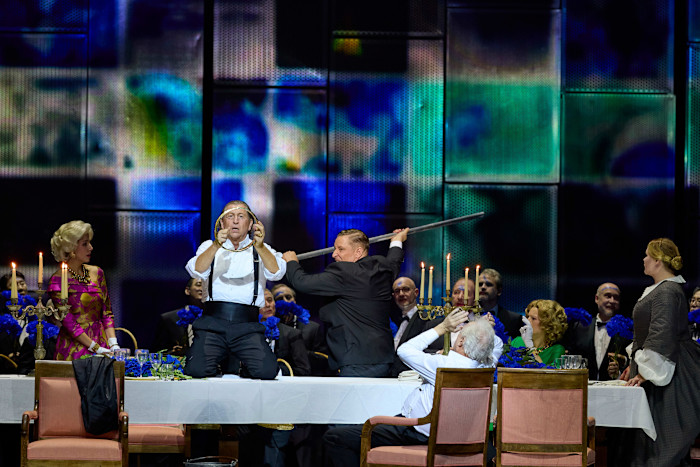
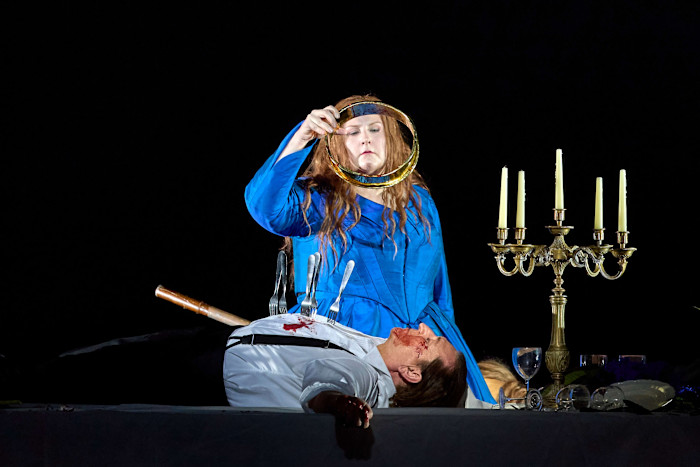
Ever wondered what to do with all those forks on a fancy dinner table? Hagen has a solution. He collects them all and sticks them, one by one, into Siegfried’s not-quite-dead torso. Conveniently, Siegfried is dying on the dinner table. As Siegfried continues to sing his final phrases, the forks wobble and begin to fall out; Hagen has to stick them back in and hold them in place.
We are nearing the end of Götterdämmerung, the dying spasms of Calixto Bieito’s new Ring for the Paris Opera, the last piece of preparation before the complete Wagnerian cycle is staged in November.
There have been numerous moments in the course of Bieito’s Ring cycle where it has looked as if the Catalan stage director found his concepts on a low-budget website, and checked out without asking himself whether he really needed everything in his shopping cart. The forks are one of the silliest. Bieito’s Hagen is a sociopath; we would have figured that out without the forks.
Simple sociopathy leaves no room for character development and no function for the chorus, which generally reflects the society in which Hagen functions. It seems Bieito either had no time to direct the chorus or simply chose not to do so. This is a man who used to devise societies of immense detail, each chorister playing a fully developed character, as in his 2002 Masked Ball for the ENO, or his S&M Entführung aus dem Serail for Berlin’s Komische Oper two years later. Here, the chorus simply stands in a dimly lit line and sings at the audience. The dysfunctional Gibich family is left to emote frantically in the footlights.
Paris could hardly have staged a more convincing context for an opera about a civilisation on the brink of collapse. Protesting students pack the Place de la Bastille in the hours before curtain-up. Riot police in full body armour fired a water cannon and tear gas into the crowds; there are more coughs than usual from the audience as the music begins, but remarkably, the house is packed. Parisians won’t let a little bit of state violence stand between them and their Wagner. Unfortunately, nothing that followed was as dramatic.
The Nornes who predict the future at the outset wear Victorian garb and operate a Jacquard loom, the punch-card computer’s 1804 ancestor. The Gibich family is rich and incestuous; nothing new there. When the Rhinemaidens reappear, they are Stepford wives dressed for a ball. Apart from the briefest appearance of gas masks, there are few coherent links to the rest of Bieito’s Ring. Computer-generated video footage presents a jumbled assortment of mutating churches, control centre imagery, and, for one entire scene, a giant orange chandelier, rotating in slow motion. Searching for meaning? Good luck.
Fortunately, there is plenty of meaning in the orchestra pit. Pablo Heras-Casado draws some exquisite playing from his musicians; there is something deliciously un-German about this Ring. Not a lack of precision or force — both are abundant — but a kind of curvaceous sensuality, a savouring of colour, a capacity for tenderness, a warm lilt.
Heras-Casado also supports his singers superbly, and they deserve it. This is an excellent cast, from Tamara Wilson’s luminous, fearless Brünnhilde (upon whom Bieito has imposed Obelix-style strength, a gag which wears thin) and Andreas Schager’s untiring Siegfried to Mika Kares’ fork-wielding Hagen. The performers bring all of the nuance and coherence to their singing that is missing from the stage; musically, this Götterdämmerung is more than worth the tear gas.
★★★☆☆
To October 18, operadeparis.fr