
This article is an on-site version of our Moral Money newsletter. Premium subscribers can sign up here to get the newsletter delivered twice a week. Standard subscribers can upgrade to Premium here, or explore all FT newsletters.
Visit our Moral Money hub for all the latest ESG news, opinion and analysis from around the FT
Welcome back.
Government borrowing costs are on a tear. US and UK 30-year bond yields this week reached their highest levels since 2002 and 1998 respectively. The rising yields on French debt are driving worries that the European Central Bank may need to come to the rescue.
But the pain is still worse for developing countries, especially in Africa, which have already been paying eye-watering rates to service their debts.
Time to ‘reset’ the sovereign debt system?
At a glitzy evening ceremony this week in the island financial hub of Mauritius, the Africa Credit Rating Agency was born: an institution designed to tackle a major bugbear for governments on the continent.
In recent years, they’ve been arguing with growing force that the interest rates on their debt are unduly high — in large part, they say, because of unfairly harsh assessments by the big three global credit rating agencies.
The new agency was created under a mandate from the African Union but is planned to have independent governance, though details of its shareholding structure have not yet been disclosed. It will “assess objectively the risks related to African economies” and help the world to “better understand” their potential, AU Commission chair Mahmoud Ali Youssouf said on Wednesday.
Whether credit rating agencies deserve a share of the blame for Africa’s high borrowing costs is the subject of an intense and complex debate, as I wrote previously.
But there’s no disputing the growing severity of the debt problem facing the continent, as it grapples with some of the world’s most urgent development challenges.
Net interest payments consumed 15.7 per cent of government revenues in sub-Saharan Africa last year, according to UN Trade and Development (Unctad) — more than double the average figure for developing countries ex-China. African countries’ average borrowing costs nearly doubled between 2020 and 2024, according to analysis of World Bank data by researchers at the ONE campaign.
This has been squeezing space for spending on essential services, Unctad notes, with African governments’ net interest payments exceeding their spending on health or education. This year the challenge has become still worse. Many African economies have been hit by the energy market fallout from the US war with Iran, and their borrowing costs are getting even higher amid a global rise in government bond yields.
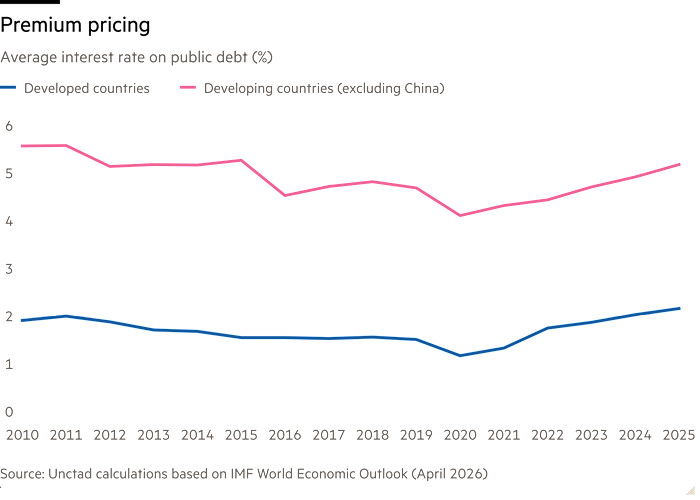
Government finances in the continent are under further pressure from cuts to developed nations’ foreign aid budgets, which have fallen by nearly two-fifths in the past two years and will decline again this year, according to Unctad. Nor is the debt problem confined to Africa, it notes, with developing nations facing average borrowing costs well over double those of their developed-world peers.
What’s the answer? An interesting new blueprint emerged this week in a paper from researchers at the Center for Global Development and the Rockefeller Foundation, arguing for what they dubbed a “growth and investment reset”.
This would be targeted at developing countries whose debt levels are sustainable in principle but face acute liquidity problems that are harming their ability to invest in their future. It would involve a big expansion of support from the IMF and World Bank, including through guarantees that would enable countries to refinance expensive debt more cheaply.
Bilateral lenders — mainly the governments of wealthy countries and China — would commit to maintain their exposure to the debt of participating countries, with net outflows to these creditors halted for the duration of the programme.
The proposed scheme would have a heavy focus on supporting productive investment — laying the foundations for long-term growth, rather than merely bailing countries out until the next crisis. Participating governments would need to develop and commit to an investment plan focused on “projects that will demonstrate results” — meaning the scheme might boost confidence among private sector investors, instead of hoisting a red flag like some previous debt relief schemes.
“The initiative should be based on the recognition of a country’s ambitious plans for growth and investment,” the authors write, “rather than the stigma of a debt problem”.
Keir Starmer’s UK government made much of its desire to play a key role in building a fairer sovereign debt system. His successor Andy Burnham has an opportunity to make good on that promise next year, when the country will assume the G20 presidency.
In the meantime, debt-laden developing countries are working to form a common front. Next week Bangkok will host the first governing council meeting of the Borrowers Platform, a new UN-backed forum for developing nations to share knowledge around debt problems and “amplify their collective voice” in discussions on the global financial architecture.
“A rating agency will certainly not reduce significantly the cost of capital in the near future,” the AU’s Youssouf warned his audience on Wednesday. “There is a need for a more holistic reform of global markets. Our member countries and our financial institutions bear a specific responsibility to advocate for those reforms.”
Smart reads
American Express has been fined $350mn for missing about $13bn in suspected money laundering· over more than a decade.
Research suggests many men “brush off the climate problem for fear of seeming too feminine”, writes Pilita Clark.
An Australian court has blocked a coal mine expansion on climate grounds — while the US Supreme Court began hearings on whether states can hold major polluters accountable for the costs of climate change.