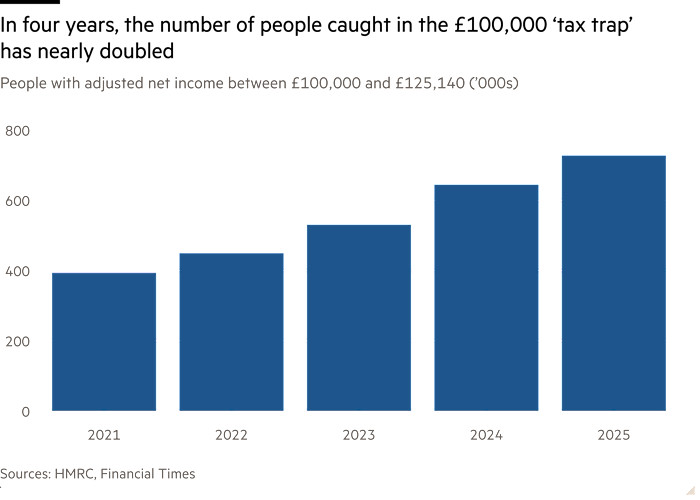
The number of individuals caught in the UK’s £100,000 “tax trap” has nearly doubled in four years, pulling more than 700,000 people into an effective marginal tax rate of 60 per cent in the last financial year.
Some 727,000 people had an adjusted net income between £100,000 and £125,140 in 2025-26, according to data from HM Revenue & Customs obtained under a Freedom of Information request by the FT.
This marked an increase of 85 per cent since 2021-22 when the tax-free personal allowance was frozen at £12,570.
The finding comes amid a debate over whether tax thresholds should be increased as wage inflation pushes more people into the higher rate.
This is particularly significant for parents who lose access to thousands of pounds of childcare benefits if they earn just £1 above £100,000.
Olly Cheng, financial planning divisional lead at Rathbones, said the threshold had become “one of the most penal tax cliffs in the system”.
“A six-figure salary used to be widely seen as a sign that you had ‘made it’. Today, many people earning £100,000 or more are finding higher earnings do not always translate into greater financial freedom,” he added.
Individuals earning more than £100,000 have since 2010 had their personal allowance tapered away until it is eliminated entirely, at present for earnings exceeding £125,140.
For every £2 earned above the £100,000 threshold, £1 of the allowance is removed, resulting in an effective rate of 60 per cent on income earned between £100,000-£125,140.
Parents earning above the £100,000 income threshold become ineligible for government-funded childcare support.
A parent in London with two children at nursery would need to earn more than £149,000 to compensate for the loss of 30 hours of free childcare per week, according to the Institute for Fiscal Studies.
This so-called cliff edge has driven some high-earning individuals to reduce their working hours, turn down promotions or make excess pension contributions to keep their earnings below the threshold.
Sir Keir Starmer’s government had explored softening the £100,000 tax trap, but ultimately decided against the plan after the Office for Budget Responsibility expressed scepticism that reform would significantly increase tax receipts.
Instead, the former Labour chancellor Rachel Reeves used her 2025 Budget to extend the freeze on income tax thresholds and personal allowances until 2031.
Prime Minister Andy Burnham is not actively considering a similar move in light of a poor fiscal outlook, but he may come under pressure to rethink the threshold.
The Conservatives unveiled plans to target the £100,000 tax trap at their party conference in Birmingham earlier this week in a bid to win back support from traditional Tory voters.
Kemi Badenoch announced her party would extend subsidised childcare to all parents — regardless of income — if it went on to win power.
Andrew Griffith, shadow chancellor, also revealed an “ambition” to tackle the tax cliff edge and to cut the 60 per cent marginal tax rate that applies to earnings between £100,000 and £125,140 — but only when he could say how it would be funded.
The so-called tax trap was created by former Labour chancellor Alistair Darling in 2009 as part of measures to rebuild the public finances after the global financial crisis.
The Treasury said: “The personal allowance is reduced for those with incomes over £100,000 to ensure support is focused where it’s most needed, including funding public services.”
It said it was “protecting payslips by keeping our promise not to raise income tax, national insurance or VAT”.