Iran has expanded its attacks beyond the Strait of Hormuz and into the Gulf as it tries to maintain its leverage over the critical waterway and prevent an increase in Gulf oil exports.
Following attacks on two tankers — one near Qatar and one off the coast of Al Jazeera in the United Arab Emirates on Wednesday and Friday — Iran’s Islamic Revolutionary Guard Corps insisted in a statement that it had control over the Strait of Hormuz.
The IRGC navy said on Friday that action taken against “non-compliant” vessels and companies would not be limited to the Strait of Hormuz: “Any vessel that passes through an unauthorised passage will be pursued throughout the entire region and its punishment will be certain.”
It would “not allow the presence of invading armies” in the waterway and “will respond decisively to enemy provocations aimed at disrupting this control”, it said.
The past 10 days have been among the most deadly for tanker operators since the war began, as Tehran retaliated against increased confidence among vessel owners to transit the strait.
Iran launched a barrage of attacks against vessels carrying Gulf crude and refined products after a series of reports at the end of September said that exports from the Gulf were close to their prewar average.
“The level of concentration of the attacks is right up there. Our suspicion is that it’s a reaction to the flow of oil out of the strait approaching prewar levels. Iran is exerting its control — or attempting to,” one tanker industry executive said.
For the most part, attacks during late September and early October have been limited to within a 40km area at the tip of Oman’s Musandam peninsula, which sits on the southern coast of the Strait of Hormuz. The US Navy has been offering air cover to tankers willing to transit the waterway via Oman’s coastline in an effort to encourage oil exports.
Some content could not load. Check your internet connection or browser settings.
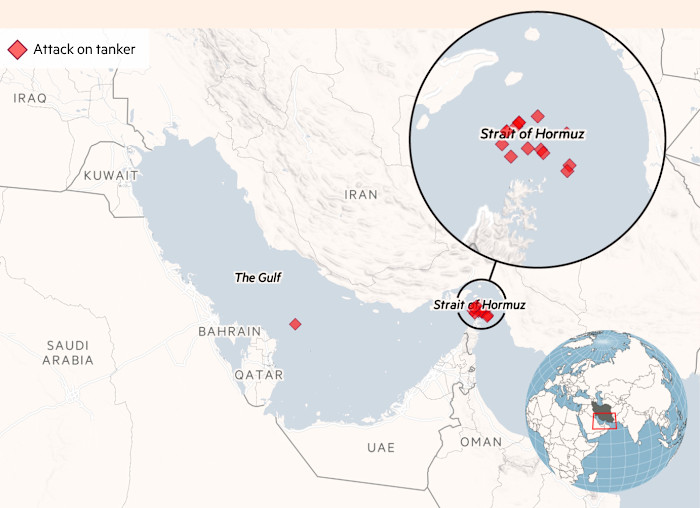
But the attacks on Wednesday and Friday, confirmed by the naval agency UK Maritime Trade Operations, suggest that Iran is expanding its range. On Wednesday, a Turkish-owned oil products tanker Acers was hit off the coast of Madinat ash Shamal in Qatar causing crew casualties and a fire on board, according to UKMTO and maritime security consultants.
Friday’s attack near UAE hit a Chinese-owned supertanker called Gem No. 2, two security sources said. Another vessel, Dhalkut, reported shooting nearby on Thursday while it was off the coast of Fujairah, the maritime security company Vanguard said. Fujairah has become a popular mooring for more risk-averse tankers waiting to pick up cargoes that have been shuttled out of the Gulf.
Iran also claimed on Friday that it had hit another ship, NV Sunshine, after it had transited the strait. The NV Sunshine was shown in a position off the coast of Qatar on Friday afternoon, according to ship-tracking data. The attack was not independently verified.
John Walker, head of advisory at EOS Risk Group, a security specialist, said that Iran was probably pushing attacks further into the Gulf to “remind Gulf states that the economic and security cost of supporting the US is not confined to Hormuz” as well as to diluting US air cover. “While US jets are busy in Hormuz, it’s easier to conduct successful attacks elsewhere,” he said.
Commodities platform Kpler said on Friday that flows had recovered to prewar levels in September but that “intensified attacks on tankers” had driven exports “sharply lower” this week. The seven-day average up to October 7 was 9.9mn barrels per day, 42 per cent lower than the prewar baseline and down from around 15.5mn barrels per day in September, Kpler said.
Reflecting a shortage of tankers and the risk premium that vessels can charge for passing through the waterway, the day rate for a supertanker to travel between the Gulf and China hit a historic record of $1.6mn per day this week.
Map by Steve Bernard