
Giving childcare benefits to people earning six-figure salaries sounds mad. But what about actively avoiding promotion, deliberately scuppering a sales deal or pleading with your boss not to give you a bonus? Welcome to the madness of the childcare tax trap that’s ensnaring tens of thousands of higher-earning parents and slowly strangling the younger generation’s economic productivity.
In England, if one parent’s net adjusted income goes a penny over £100,000, they lose virtually all state help with childcare costs for under 3s. Nursery places are now so expensive that, without this subsidy, families could be worse off by tens of thousands of pounds. This creates a perverse incentive to cut their hours, forgo a pay rise or stick huge sums into pensions to stay under the cap.
I have spoken out about the insanity of this policy for years, so I was pleased that Kemi Badenoch, the opposition leader, pledged to scrap the £100,000 childcare cliff edge at the Conservative Party conference this week.
“What we want to see is that people who work harder don’t get punished for doing so,” she said. Quite right, but we need the ruling party to get behind this and the idea of helping higher earners is politically divisive. The average punter on social media is openly hostile to it. Many point out that the median full-time wage in Britain is less than £40,000. Earning £100,000 puts you in the top 5 per cent of earners. Surely these rich whingers should be able to pay their own childcare bills?
I don’t disagree. But bizarre kinks in the tax system and the unsustainable way we fund childcare in England make this doubly unaffordable.
The £100,000 childcare cliff edge coincides with horrific marginal tax rates as the personal allowance tapers. On the £100,000-£125,140 band of earnings, a worker with a master’s degree could keep just 23p in the pound after income tax, national insurance and student loan deductions.
This annihilates their earnings power precisely at the point when they go over the cliff edge and have to pay full whack for their childcare.
The price of a full-time nursery place in England has nearly tripled since 2001, far outstripping inflation. Childcare reforms in 2024 brought down costs for parents entitled to receive subsidised hours, though childcare is definitely not “free” for anybody. However, costs have continued to climb for those who do not qualify for support, according to the latest Coram childcare costs survey.
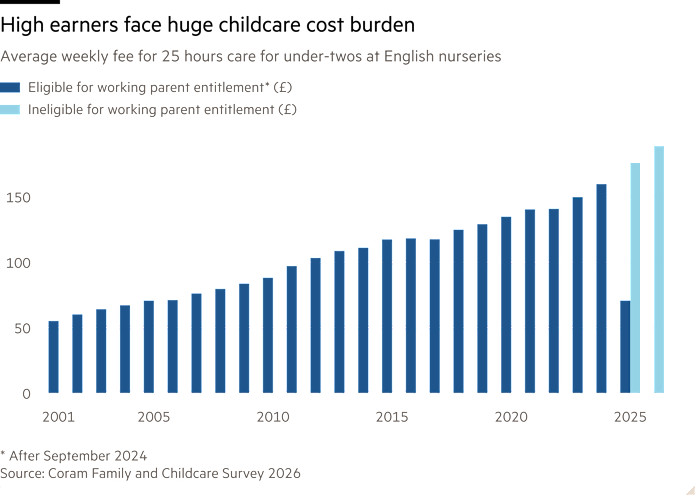
The situation is most acute in the capital. If a London parent earning more than £100,000 loses their subsidy, a full-time nursery place could easily swallow £24,000 of their post-tax pay. Such crazy marginal rates make it all but impossible for parents to out-earn this problem. Securing a pay rise of 25 to 50 per cent is unlikely, but that could be what is required to lift them out of the trap and put them in the same financial position as a parent earning £99,999. Mad.
Instead of focusing on how they can earn more, higher-earning parents are actively trying to earn less. Sifting through hundreds of responses to a recent FT survey, I found that many readers felt they could not afford to do a great job at work for fear that a pay rise or bonus would take them into the salary “dead zone” where they would lose subsidised childcare but not earn enough to make up for it.
This has created a “broken rung” of career progression for talented, high-earning young professionals in Britain who feel forced to limit their earnings until their youngest child starts primary school. How much is this costing the economy and the workers’ future prospects?
“The incentive for people not to try harder happens all the way from £90,000 to £160,000 and potentially higher,” says Matthew Griffiths, founder of the Wealthy Parent Guide, which advises parents how to navigate the trap. Increasing pension contributions is the obvious way to stay under the cap, but this requires advance planning. An unexpected discretionary bonus at the end of a tax year can blow careful calculations. “I’ve spoken to salespeople who have actively tanked deals for their company as they didn’t want the commission to land them in the trap,” he says.
NHS doctors, who have far less pension flexibility, tell us they are dropping to a four- or even three-day week. Some professional women with partners earning more than the cap are quitting work altogether because they can’t afford the childcare on top. Long before Badenoch’s announcement, there were growing calls to set a household cap. It is discriminatory that two parents earning £99,999 each are entitled to the subsidy, while a single parent earning a penny more than £100,000 is not.
With tax thresholds frozen, the number of people caught in the trap has nearly doubled in four years and is set to rise further. Staying under the cap is becoming harder as housing costs soar (both rents and mortgages), eating up more of families’ incomes while their take-home pay cannot budge.
So what is the other lever that parents say they are reluctantly pulling? Not having baby number two.
This is thoroughly depressing, so I’m glad that the Tories have moved this issue up the political agenda. Their estimated £700mn a year cost of removing the cliff edge feels modest given the misery and economic damage it causes.
However, solving this problem creates a bigger one for private childcare providers. As things stand, government funding for the “free” hours does not cover the cost of providing them. If a nursery’s most profitable customers become eligible for the subsidy and nothing is done to close the funding gap, who will be left holding the baby if yet more nurseries close?
Fixing the childcare problem is the right thing to do, but fundamental reform to our broken tax and childcare system will be needed to do it. Unlike Badenoch, I believe this should be a bigger policy priority than cutting inheritance tax or keeping the triple lock.
As an ageing society, we simply cannot afford to stop creating the taxpayers of the future. We urgently need a tax system that incentivises productivity, career progression and procreation.
Claer Barrett is the FT’s consumer editor; [email protected] Instagram @ClaerB