This article is an onsite version of our Europe Express newsletter. Sign up here to get the newsletter sent straight to your inbox every weekday and fortnightly on Saturday morning. Explore all of our newsletters here
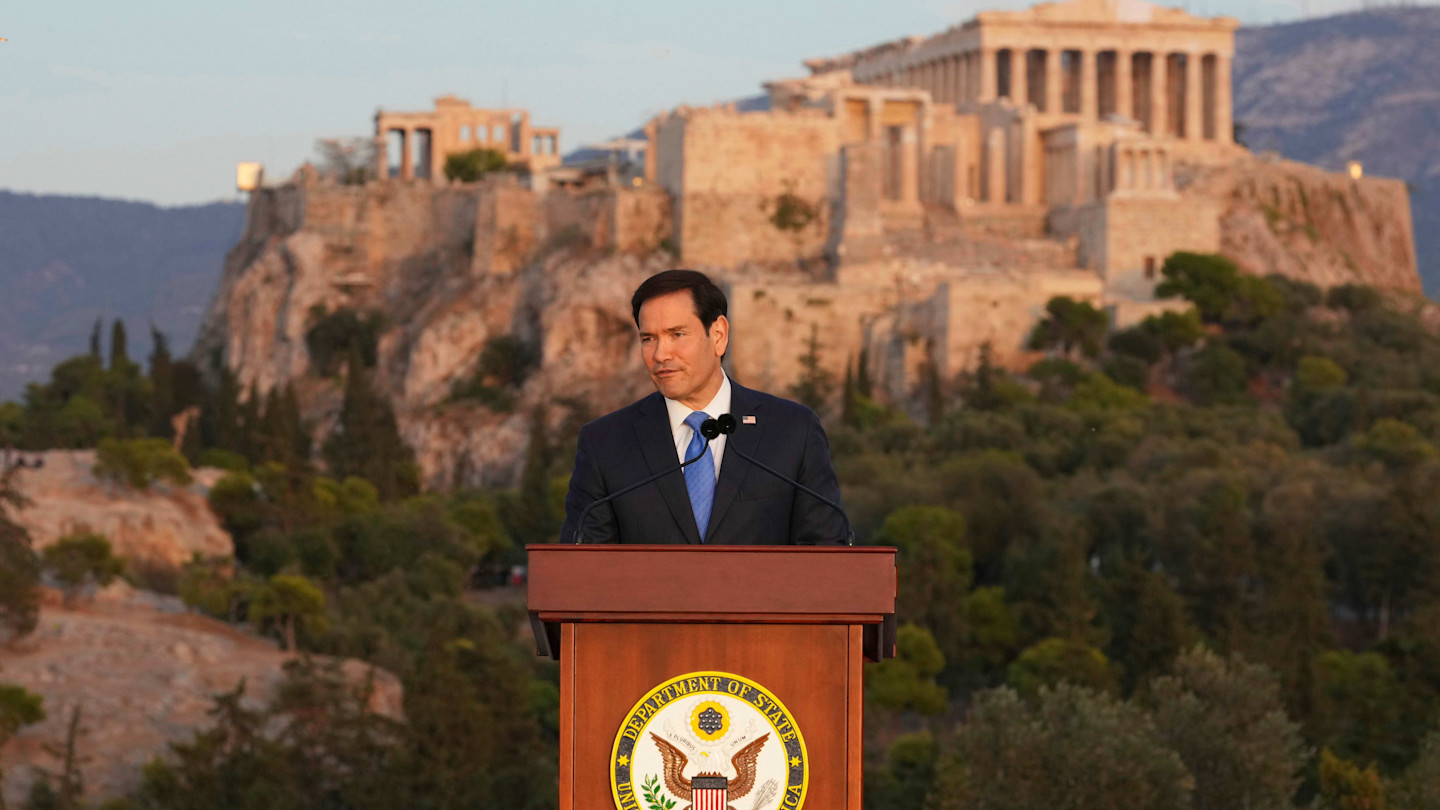
“Whenever I hear the word ‘culture’, I release the safety catch of my Browning,” wrote the Nazi playwright, Hanns Johst (often misattributed to Hermann Goering). I, on the other hand, reach for my Bose headphones whenever “western civilisation” is mentioned. Marco Rubio’s speech at the Acropolis on Wednesday is the latest example. This time my noise-cancelling device was out of reach. For those without the time to read it, here are your CliffsNotes.
The US secretary of state went to Athens to invoke Plato to justify Maga. Along the way he mentioned Caesar, Charlemagne, Cortes, Alexander the Great and other conquerors of faraway lands. The “legendary stand of 300 Spartans” against Persians at Thermopylae got its obligatory reference. As did the “men who built the Parthenon” and the “architects of European Christendom who raised the cathedrals of Milan, Cologne, and Florence”. As a Catholic, Rubio lays heavy emphasis on Aquinas, Augustine, Thomas More and others.
Those towering men of antiquity “believed fiercely in the ideal of the great man: the exceptional individual who achieves immortality through his great deeds”, Rubio said. No prizes for guessing who today’s great man might be (hint, he supplied the Florsheim shoes that Rubio often wears). Today’s great men, Rubio continued, had only a decade to save the west from extinction. “The course we take will determine whether the west maintains its place at the head of the world, or resigns itself to a future of atrophy, and servitude, and decline.” Rubio’s stab at deeper philosophy was to cite thumos — the part of the human soul that stands for vitality and purpose in Plato’s typology — as the secret source of western superiority. “Without it, nations lose their will to fight, their will to strive, and their will to survive,” Rubio said.
There is something deeply puzzling about Rubio’s quest for intellectual scaffolding to dress up the Maga worldview. Just as hypocrisy is the compliment that vice pays to virtue, Rubio’s AI slop is the homage a mindless philosophy pays to those who might mind. I don’t know why he bothers. Anyone with a passing education can see through it. Should Rubio read The Republic, rather than loot ChatGPT for references, he would find that Plato meant something very different to what he had in mind. Thumos (spirit) is the part of the soul that helps another part, reason (logistikon), conquer the final third — appetite (epithymia). Unbridled appetite leads to greed, love of money, and indulgence of physical desires. It seeks to dominate others. Does any of this remind you of someone?
That Rubio was flanked by Kimberly Guilfoyle, the US ambassador to Greece and former girlfriend of Donald Trump Jr, was one tell. Guilfoyle, like so many of her peers, is alleged to be using her government job for self-enrichment. For the latest on that, read this report in the Wall Street Journal. Another tell was that Rubio did not cite any Enlightenment figure — no Mill, Descartes, Locke, Voltaire, Kant, Tocqueville or Smith rated mention in his version of western civilisation. Rubio’s west consists of Christian warriors and ancient generals.
It goes without saying that such dross annoys those who take pride in what is good about western civilisation. People in Munich reacted badly last year to JD Vance’s Valentine’s Day lurid warning about threats to western civilisation. The same applies to Rubio’s follow-up this year at the same venue. The Tufts political scientist, Daniel Drezner, is right to label Rubio’s speeches as “dime store rhetoric grasping at profundity and failing”. Drezner is also right to scoff at the idea that Rubio is the adult in Trump’s orbit. Rubio’s speeches are auditions to be Trump’s heir. In spite of Rubio’s day job, no diplomacy is entailed or intended. Both of the leading contenders to succeed Trump use Europe as a backdrop — and punch bag — for their presidential ambitions. You and I might cringe, dear Swampians. But the crowd that Rubio is wooing has more than its fair share of cynics and fools. We will be hearing a lot more from him about western civilisation before this excruciating chapter comes to an end. For more on that, read Plato on hubris.
I am turning, as I often do, to my colleague Gideon Rachman. Gideon, I know a speech is just a speech and we should not overreact. My question is what do you see as Rubio’s goal with such addresses? What impact do they have on his supposed European audiences?
Recommended reading
My column this week is about how California’s billionaire tax would change America. Prop 40 is poorly designed as a fiscal measure but is clever politics. “A rational billionaire would see the merits of buying social peace,” I write. “An enlightened one would acknowledge his debts to federal science, public education and chance. Alas, there are few such super-rich to be found.”
For more on Kimberly Guilfoyle, do read this essay by the University of Michigan’s excellent Don Moynihan, “The arrest is yet to come”. His Substack, Can We Still Govern?, is well worth subscribing to. “The scale of the corruption is extraordinary,” Moynihan writes. “Rebuilding the FBI, DoJ, and inspectors general is not enough. Such institutions cannot stop corruption when the president wants corruption.”
Do also read Julianne Smith, former US ambassador to Nato, and a sharp geopolitical mind, in Foreign Affairs on how the west is doing far too little to deter the new and more dangerous phase in Russia’s hybrid war. Gideon is also great on this topic in his latest column on why Putin’s nuclear threats no longer work.
Finally, I review Michael Lewis’s new book, Blockers, in tomorrow’s Weekend FT. It chronicles the woeful tale of Elon Musk’s Doge and the future of federal government. As you would expect from the author of Liar’s Poker and The Big Short, Lewis’s latest hits the mark.
Gideon Rachman replies
Hi Ed. Rubio’s speeches in Europe are indeed fascinating in a grisly sort of way. Who writes this guff? Is it really ChatGPT, as you suggest? Does Rubio actually believe any of it? Did he overdose on Christopher Nolan on the flight over? And is the intended audience in Europe — or back home?
You ask about the European response. Well, I was there in Munich (as were you), when Rubio made a similar speech in February. And I’m afraid to say that he got a standing ovation. But the context was quite specific. The Europeans were still bruised by Vance’s contemptuous speech at the same venue, the previous year. Rubio, at least, appeared to be talking about a common culture that linked the US and Europe. And the German hosts were determined to patch things up with the US — and so leapt to their feet at the end of the Rubio Munich address.
Of course, once you start thinking about Rubio’s speeches, they begin to fall apart. As well as the reasons you mention, there is the clear nostalgia for the European age of imperialism. Rubio seems to associate territorial expansion and military conquest with European greatness. Is he really implying that Britain should still be ruling India? Or that Algeria should still be part of France?
Even when he is attempting to be conciliatory, the US secretary of state is grotesquely patronising to his European hosts. “We believe that Europe can awaken from its long slumber and rekindle the fire that was here millennia ago.” Gee, thanks Marco.
A fitting European riposte would be: “We truly believe that America can restore civility in public life, respect for election results and turn its back on corruption and abuse of office. We have never given up on you — and we never will.”
Your feedback
We’d love to hear from you. You can email the team on [email protected], contact Ed on [email protected] and Rana on [email protected], and follow them on X at @RanaForoohar and @EdwardGLuce. We may feature an excerpt of your response in the next newsletter