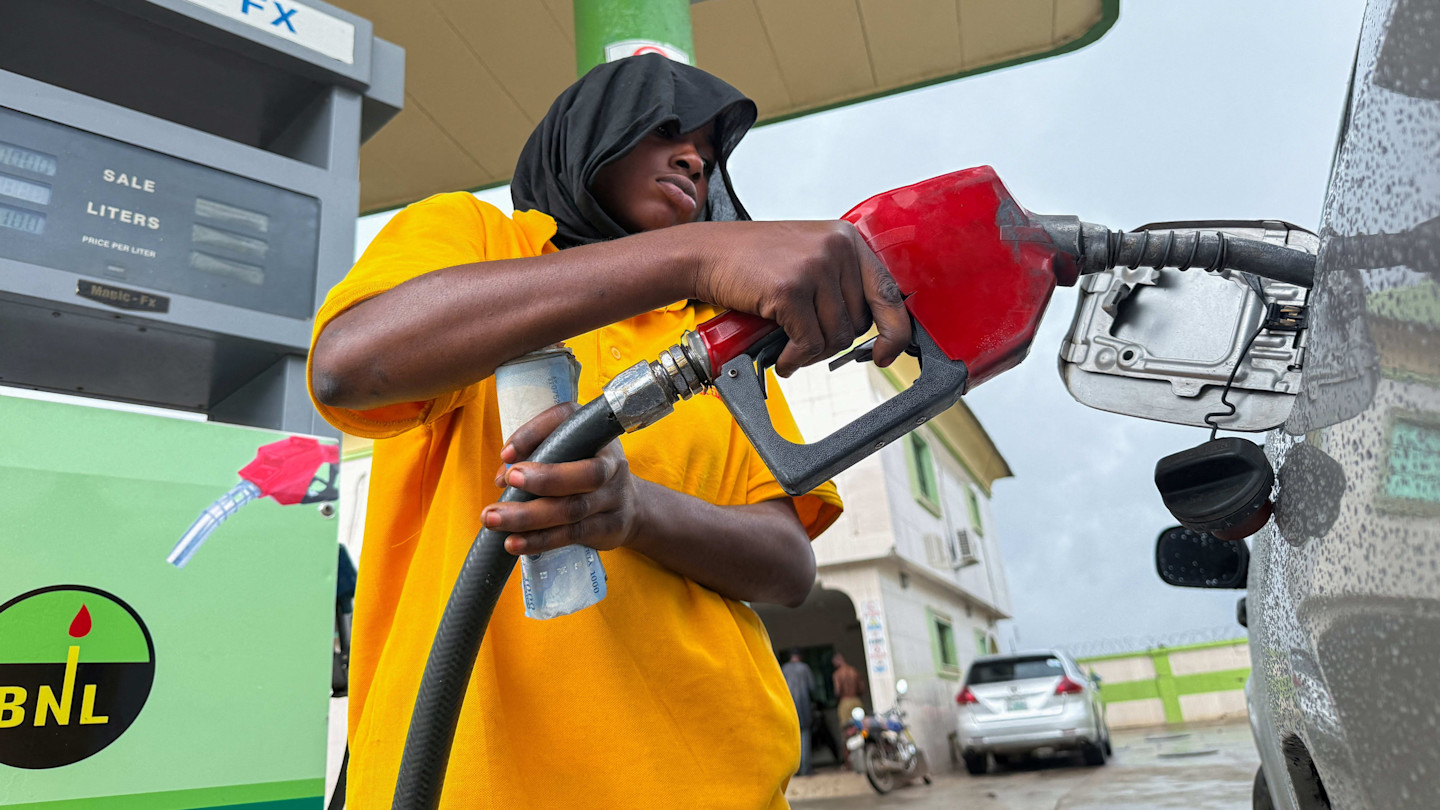
Nigeria has introduced a surprise petrol discount months ahead of an election dominated by voters’ frustrations about sky-high prices, a move that risks unnerving international investors wary about setbacks to its economic reform programme.
Finance Minister Taiwo Oyedele said this week that a 30-day discount would be offered at the hundreds of petrol stations operated by the Nigerian National Petroleum Company (NNPC), the state-owned energy producer.
There has been growing frustration across Nigeria at record-high prices since the beginning of the conflict in the Middle East in February.
NNPC had introduced a N66 ($0.05) per litre discount early last week and said in a statement on Friday that its discount period would now continue until October 31. It has been selling fuel at around N1355 ($1.02) per litre in Lagos and around N1400 ($1.05) across Nigeria.
President Bola Tinubu, who is seeking re-election in January, began an ambitious economic reform programme in 2023 that included the hasty removal of an expensive fuel subsidy, which was becoming fiscally unsustainable, and a shift towards market-based pricing.
Nigerians have been experiencing an intense cost-of-living crisis since then, and analysts pointed to the forthcoming elections as the most likely reason for the move.
But it risks worrying investors who have until now welcomed Tinubu’s efforts but remain wary of the political pressures weighing on Nigeria.
“Investors never like uncertainty. They were caught by surprise by this announcement,” said Razia Khan, the chief economist at Standard Chartered. “The danger is that they are not going to warm to Nigeria when it looks like a backdoor reintroduction of something that resembles a fuel subsidy.”
Officials denied that any steps to reintroduce the fuel subsidy are being taken. “It is not a subsidy. The government is just saying: we sell to you at cost,” said Oyedele on Thursday.
The government said that NNPC would forgo its profit margin and sell at the wholesale price.
Oyedele said negotiations were under way with domestic refiners and importers to introduce a wholesale price ceiling at N1,350 per litre. They would be asked to absorb any costs above that and recoup losses once prices fall.
Nigeria is home to the largest refinery in Africa, owned by industrialist Aliko Dangote, which supplied over two-thirds of the petrol used in the country in August.
Many Nigerians support reintroducing fuel subsidies and Atiku Abubakar, one of the main opposition candidates to Tinubu, has made headlines by promising to do so.
“This is obviously a pre-election sweetener,” said David Olujinmi, a researcher at Lagos-based consultancy SBM Intelligence, adding Tinubu’s All Progressives Congress was feeling the heat building. “They can hear the voice of the street that people want some form of relief when it comes to petrol prices.”
Nigerians, many of whom are reliant on fuel-powered generators for electricity, are especially exposed to price fluctuations. There are a growing number of poorer Nigerians who have taken to sleeping close to their workplaces in the largest cities rather than commuting back to their homes in the suburbs owing to the rising cost of transport.
While the discount was initially announced as a 30-day measure, it is widely expected among analysts that it will stick at least throughout the election period.
“This looks rather rushed through,” said Khan at Standard Chartered, adding that Nigeria needed to pay more attention to how investors internationally would perceive its election moves.
“A lot is going to depend on how long this measure is in place,” she said. “If it lasts well beyond the election, that is a clear fiscal negative. They won’t like that,” adding it could help bring down inflation in the short term.
There is also scepticism about how much what is likely to amount to a small discount, which is being targeted for public transport operators, will do to assuage Nigerians’ concerns.
“It is too little and too late for Nigerians,” said Noelle Okwedy, a Lagos-based analyst with the energy-focused think-tank Enzi Ijayo. “They are campaigning, but it is not pleasing anybody. It is too low for Nigerians and investors are spooked.”