
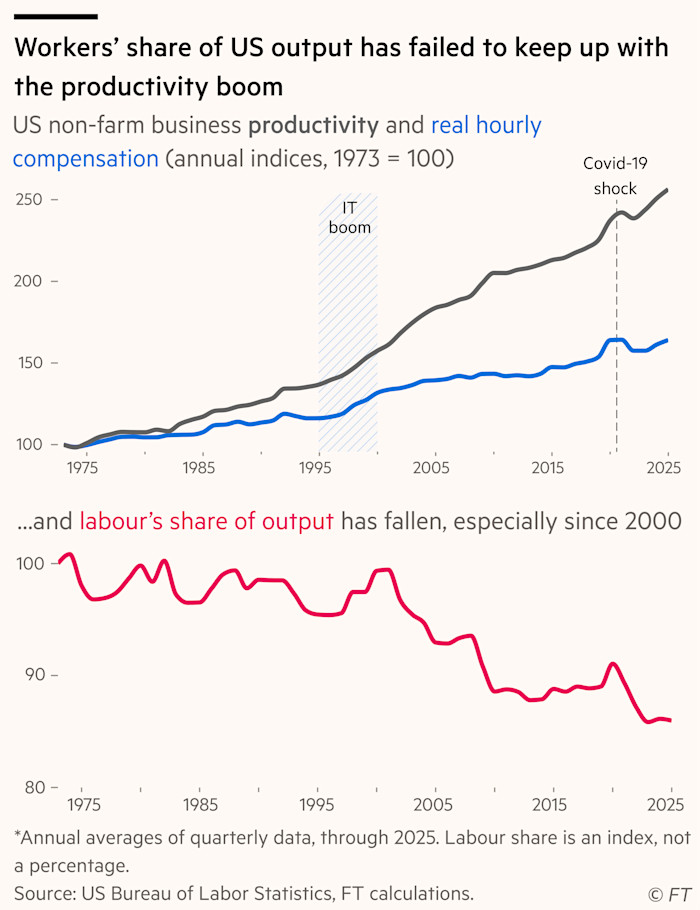
Good morning. Since the 1970s, US businesses have become much more productive. After adjusting for inflation, they produce more than double the value per hour than they did in 1973. Workers’ real hourly compensation — wages and benefits, adjusted for price rises — has risen too, but by much less.
Workers are also receiving a smaller share of the value businesses produce. The labour share of output fell from roughly 63 per cent in 1973 to about 55 per cent in 2025 (this does not mean the rest all went to corporate profits; it also covers costs such as capital depreciation, interest and taxes).
What explains the shift? Offshoring may have shifted some labour-intensive tasks abroad, automation let equipment or software replace workers, and weaker bargaining power could have left workers with less leverage to capture the gains. But the specific causes will vary between industries and between higher- and lower-paid workers.
The accounting also matters. The productivity line is adjusted for prices of business output; compensation is adjusted for consumer prices. That difference explains much of the gap between the two lines before 2000. After 2000, the decline in labour share becomes a larger part of the story, according to the US Bureau of Labor Statistics.
The late-1990s IT investment boom shows how productivity can accelerate. The Covid-19 pandemic shows how measured productivity can jump not necessarily because companies are more efficient but because hours worked fell faster than output. The next productivity boom may come from AI, which may already be chipping away at the bargaining power of workers in the most exposed sectors. The decline in workers’ share is one trend no one wants AI to accelerate.
Send us your thoughts: [email protected].
Good reads from Unhedged
Hakyung: Ecstatic minimalism (New Yorker)
Rob: Tuna renaissance (FT)
Katie: Wine heist (FT)
Daire: Bulldozing utopia (FT)

Can’t get enough of Unhedged? Listen to our new podcast, for a 15-minute dive into the latest markets news and financial headlines, twice a week. Catch up on past editions of the newsletter here.