
Benjamin Netanyahu’s far-right Israeli government has presided over deadly military offensives in Gaza and Lebanon, growing settler violence in the occupied West Bank and a steep fall in the country’s international standing.
His opposition rivals, led by former military chief Gadi Eisenkot, have vowed to repair the damage if they win the knife-edge elections set for October 27.
But among foreign officials and analysts, there is scepticism as to the real scope for change.
Three years after Hamas’s devastating October 7 2023 attack, a former UK Labour minister said they believed the lingering trauma and hardline shift in Israeli society were here to stay — and with them the overwhelming focus on security.
“The idea that [Israel-UK] relations will be OK if Netanyahu loses the autumn elections — I think that is very, very naive,” the person said.
Many allies’ tougher positions on Israel — along with that of the US Democrats — were driven in part by horror at the humanitarian crisis and death toll in Gaza. Even Israel’s relationship with the Trump administration has hit hurdles after Netanyahu publicly rejected a recent US-backed proposal for Gaza and after the joint war in Iran failed to dislodge its regime.
Elisa Ewers, a former senior US official now at the Council on Foreign Relations, said foreign officials need to be “restrained in their expectations”. “There is unlikely to be an immediate, wholesale shift in Israeli security policies. But there will be a change in tone, and changes on the margins . . . Whether that will be enough to chart a new course is the real question.”
Within Israel, most mainstream polls currently show the opposition bloc narrowly ahead of Netanyahu’s far-right coalition, though both remain short of a clear majority.
During the campaign, opposition leaders have maintained that if they win, they will continue striking hard against militant groups across the region. All have attacked Netanyahu for failing to “destroy” Hamas and “eliminate” Iran’s nuclear programme, as he had vowed to do.
Some have sought to outflank Netanyahu from the right. Former prime minister Naftali Bennett has vowed to strike Iran in retaliation for every missile fired on Israel by any armed group in the region. He and his running mate Yair Lapid have also pledged to proscribe Qatar as an enemy state.
One opposition leader told foreign diplomats in Israel at a recent private meeting: “A lot will change, but probably not as much and not as fast as you all would like.”
Pragmatic opposition figures say they understand the urgent need to mend ties with allies and, as one senior opposition official put it, “use diplomacy and not just bomb everything in the Middle East”.
“This current government abandoned all other tools” besides hard military power, the person added. “You need an approach that turns military action into enduring strategic and diplomatic victories . . . and you need to talk to countries that you don’t necessarily agree with.”
But with Netanyahu attacking his rivals as “weak” leftists, the opposition has usually sought to play down such points in public, preferring to focus on domestic issues.
Eisenkot is considered the most likely figure to head a governing coalition if the opposition wins. His centrist Yashar party is polling ahead of Netanyahu’s Likud, but has yet to put forward an official foreign and security policy.
Other opposition leaders include rightwingers such as Bennett and former defence minister Avigdor Liberman; the centrist Lapid, himself a former prime minister; and the leftwing former deputy military chief Yair Golan.
Analysts stress that policies will ultimately depend on the precise make-up of a future governing coalition. But several people familiar with the situation, along with public statements by opposition figures, have set out the contours of an approach focused on halting what they see as the worst excesses of the current far-right government.
A particular focus would be reversing many of the actions of ultranationalist ministers Bezalel Smotrich and Itamar Ben-Gvir, especially in the occupied West Bank.
Eisenkot and other opposition leaders have promised to address ongoing attacks by extremist settlers against Palestinians. The former military chief has called the assaults a deliberate and “dangerous policy” encouraged by the current government, which he labelled “immoral and not Jewish”.
Construction of wildcat settler outposts and sprawling farms considered illegal even under Israeli law would be curtailed and a handful of settlements near Palestinian villages taken down, according to opposition figures and people familiar with the matter.
“At the very least, they will want to send a signal to the international community that there has been a change,” said Shira Efron, an Israel-based senior fellow at the Rand Corporation think-tank.
Functional relations with the Palestinian Authority — which exercises limited self-government in the occupied West Bank — are expected to improve. Efron and other people familiar with the opposition’s thinking said the transfer to Palestinians of some tax revenues and other funds currently withheld by the Israeli government was likely to quietly resume.
Yet at the same time, some opposition leaders have struck a much tougher note on the campaign trail. Liberman has promised to “dismantle” the PA and annul the 1993 Oslo Accords that brought it into being. Most opposition leaders have not signalled any rollback of settlement construction already approved by Netanyahu’s government in the West Bank.
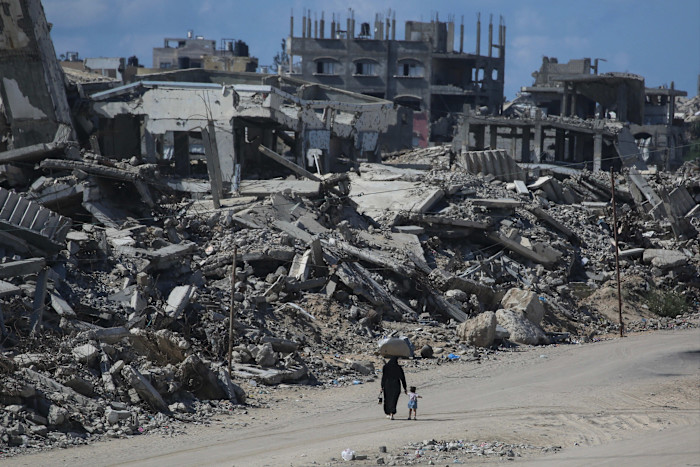
In both Gaza and Lebanon, a wholesale Israeli military withdrawal from self-declared “security zones” it controls remains unlikely as long as Hamas and Hizbollah do not disarm. Yet there is scope for more positive engagement with US-led diplomatic processes, the people said.
Any new government “will want to work with [US President Donald] Trump,” Efron added. “It’s all the small things [included in the respective ceasefire deals] that Netanyahu doesn’t give. There won’t be a flat-out no” from the opposition, she said.
The senior opposition official went further, highlighting that ministers in Netanyahu’s government have talked about pursuing the mass “emigration” of Palestinians from Gaza and building new settlements there.
“Our intentions are completely different, so the end results will be completely different,” the opposition figure said.
One prominent leftwing activist, who asked not to be named, said regarding the occupied West Bank that there was scope to undo “60 to 70 per cent” of the damage of the past four years. Budgets for settlements could be reduced, the police professionalised and the military brought in once more to administer the territory, the activist said, removing it from the hands of hardline pro-settler officials.
But a real shift would entail restraining orders against hundreds of settler extremists, the person added, including removing some 150 illegal outposts and enforcing laws against unlawful construction.
“I don’t see an Eisenkot government waking up in the morning and looking to go head-to-head with the settlers,” the activist said.
On one issue, the opposition has found consensus from both the left and right: there will be no Palestinian state.
Some, like Bennett and Liberman, have long opposed it. They have also advocated annexing more than half of the West Bank — territory that Palestinians hope will be the foundation of a future state. Others, like Lapid and Golan, simply argue it is unrealistic to expect movement on the issue in the near future.
Eisenkot, for his part, likes to say he has never in his life “said the words ‘Palestinian state’”.
Yet he also has argued in past interviews that “annexing 2.8mn Palestinians [in the West Bank] to Israel will be a severe threat to the Zionist project” and said he favoured “separation” between the two peoples.
That contrasts with increasingly explicit support for a Palestinian state among some of Israel’s traditional allies. The UK, Canada and Australia all recognised Palestine last year.
One comparatively easy diplomatic win — at least for the Trump administration— may be found in south-west Syria, said several people familiar with the situation.
Israeli forces hold a wide area of land there, which the military describes as a buffer zone. A security agreement between Israel and the new Syrian government has proven elusive, despite US mediation efforts.
Eisenkot has indicated general support for such a deal, while criticising Netanyahu for the “growing , dangerous distance” between Israeli and US interests in the Middle East.
A person familiar with the matter said the overall message conveyed by one opposition leader directly to the Trump administration was: “Things will change, we’ll do things differently” — but they said it was still unclear what that would mean.
Lapid has argued that the world understands the difference between Israel as a country and the “dangerous, arrogant, negligent and violent” current government. “Things can be fixed,” he said in an August speech.
Others are not as confident.
“The challenge is there may be impossible expectations placed [on any new Israeli government] that can’t be met due to Israel’s own political constraints and so the damage of recent years will be hard to overcome immediately,” Ewers said.
“But any new government will need to make some swift decisions, to open channels [of communication] and take some concrete steps . . . that stop the haemorrhaging, at least.”
Additional reporting by Jim Pickard in London