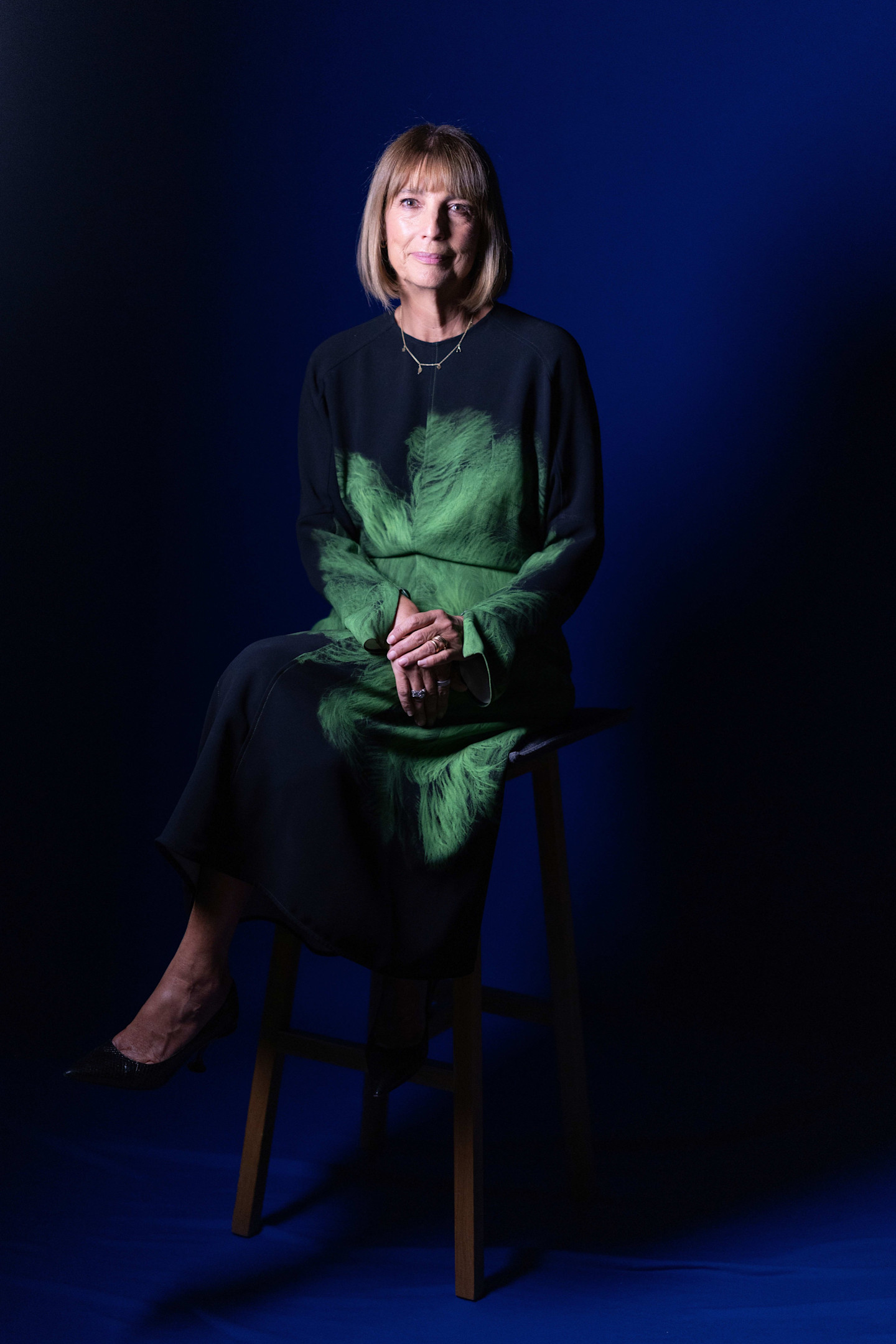
When Dame Carolyn McCall was named the new boss of ITV in 2017, the Daily Mail crowned her “Queen of the FTSE”. The then 55-year-old had led easyJet into the UK’s FTSE 100 index and had grown the airline’s share price by more than 200 per cent over her seven years in charge.
“That was very nice of them,” she tells me, seeming genuinely touched. “I wonder if they’d call me that now.”
Possibly not. Her nearly nine years running Britain’s only listed commercial broadcaster have been tough. Her toughest ever role? “It probably is, actually.” Judging by the ITV share price, down by more than half since she took over, the stint so far has been a let-down. “I don’t feel the queen of anything to be honest, I’ve never felt the queen of anything, but I do feel what we’ve done at ITV has been incredibly important.”
McCall has run businesses — and effected important change — in three very different industries (the Guardian Media Group came before easyJet). A psychoanalyst might put those eclectic tastes, and her hunger for a challenge, down to a childhood in India, Singapore and Australia (with boarding school in the north of England). She dabbled after university with teaching, but found her tribe at GMG. “I loved [market] research . . . and I was really good at sales.” The four decades since have been consistently eventful.
At ITV, the drama of its best-loved shows — from Mr Bates vs the Post Office to Love Island — has been outdone by the company’s own story. McCall’s tenure has coincided with a brutal reshaping of the global television industry, with streaming giants from Netflix to YouTube stealing ever-larger audience shares from old-style channels.
We are speaking in McCall’s open-plan office area at ITV’s White City headquarters (which, oddly, it shares with old rival the BBC). It is barely three months since the group announced its break-up. Sky is set to buy ITV’s broadcast division (all linear channels, the ITVX streaming platform and the group’s share of ITN and local news), leaving behind a rump production arm, ITV Studios.
The deal has been years in the making, but McCall knows it won’t be quick to complete. “It’s a historic transaction for this industry,” she says. A two-phase competition review could last a year.
But she is quietly hopeful regulators will conclude it no longer makes sense to judge old-style terrestrial broadcasters in isolation from the rapidly ascending global streamers.
“[Media regulator] Ofcom . . . have seen . . . the pain in the numbers,” says McCall. “They see how hard it is . . . advertising, overheads, competition, viewer numbers.” Last year YouTube accounted for 15 per cent of overall viewing, and Netflix 9 per cent, both up 1 point, compared with ITV’s 11 per cent, down 1 point, according to Ofcom. Advertising revenue fell 5 per cent.
If only the authorities had taken an enlightened view 16 years ago on “Project Kangaroo” — a plan to pool streaming technology across UK broadcasters. “It was a hugely missed opportunity,” says McCall. “They would have had a head start on technology.”
Like most legacy broadcasters, ITV suffered as Covid pushed Britons towards booming global streamers and geopolitical tensions raised inflation. “We’ve just been in a very negative cycle of cost of living, consumers not feeling confident, businesses therefore not feeling confident [and] that cyclical effect on advertising.”
But macro issues alone do not explain why the ITV break-up seems to have gone down badly with investors. The share price is 20 per cent below where it was when the deal was announced in July.
Uncertainty is the short answer, she says. “It’s not just the length of the [review], it’s the risk. And as the months go on, the risk reduces. I think the share price should respond well to that.” The £950mn promised payout to shareholders will be a big inducement.
But some have said the sale price was too cheap. The headline number of £1.6bn is inflated by a £200mn cashless transfer of Sky assets and a potential £200mn payment that is linked to 2027 advertising sales and not guaranteed. McCall rebuts suggestions she failed to negotiate effectively. “What I haven’t said before is that clearly we didn’t only talk to Sky [and Sky owner] Comcast . . . We did have two other interested parties.” She declines to name them, though says they were both media groups.
The talk of share prices brings us on to McCall’s broader frustration with the stock market. Four years ago, she let it be known she was “totally fed up” with the market’s failure to give ITV credit for the long-term value of its production business. The blame, as she sees it, lies in UK pension funds’ abandonment of the British blue-chips they once anchored: barely 4 per cent of UK-listed equities are owned by UK pension funds, a tenth of the tally a few decades ago. “That figure is horrible, isn’t it? . . . Having access to public markets is important for us as a country. Really important. You can’t just rely on an alternative source of capital like private equity.” Tax incentives should be changed, she says.
The root problem for ITV, of course, is that it is a classic legacy operator in a rapidly disrupting industry. How different from easyJet, itself an arch disrupter in an airline industry that was stuck in its ways.
A childlike smile spreads across McCall’s face. “It was a fantastic place to be,” she reminisces, the burden of ITV’s challenges suddenly forgotten. As she relives the excitement of working until 2am or 3am, answering customer complaints herself and winning over pilots to improve on-time performance from under 50 per cent — “it should have been 80 per cent” — the affection she feels for her easyJet era, and its “massive cultural change”, is obvious.
Could that progress be undermined now that Apollo — part of a private equity industry known for aggressive cost cutting — is acquiring the airline?
“The honest truth is I don’t know. I hope not because it won’t help private equity companies [reputationally]. With airlines, you have to be extremely careful. I mean, safety really has to be number one. You cannot take shortcuts . . . Safety lies with your people.”
Getting people management right has always been McCall’s special strength. At easyJet this meant “treating passengers as customers. Caring about them. Smiling.”
She has also been a keen moderniser, launching the easyJet app — “still the best app in the airline business” — and digitising the Guardian newspaper and the broader Guardian Media Group in the early 2000s.
McCall describes establishing the endowment for the Scott Trust to fund the Guardian long term — an idea suggested by her then chair, the late Paul Myners — as “one of things I am most proud of in my career”.
But lest she leave the impression that, as the politically neutral head of a politically neutral organisation like ITV, she is displaying left-leaning sympathies, she goes on to deliver a cool verdict on Andy Burnham’s new Labour government. Though she likes his “presence, charisma, mentality [and] optimism”, she bemoans the tendency to dream up new policies without being clear how they will be funded.
The net result: “Business confidence is not high and [companies] are protecting profit. And how do you protect profit? By not spending a lot of money on marketing or promotion . . . So that’s a vicious circle.”
Talking about financial stress, I want to know whether the future ITV — shrunk to the production business — will be big enough to survive on its own?
“It’s the second-largest TV production company in the world,” she retorts. The division has grown nearly 40 per cent in the past eight years and McCall makes clear the company and investors want to see ITV Studios as a listed business. But she does point out the fragility of dealmaking with a business that depends on retaining creative talent.
What about the media world beyond ITV? “Netflix is a brilliant company,” she says, but may itself become vulnerable. “They are now quite old . . . and so they’re probably thinking who’s going to disrupt us? Because there’ll be more disruption, especially with AI.”
And McCall herself? She admits the ITV job has been “much harder” than she expected and has lasted twice as long. She is now 65 and is widely expected to exit the broadcaster once the Sky deal is complete.
I thought she’d leave it there, but to my surprise she opens up. “I have done a lot of CEO roles and I think there will come a day where I just say I don’t want to be a CEO.” Chairing a board appeals. During our conversation, she has praised Sir Mike Rake, the former easyJet chair, for the trust he put in her, as well as Myners, for his wise counsel. “If I was ever to be a chairman, which I anticipate I will want to be, I will be a good chairman because I’ve seen what not to do as well as what to do.” Headhunters, take note: the Queen may yet be reanointed.