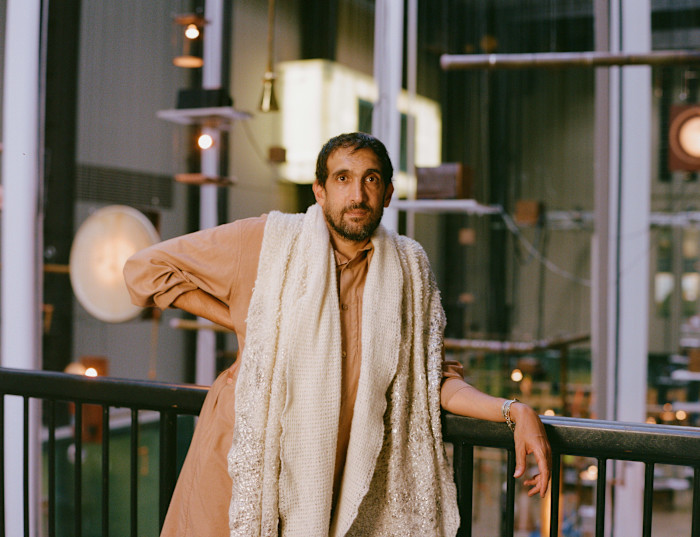
Tate Modern, late September: a major engineering project is taking shape in the Turbine Hall. Workers in hard hats mill purposefully as a mini-forklift manoeuvres large, fissured slabs into place; scissor lifts reach up towards elaborate bamboo pipework; an enormous ox-skin drum is suspended vertically 15 metres up, while huge horns point down; hundreds of wires hang from above. Striding across the hall in colourful garb and boots is a slender but imposing figure: this is the Paris-based, Lebanese sound artist Tarek Atoui, the latest recipient of the Hyundai Commission.
The Turbine Hall is Tate Modern’s defining space and arguably what makes it one of the most visited museum attractions in Europe, but in recent years it has become a contested area. The stick stockades and reindeer skulls of Sámi-Norwegian artist Máret Ánne Sara’s 2025 commission — a response to the threatened way of life of the indigenous community that she was born into — highlighted for some how the Tate has come to favour the politics of issue-based art over the art itself. There have been successes: Kara Walker’s “Fons Americanus” (2019) was well-greeted by critics and public alike. But the greatest hits of the Turbine Hall’s first 25 years, such as Olafur Eliasson’s “The Weather Project” (2003) or Doris Salcedo’s “Shibboleth” (2007) — aka “the crack” — have begun to seem a long time ago.
Against this backdrop, Atoui seems an inspired choice, offering something different and unusual, undaunted by the scale of the setting. His confidence is marked by the narrowing of the choices he’s made. Atoui’s practice is broad, “circulating between the worlds of music and visual art and education”, he explains, as he drains the first of a series of bottled vitamin shots in a bid to stave off a poorly timed illness.
He has explored traditional and ancient ways of making music alongside the digital and artificial; he’s worked with people who are deaf and hard of hearing, examining the different ways that sound is perceived; he has documented the acoustic identities of port cities, mixing history, ecology and memory. Yet for the Turbine Hall commission, he spent time in the environment itself before deciding what instruments could work there.
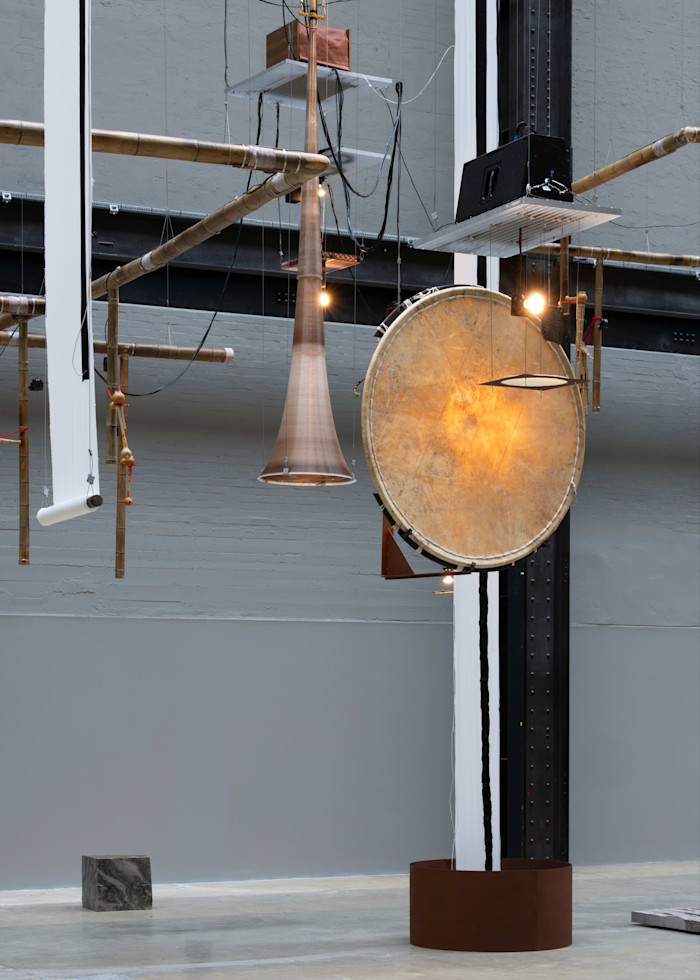
In 2004, Bruce Nauman’s “Raw Materials”, with its echoing spoken-word recordings, baffled many. “I ended up working with a restricted number of families of instruments,” Atoui says, “four of them actually, that I would say have acoustic qualities and sounds that benefit from the reverberance of the space and from the architectural and climatic conditions.” In each family, there might be more than 70 instruments, he stresses; the installation is not about to be swallowed by the size of the hall.
He settled first upon the sheng, a mouth-played pipe instrument that dates back more than three millennia. “You find it from south to north in east Asia, and in every place it’s a different material, with different tuning, different numbers of pipes, but the principle is the same,” he says. “I collected these from across Asia, and even revived ones that were in museum collections.”
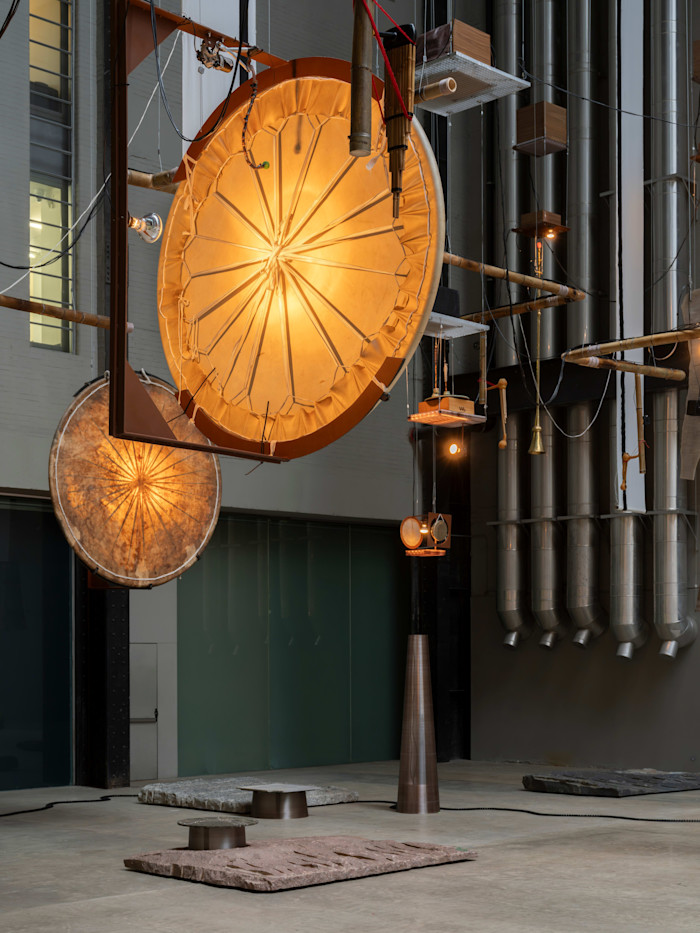
That network of bamboo pipes above our heads will provide the computer-controlled breath that plays them. Then there are the karnai horns, traditional ceremonial instruments of Uzbekistan, blown up in scale via 3D printing from sugar resin and bamboo dust by London-based architect Arthur Mamou-Mani. The mighty Korean drums were made by a master drum-maker near Gwangju. The fourth instrument — a collaboration with clothing designers Satoshi Kondo and Issey Miyake — is a specially developed fabric coated with graphite paint, which conducts electricity, making it an analogue oscillator. The idea originates from Atoui’s work with members of the deaf community: in that project, he used graphite ink to create synthesised bass vibrations, allowing the person drawing with it to make music they could feel. The movement of the 30-metre-long textiles in the air currents of the room will generate music, too.
Finally, there are those stone slabs, which, Atoui says, have speakers within them to “trap the sound . . . by sitting on the stone or leaning against them, you also have this vibrational quality and physical feel of the sound, without it being too loud.”
That’s an apt metaphor for the political element of his work: “I’ve seen projects here that were politically loaded and with a very strong political message,” he says. In his case, “there’s a displacement of the political . . . of being together in a space while speaking another language, the language of music and sound, that can have in it a lot of things that are induced by the political state of the world today, but that is not necessarily addressing them in a [direct] way. Sound allows you to open up this lyrical and imaginative space to talk in a different way.”
Atoui, 46, was born in Beirut five years into the Lebanese civil war, one of the most complex, multi-sided conflicts of our time. “The war was not a daily thing,” he says. “There were moments of intensity that were super intense, when you didn’t even know who was fighting who, and moments when life would be back to normal for a few months, a few weeks. Then it collapsed again.
“Childhood resists war much more than adulthood,” he adds. “You don’t know what a time of peace is, so you have nothing to compare it to.” He was 10 when it ended, yet says it was only when he left to study in France in his late teens that he began to recognise the strangeness of never having learnt to ride a bicycle nor been taken to a park.
Both his parents were teachers, but his mother’s death when he was eight pushed him inside, to immerse himself in books and poetry. As life returned to the streets, and theatres began reopening in his teens, his cultural world expanded. He moved to Reims originally to study business and geopolitics, but was drawn to music via the techno and rave scenes. For Atoui, the underground came before the avant-garde, Aphex Twin before John Cage. It was his interest in experimental electronic music that led to him “travelling backwards in time” to discover the groundbreaking artists of the decades after the second world war — Cage and Ligeti, as well as Xenakis, remain important to him, but he embraces wider influences — architects, craftspeople, film-makers such as Pier Paolo Pasolini and Andrei Tarkovsky, artists such as “deep listening” pioneer Pauline Oliveros and Christian Marclay.
One of the most exciting and innovative elements of the commission will be the more than 40 musicians Atoui has invited to engage with the piece over the course of its run. Here is the influence of the experimental composer Atoui is, matched to his belief in improvisation: “You can come with just a simple instrument like a saxophone and play,” he says. “There are microphones listening to you that will integrate your sound into the composition and transform it as well. But you can also plug in your control machines and use all the instruments, the drums, the flutes, and recompose a piece for the space.”
It’s no surprise that he has also spent time thinking about what has worked in the past. Had I noticed the playful references to what has gone before? The way the central drum nods to Eliasson’s glowing “sun”, and the fissures on the stone slabs to “the crack”? I hadn’t, but I see them now. Perhaps 2mn others will get the chance to see — and hear — for themselves.
October 13-April 11, tate.org.uk