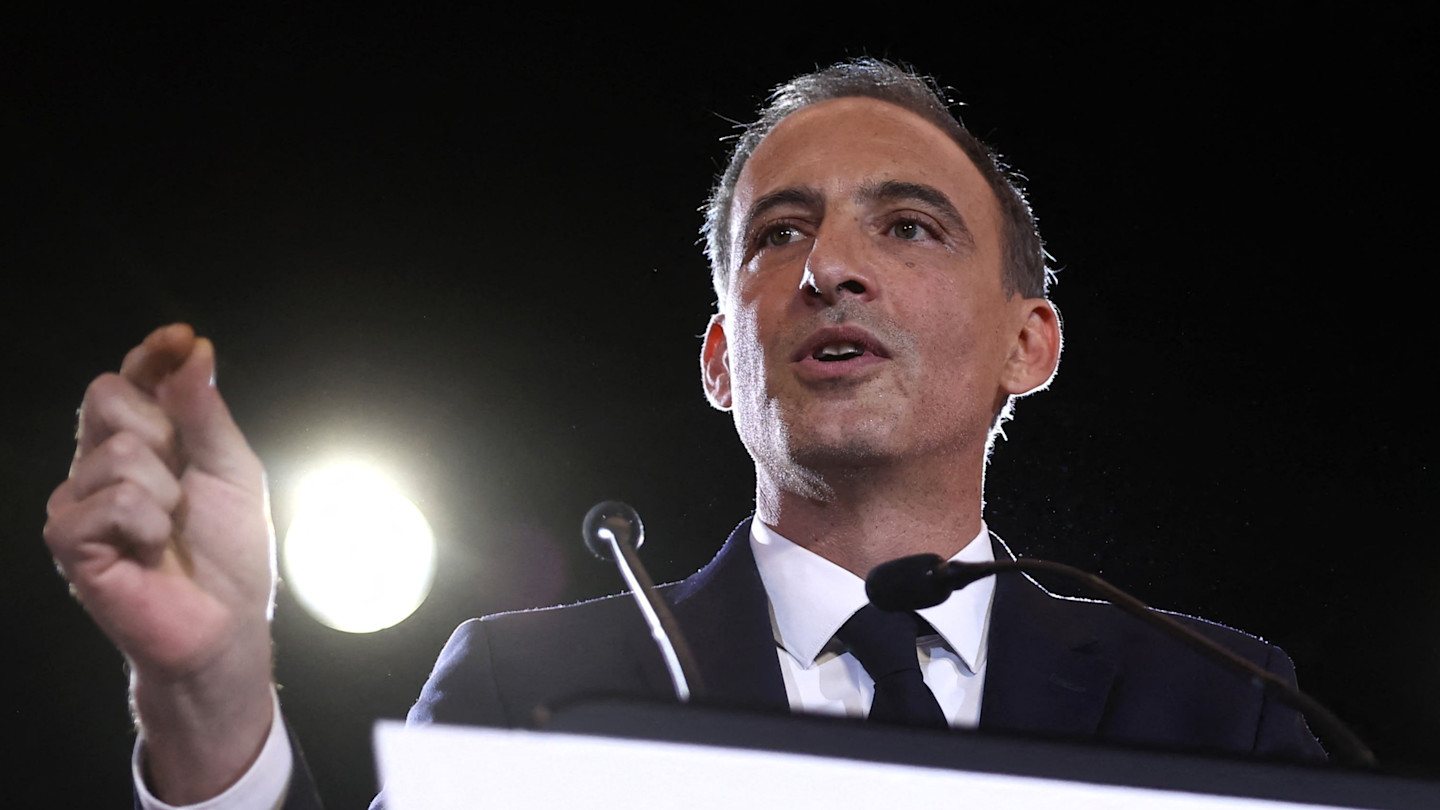
Raphaël Glucksmann has won the nomination of the French centre-left for president, kicking off a campaign that will have long odds of winning in next year’s national vote.
Glucksmann, a pro-European MEP who has little experience of domestic politics, won the first-round primary ballot to represent a block largely made up of supporters of his small Place Publique party and the Socialists with 66 per cent of the vote.
He beat Socialist Party leader Olivier Faure, who came second with 14 per cent, and former Socialist presidential candidate Ségolène Royal, with 7 per cent of the vote.
“My first responsibility is to unite . . . the entire socialist family, and then to unite the entire family of the democratic left,” Glucksmann said following the results on Sunday. “Our real adversary is the far right, and we will unite to go into battle and prevent the Trump supporters, the Putin supporters, the xenophobes, and the demagogues from seizing control of the Republic.”
The 46-year-old activist and writer turned politician becomes the chosen candidate for a portion of France’s leftist parties, but the block remains fragmented. Far-left candidate Jean-Luc Mélenchon has been gaining in the polls, while Communist Party leader Fabien Roussel, Green party head Marine Tondelier and independent François Ruffin, who split from Mélenchon’s La France Insoumise, are all running on their own ticket.
So far no alliance has been forged among the diverse parties, splitting the left’s vote.
Glucksmann is currently polling in fourth nationally at 11 per cent, according to the most recent poll from Ifop that tested the scenario that Glucksmann won the primary. He has failed to gain significant momentum since he declared his candidacy in August. However, his win in the primary has secured him the financial and organisational backing of the much larger Socialist party.
He is still far behind Rassemblement National’s Marine Le Pen, who has consistently held a large lead and is polling at 32 per cent, raising the possibility that a far-right leader will take the Élysée for the first time. In the Ifop scenario, Mélenchon is now vying for second place with centrist Édouard Philippe, with 15 and 16 per cent of the vote each.
The results of the primary were delayed from Saturday night after the Socialists said the vote had been disrupted by a cyber attack, although the party has not named a perpetrator or identified a motive for the incident.
“The intervention of technical experts confirmed that there was no alteration to the integrity of the election and that the votes were properly recorded,” the party said.
Glucksmann’s challenge will be to close the gap with Mélenchon, his longtime antagonist on the left, in order to convince leftwing voters to fall in with him instead.
Glucksmann launched Place Publique in 2018, gaining national prominence after leading a joint list with the Socialists to come third in European elections in 2024.
The son of an activist intellectual family, Glucksmann has campaigned on promises to boost workers’ pay, levy more taxes on large inheritances and rescue France’s struggling public schools, an issue which has generated large-scale protests across the country in recent weeks. A longtime critic of Russia, he has also supported stronger European defence and support for Ukraine.