Welcome to Trade Secrets. Well, EU trade commissioner Maroš Šefčovič went to Beijing and came back with an “understanding” over hybrid cars where the EU implicitly sets an import quota that China accepts. I guess that beats having a misunderstanding but, quite apart from being a retrograde step to managed trade, it’s a short-term fix rather than an actual solution. I’ll address the EU strategy towards China at more length later in the week, with the Council of EU member states meeting on Thursday and Friday.
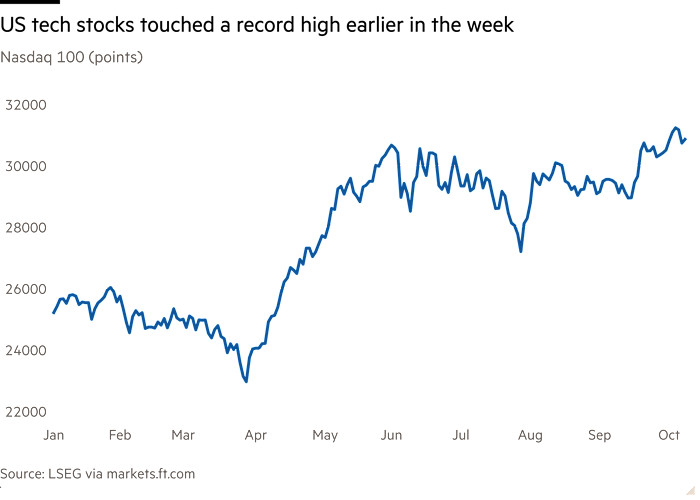
Today I’ll look at how we got here and why the EU hasn’t yet used the tools it has spent years putting in its bag. Charted Waters, where we look at the data behind world trade, is on stock prices.
This Thursday from 1-2pm UK time my colleague Soumaya Keynes and I will be doing an online Q&A for readers. Please drop in and ask us something difficult, or praise us lavishly — either is fine. It’s only an hour — how bad could it be?
Get in touch. Email me at [email protected]
Another fine Merz EU’ve got Xi into
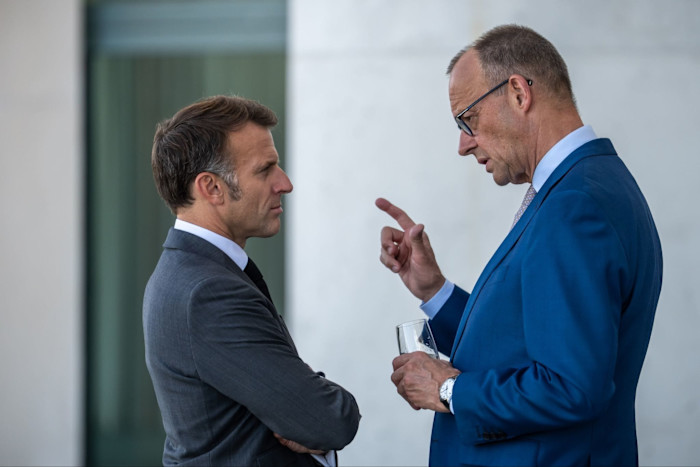
I’m not sure that headline quite describes the situation, but having come up with it I couldn’t not use it. I’m only human. Last week’s Franco-German kite-flying on the future of trade policy got a lot of attention, possibly more than it deserved. In technical terms it was vague, especially the general hand-waving exhortation to reform and increase the use of existing trade defence instruments (TDIs), such as anti-dumping duties. The EU might try to replicate its hybrids deal in other sectors, but it’s unlikely broadly to retool trade with China without some muscle to back it up.
The proposed new “instrument for decisive and systemic reaction” looks a great deal to me like the existing anti-coercion instrument (ACI), except that a qualified (weighted) majority of member states is needed to block rather than authorise it. This strikes me as a distinction without a practical difference: if France and Germany really threw their weight behind designating a trading partner’s actions as “coercive”, enough others would come on board to give them the numbers. At least they didn’t call it a “bazooka”, so that’s something.
Its real import would be political, to signal that Germany has finally and definitively joined the activist camp that seeks to use trade and other tools to take on China. Given German Chancellor Friedrich Merz’s habitual vacillation on the subject and the likelihood of reprisals from Beijing, whether Berlin will commit remains highly uncertain. Everyone has a battle plan for trade war until they get retaliatory punches in the face.
Concern among German companies about China doesn’t necessarily translate into a thirst for conflict, especially when retaliation starts. A survey of companies by the German Chamber of Commerce and Industry last month showed a solid 60 per cent of respondents wanting to reduce strategic dependencies, but only 36 per cent wanting to restrict access to the EU single market and just 31 per cent wanting more use of TDIs.
I’ve watched these instruments — the ACI, the International Procurement Instrument, the Foreign Subsidies Regulation — pile ever higher over the past few years. I’ve seen anxiety about China increase. It was already being designated an “economic competitor” and “systemic rival” in the EU’s supposedly pivotal China strategy published in 2019, which itself drew inspiration from a paper by the German Bundesverband der Deutschen Industrie (BDI) business group. And yet I’ve seen these tools lie there chronically underused.
There are some creative ideas about strategies. Andrew Small of the European Council on Foreign Relations suggests a “swarm” tactic whereby multiple instruments are deployed at once, each on its own hopefully not enough to provoke a fierce retaliation from China but together having an impact. The idea is that co-ordination across different tools and sectors — time and again there’s a single instrument trying to achieve too much — would be what our friends in the armed forces call a force multiplier.
But it remains the case that the most important missing element in the EU’s trade strategy towards China isn’t weaponry or tactics: it’s a willingness to fight. I for one will need more than a vague three-page note to believe that Germany has done a fundamental shift.
The US’s absurd tariff ambitions have crashed to Earth
Scott Bessent isn’t going to the IMF-World Bank meetings this week. I bet everyone is tremendously disappointed, what with the US Treasury secretary’s entertaining display of hubris and then capitulation in the face of bond markets, like a Shakespearean tragedy compressed into a one-act sketch and played for laughs. Attendees will no doubt also miss his signature ability to aim for wit and crash-land in petulance.
He’s not the only thing missing. So, in fact, is any semblance of a coherent US economic and trade policy. With the midterm elections a few weeks away, let’s take stock of what President Donald Trump’s administration has achieved trying to use trade and tariffs to wider ends. As with policy across a bunch of areas, this year the administration has largely checked out and spends most of its time ignoring or repairing damage. It’s fortunate that distracting from this is an AI boom that has produced GDP growth, rising stock prices and continued expansion of trade. For now.
The administration came into office talking about using tariffs to coerce countries into obeisance on security and trade matters. It’s worth revisiting Bessent’s astonishing misjudgment about what a powerful instrument of leverage they would be. His confidence in his mastery of economic history turned out to be horrifically mistaken. Another administration official, Stephen Miran, laughably said tariffs were going to be so effective that they would force other countries into a “Mar-a-Lago accord” that would weaken the dollar and push them to lend to the US by buying extremely long-dated bonds.
We spent 2025 finding out that coercion didn’t really work. Canada and Greenland remain unannexed. (Trump’s recent deal with Greenland was something the US could have done before.)
We’ve spent most of 2026 watching the administration repair damage in the form of reconstructing the tariffs declared unconstitutional by the US Supreme Court, and then Bessent himself flailing around trying to stem the big drops in bond prices. There haven’t really been any large new initiatives in trade policy. The administration has kept the US-Mexico-Canada (USMCA) trade deal alive to try to use it as leverage to get more concessions from its two neighbours. That is failing: Canadian Prime Minister Mark Carney called Washington’s bluff.
The coercive “gunboat” deals have provoked some changes, but haven’t fundamentally remade the world trading system and certainly haven’t closed the US deficit. The Mar-a-Lago accord remains firmly discordant.
It’s not often you see such a clear-cut example of a government whose view of the world was clearly and simply proved to be so completely wrong in such a short space of time. If I were Bessent I’d be hiding too.
Charted waters
And still the bubble inflates.
Trade links
The FT opines that the global economy has shown robust growth but is worryingly dependent on AI.
So, says FT markets columnist Katie Martin, are investors’ portfolios.
Speaking of the EU and China, the bloc’s most prominent Beijing-friendly (and pro-immigration) head of government, Spanish Prime Minister Pedro Sánchez, might be leaving the scene after he called a snap election last week for November, largely over domestic issues.
Experts say that Trump’s deal with President Vladimir Putin that calls for Russia to send diesel to the US probably won’t do very much to reduce prices.
Trade Secrets is edited by Harvey Nriapia