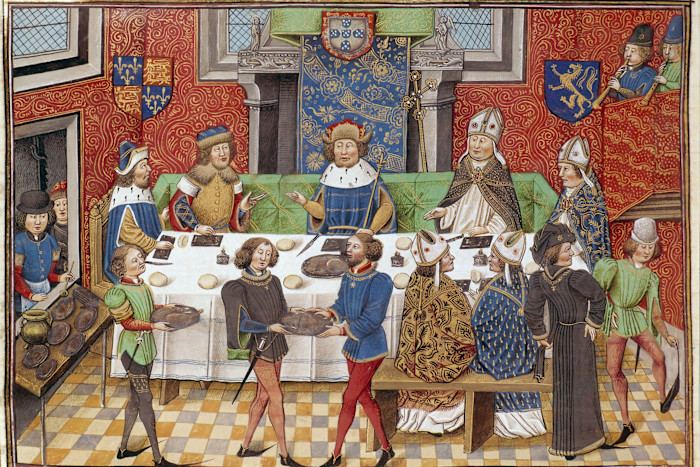
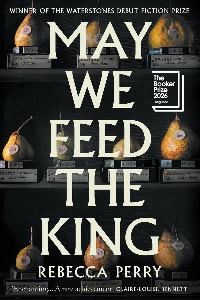
For centuries, powerful rulers have withheld decent meals from their own workers while overindulging themselves — all to maintain the imbalance in power between them. Rebecca Perry’s debut novel May We Feed the King, which was published in the UK in January and in the US in September, focuses on the output of a medieval kitchen to illuminate all aspects of courtly life.
Perry is the author of two poetry collections, a lyrical memoir and several pamphlets, and her novel has already won this year’s Waterstones Debut Fiction Prize and is shortlisted for the Booker Prize. Her control of the language is one of the novel’s greatest pleasures. Every word is exquisitely chosen, with many consciously conveying both a taste for flavour and a grab for power, relying on multiple meanings of “appetite” or “constitution”.
The novel opens in the present day with an unnamed protagonist detailing her latest commission in a medieval castle. Her job is to curate “semi-permanent scenes (domestic, culinary and otherwise)”. The curator is particularly interested in how replica foods, purchased online, can be combined with authentic furniture, clothing, soundscapes and scents, to capture the atmosphere of historical spaces, from a devoted nun’s bedroom to the final meal of treasonous plotters. “The rule is this: it must appear as if the person or people have just left the room.”
Most of what we learn about the curator is reflected through her work, which “has sustained me when people could not”. There are allusions to a previous break-up but little interrupts her research, except a developing relationship with the castle’s archivist.
In the first section of the novel, the curator trawls through centuries of ledgers, looking for a historical figure to build her scene around. She briefly considers the “Apple King”, an abdicating stain on the castle’s history, but she settles for a monarch who occupies only a single page in the records, which has been “altered, challenged, embellished, struck through, left to rest as one great question mark by people who damned him [ . . . ] What a reduction of a life.”
The curator is careful to warn us that all we can know from archives are specific facts — “a commission to the embroiderer, a tally of the kitchen’s dry store” — but the novel’s second section plunges us into the Middle Ages. The King’s world is described not with dates or maps but through plots and gossip and the intoxicating details of indulgence. The new King is sympathetic and gentle, reluctant to undertake any of the primary responsibilities of a medieval monarch: “[he] is horrified by the regularity with which he is expected to sign away life”. Once in the role, his appetite shrinks. His impotence is frustrating to his advisers, and it is also a source of rumour across the court.
The Queen’s affair with the assistant to the royal physician is an open secret, while the King develops a close relationship with his young male attendant. When the Queen’s cousin’s wife comes to visit, it seems to the court that she is there solely to create scandal. Every lady-in-waiting hears something different about what the King is up to in his private quarters.
The creation of a single, dominant storyline out of the barest facts, “the notion that one thing leads to another and then another and then done”, is precisely what the curator seeks to avoid in her work. She considers it her responsibility to use history to present all possible interpretations, an ethos that she communicates in a lecture in the final section.
This world is thrilling when seen through both the King and the curator’s eyes; it depends on the glistening meat of his coronation feast and the replica spit roast of the curator’s scene to bring back to life something that seemed long dead.
May We Feed the King by Rebecca Perry Granta £14.99/Transit Books $18.95, 272 pages
Join our online book group on Facebook at FT Books Café and follow FT Weekend on Instagram, Bluesky and X