I have a problem with Paddington Bear. Whenever I travel through his namesake station in west London, a queue of people is waiting to be photographed with a bronze statue of the character, perched on his suitcase, by platform one. Paddington, who was sent to London from Peru and has a tag reading “Please look after this bear. Thank you”, has come to represent wonderful values: immigration, integration, tolerance, diversity. And yet its cuteness tends to crowd out its message.
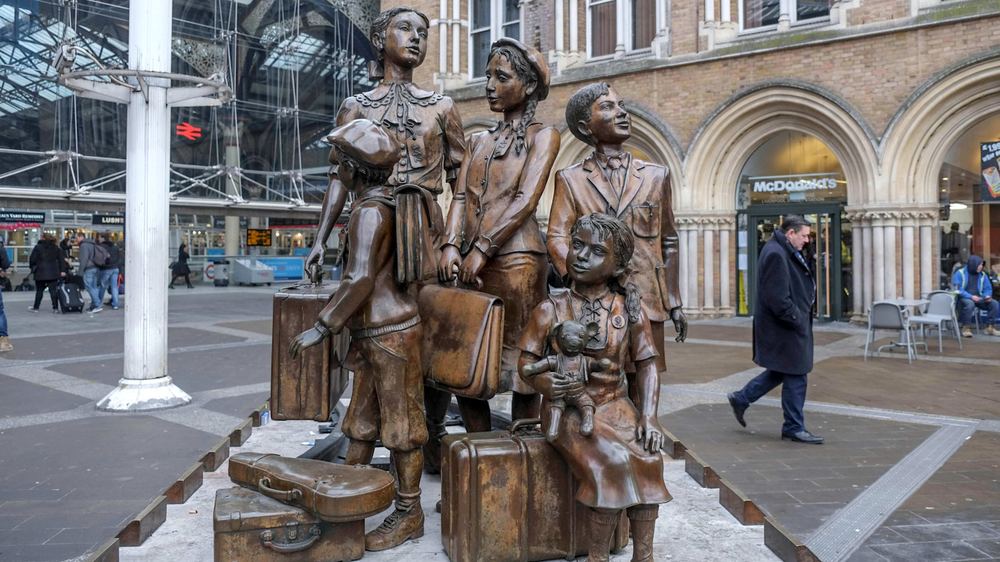
Across town at Liverpool Street station is another statue, standing for many of the same things: a bronze depiction of a group of children, also with suitcases, at the end of railway tracks. These are some of the 10,000 children who arrived in the UK between 1938 and 1939 as part of the Kindertransport, young Jewish people being sent to safety out of the jaws of the Third Reich. I have never seen people pose for photos with this statue: they sit on its plinth and plonk down their purchases from the neighbouring McDonald’s.
Liverpool Street station — managed by Network Rail, like Paddington — will be undergoing an extensive renovation in the coming years and the architects have made a point of moving the Kindertransport statue, albeit with a slightly optimistic estimation of its current stature. “The Kindertransport Memorial remains a prominent focal point, repositioned within this space,” says Acme’s website, which depicts it outside a new brick-vaulted entrance.
Train stations make sense for such statues. First, movement is inherent to migration, and they may have direct connections to the events memorialised. There is something to be said for numbers too: Liverpool Street, the country’s busiest railway station, had 98mn passenger entries and exits in the year to March 2025. That’s a lot of eyes.
But Friedrich Ludewig, Acme’s founding director, acknowledges that a train station is “not a particularly respectful context [for a statue] because the world around you is rushing through”, and says that the Kindertransport Memorial is little remarked. He has observed a similar, dispiriting lack of engagement with the National Windrush Monument at Waterloo station, which depicts a family atop their suitcases, celebrating the Caribbean people who arrived in the UK after the second world war to help rebuild the country.
Acme’s initial plan for the station overhaul was to marry the Kindertransport Memorial with a floral planter, but this evolved after engagement with the Jewish community, says Ludewig. “They felt we were undermining a bit too much what the memorial should be talking about: being slightly lost, being dumped in front of a station, quite a lot of fear, ‘What am I going to do?’” Prettification — Paddingtonisation — would be the wrong approach; instead, the memorial will be raised, with integrated seating, in the hope of prompting more interaction (and fewer McFlurries).
Ludewig is frank about what does attract crowds: the Kindertransport Memorial is “the opposite of Platform 9 3/4 in King’s Cross, and it doesn’t have a gift shop”, he says, referring to the sculpture of suitcases half-disappeared into a wall leading to the imaginary platform used by wizard Harry Potter.
Eleanor Pinfield, head of Art on the Underground, says that the Kindertransport is “such a central narrative of the nation . . . yet probably invisible beyond this statue”. What our public sculpture does, she adds, is “signpost a value and create a collective value”.
But what happens when we forget what that value is and the memorials no longer prompt memories? Statues can be torn down or have their meaning evaporate as historical knowledge fades. Besides, the relevance of public images has no doubt weakened as we walk around in our own worlds, our heads screen-locked.
Suitcases are a leitmotif of these works because these stations are transitional spaces, places where we are in between and even a little vulnerable, whether tourists or people fleeing for their lives. But not all these bronze suitcases — and their bearers — are created equal. We need to find a way to open our eyes to historical lessons, not just cuddly fictions.