Zambia has received enough support from bondholders to buy back its 2053 dollar debt in full, after offering an extra $65 million to pull in a group of holdout creditors that resisted the transaction.
Participation in the tender offer launched at the end of last month has exceeded 75%, according to people familiar with the matter who asked not to be named because the information isn’t public. That level allows Zambia to force any remaining holders to sell their notes. Under the terms of the deal, creditors will receive 84.35 cents on the dollar, with the price falling toward 82.76 cents the closer support gets to 100%.
The transaction appeared in jeopardy last week, with a creditor group owning more than 25% of the securities declining to participate at the original terms. That threatened to scupper what the Zambian government called the first-ever debt-for-development swap focused on the energy sector.
In response, Zambia raised its offer from the original 78 cents and extended the acceptance deadline to June 9 from June 5. The holdout group, represented by Cleary Gottlieb Steen & Hamilton LLP, said shortly after that it intended to participate in the revised offer, removing the principal obstacle to completion.
Power Access
A successful buyback of the $1.36 billion of bonds will clear the way for Zambia to proceed with the swap, backed by a $600 million loan from the African Development Bank. The government will channel $275 million in savings from the buyback into the electricity grid in a nation where about half the population lacks access to power.
S&P Global Ratings called the offer “an opportunistic liability management operation,” adding that the government would have been able to “service the bond on time and in full” had it not opted for the buyback, given the improving macro-economic backdrop.
The improved tender price is “probably attractive for bondholders to accept,” according to Carlos de Sousa, emerging markets portfolio manager at Vontobel Asset Management.
“The route they’ve chosen, and probably the best for the sovereign, is to borrow from a multilateral, the African Development Bank, to repurchase the bond,” he said. “Most developing countries would be better off having a debt composition that is more skewed toward concessional borrowing and less commercial.”
Zambia’s finance ministry directed queries seeking comment to Sodali & Co., the firm helping with the tender, which didn’t immediately respond.
Upcoming Elections
Speculation had swirled that holdout investors stood to benefit from a step-up in coupon payments to 7.5% in December, from 0.5%, giving some an incentive to stay out. Zambia said Thursday that it hadn’t met a key debt-sustainability metric needed to trigger the increase, undercutting that argument.
Another complicating factor is that Zambia is currently without a finance minister. The cabinet was dissolved ahead of the August general elections, in which President Hakainde Hichilema is seeking a second term. The winner will only form a new government after the vote, when his administration plans to conclude talks with the International Monetary Fund for a new program.
Still, the government indicated it planned to return to the international bond market as soon as possible after the elections, and called on investors to express their interest to Citigroup Inc., the bank managing the deal. It’s unclear if a new IMF program would permit new commercial borrowing — the one that ended in January didn’t.
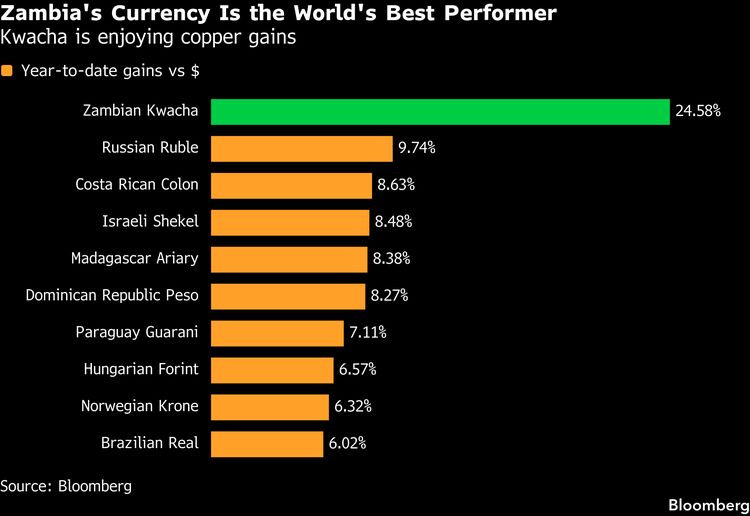
Zambia, Africa’s second-biggest copper producer, has rebounded strongly after becoming the continent’s first pandemic-era sovereign defaulter. Increasing metals prices and output have helped to grow foreign exchange reserves to a record, while the government worked through a years-long debt restructuring process.
The nation’s kwacha is by far the best performer this year among currencies tracked by Bloomberg, and inflation has dipped to the lowest since 2018.
The 2053 notes were indicated 0.15 cents higher at 82.61 cents on the dollar on Tuesday.