Indonesia’s central bank took aggressive action to reverse a market selloff and support its currency, hiking interest rates in a surprise decision to halt foreign outflows triggered by policy uncertainty under President Prabowo Subianto.
Bank Indonesia raised its benchmark BI-Rate by 25 basis points to 5.5% on Tuesday, more than a week ahead of its next scheduled meeting, when analysts expect further increases.
The country’s rupiah has hit successive record lows, bond yields have soared and the stock market has plunged amid a swirl of concerns over Prabowo’s spending plans, policy interventions and populist economic agenda. Worries over MSCI Inc.’s decision on whether to downgrade Indonesia has also cast a months-long shadow over its stock market.
In another move that could unnerve investors, two officials widely talked about in local media as potential replacements for Finance Minister Purbaya Yudhi Sadewa were spotted visiting the presidential palace in Jakarta late Tuesday.
Economist Chatib Basri, a member of Prabowo’s economic council, downplayed questions about joining the cabinet while Health Minister Budi Gunadi Sadikin, asked about the purpose of his visit, avoided answering reporters.
The surprise rate decision “does show a sense of proactiveness in preventing any further backsliding in sentiment,” said Oversea-Chinese Banking Corp. economist Lavanya Venkateswaran. “However, its sustainability will also depend on clearer policy direction of the broader authorities to address perceived risks around recent announcements.”
Angus MacKintosh, an analyst at Aletheia Capital, was more blunt: “In some ways, this smacks of desperation.”

The early response from equity and currency markets was positive. Indonesia’s benchmark stock index extended gains to over 7%, the most in more than six years, led by banking stocks. “Stemming the currency decline may help to stimulate local buying,” MacKintosh said.
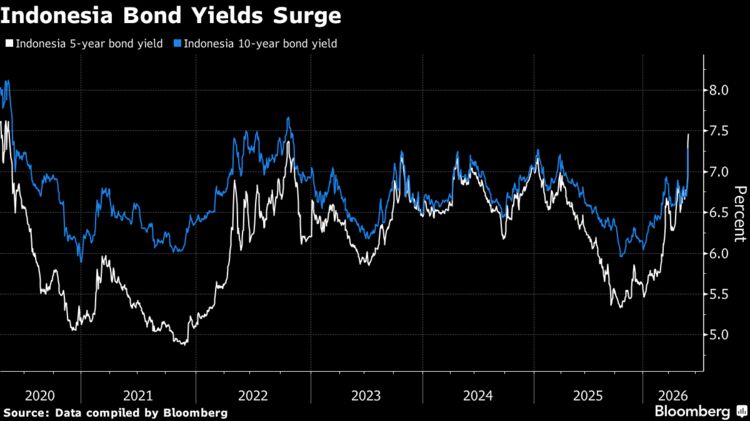
The rupiah was also up 0.7% against the US dollar, retreating from the record low on Monday. But government bonds · continued to sell off, with yields on the 10-year note climbing 23 basis points.
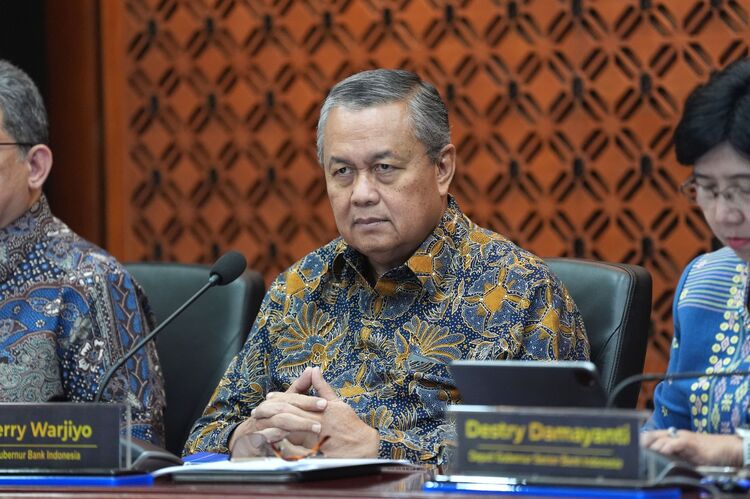
Bank Indonesia Governor Perry Warjiyo plans to host a call with international investors to explain the off-cycle BI rate hike later this evening for people in the US and Europe, and again on Wednesday morning for those in Asia, people familiar with the matter said, declining to be identified because the details are private.
Bank Indonesia regularly holds investor calls after a rate decision, although they’re not often hosted by the governor himself.
Analysts do expect the central bank to take more action. Barclays Plc, BNY and PT Mega Capital Sekuritas said after the decision that they expect further rate hikes at the June 18 meeting, with another 50-basis point increase a possibility.
Higher interest rates can support a currency by making local bonds and deposits more attractive to global investors, helping draw in capital flows. That may provide just temporary relief, according to Capital Economics.
“What investors are looking for are a shift in the policy direction of President Prabowo and his government, and so far that doesn’t seem to be in the works,” said Jason Tuvey, its deputy chief emerging markets economist.
Under Prabowo, the finance ministry and central bank have coordinated even more closely on fiscal and monetary policy to help stabilize markets and restore investor confidence.
“The already strong fiscal-monetary coordination will be continuously strengthened and sustained over time to remain mutually supportive and aligned,” BI said in its statement Tuesday.
But investors have also balked at Prabowo’s move to appoint his nephew to the central bank’s top leadership. A law passed last week also expands the bank’s mandate to boost economic growth, and subjects its officials to a performance evaluation by parliament.
Read More: Bank Indonesia Gets New Growth Mandate, Parliament Oversight
Bank Indonesia and the government had pledged on Saturday to join forces to boost the appeal of Indonesian assets and attract portfolio inflows. That did little to encourage markets, with the sell off continuing when markets opened Monday.
The central bank has now raised the rate by 75 basis points over three weeks, following a larger-than-expected 50 basis-point hike in May. While that raises borrowing costs, Warjiyo told parliament Tuesday that the latest increase was to attract foreign inflows.
Warjiyo also pledged to keep intervening to stabilize the rupiah, even as Bank Indonesia’s sustained currency defense has drained its foreign exchange holdings. Reserves fell for a fifth month in May, the longest losing streak since 2018.
The rupiah is the biggest loser among major currencies this year, weakening nearly 8% against the greenback. The Indonesian stock market’s 35% drop has also made it the world’s worst performer.
It is the second off-cycle rate increase under Warjiyo since he took the reins at Bank Indonesia about eight years ago. In May 2018, the central bank raised the benchmark rate by 25 basis points to counter an emerging-market selloff triggered by rising US interest rates.
“This increase is a follow-up measure to strengthen the stabilization of the rupiah exchange rate against the impact of heightened global volatility caused by the war in the Middle East,” the central bank said in a statement.
It also “sees the need to take further steps to strengthen the stabilization of the rupiah exchange rate by raising yields and offering various incentives to encourage foreign inflows.” Those further steps include:
- Intensify its interventions in both onshore and offshore markets to stabilize the currency
- Raise the yields on its rupiah-denominated securities
- Reduce the hedging swap rate by 10% to “compensate for the costs that investors currently bear.” Meanwhile, the regular swap rates will be determined in accordance with market mechanisms
- Reopen the repurchase agreement auction for 3, 6, 9, 12-month tenors for banks to ensure sufficient liquidity in the money and banking markets. The move is aimed at maintaining primary money growth above 10%
- Monitor banks and corporations that buy dollars in bulk to ensure they have underlying documents