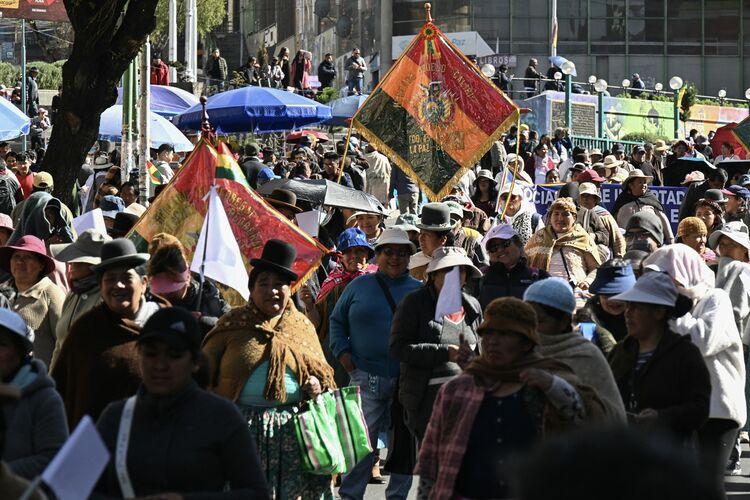
Bolivia’s embattled President Rodrigo Paz signed a measure that clears the way for a more aggressive crackdown on anti-government protests that have rocked the South American country for more than five weeks.
In the presence of top military commanders at the presidential palace on Monday, Paz promulgated legislation that eases the state’s ability to impose emergency measures amid escalating clashes between security forces and protesters. The demonstrations are led by the national labor union, the La Paz farmers federation and former president Evo Morales.
More than 90 road blockades have sapped food, fuel and medical supplies, especially around the administrative capital of La Paz and neighboring El Alto. Counter-protests have added to the turmoil.
“A clear message to the armed forces and police: You have the responsibility of safeguarding our future,” the president said in La Paz. He urged them to act firmly but with respect for human rights and the constitution.
“Bolivia is in danger because of narco-terrorism,” Paz said, adding that legitimate popular grievances have been hijacked by drug-trafficking organizations.
The unrest caused an estimated 10 deaths and 37 injured between May 1 and June 2, according to the latest data from the Defensoría del Pueblo, an ombudsman. The autonomous agency reported another 33 injured, including 26 civilians and seven police officers, in a June 6 clash in San Julián in the eastern department of Santa Cruz.
In another incident in San Carlos municipality in Santa Cruz Monday, protesters torched a police station administrated by a government anti-narcotics force.
The protesters are demanding Paz’s resignation.
Read More: Bolivia Lowers Emergency Measures Threshold as Protests Grow
The legislation that enables Paz to issue a decree that temporarily suspends certain individual rights was approved by the lower house on Sunday after passing the Senate on Thursday. Paz has not yet issued a decree.
Over the weekend, the national labor union, or COB, denounced the arrests of five protest leaders while blackouts have hit the Chapare region where Morales is believed to be holed up.
The US, Chile and other Latin American countries have delivered aid and issued declarations of support for Paz, who took office in November on a pro-investment platform aligned with the Trump administration. The latest message of support came from Panama on Monday morning.
US Secretary of State Marco Rubio spoke with Paz on June 4 to reaffirm US support. Chile’s Foreign Affairs Minister Francisco Pérez Mackenna said Monday the government would send additional aid to Bolivia this month.
‘Democracy Test’
Paz has framed the ongoing crisis as a test of Bolivia’s democracy following two decades of socialist rule.
In a social media post on Monday, Morales blamed Paz for fostering the internecine conflict. His responsibility is to resolve structural problems “not promote polarization, stigmatization and confrontations,” Morales said on X .
COB and the La Paz farmers federation, or Tupac Katari, which once supported Paz, are among the groups organizing the blockades. Their leaders expressed anger at having been excluded from the government’s decision-making process, among other grievances.
Bolivia has undergone violent spasms in the past “but none has ever been so prolonged and indefinite, and this has been one of the most violent,” said Bolivian human rights lawyer Ramiro Orias, program director at the Due Process of Law Foundation in Bolivia.
The government has not done enough to preserve order, while “the protesting groups have also refused to sit down to negotiate unless President Paz’s resignation is discussed first,” Orias added. “So a peaceful and negotiated solution does not appear likely anytime soon.”