By Liam Denning | Updated on Jun 09, 2026 at 11:00 AM
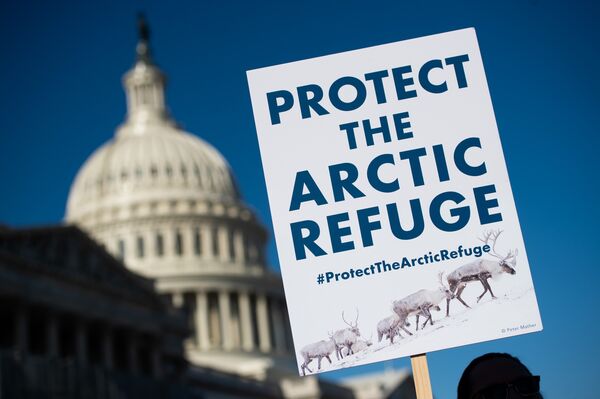
The Department of the Interior adopted a style best described as delusional triumphalism when it announced the results of its latest auction of drilling rights in the Arctic National Wildlife Refuge.
The auction of oil leases on environmentally sensitive land on Alaska’s northern coastal plain was, in Interior’s telling, “another important step toward restoring American Energy Dominance,” creating jobs and generating “significant revenue” for Alaska and the US as a whole. The real tell was its insistence that the lease sale “underscores the vision that both industry and government share about the viability of development” in ANWR.
Industry shared in that vision largely by not showing up. Only two companies participated: Alaska’s own state development authority, which sort of counts as a company if you squint, and a small in-state natural gas producer. They bid on only five tracts, in aggregate, out of 58, raising princely proceeds of $3.7 million with an “m.”
This echoes the last auction under President Donald Trump, held near the end of his first administration. That one raised $14.4 million, a fortune by comparison, with bids on 11 tracts . Nine of those went to that state development authority, while the other two landed with an energy company and a real estate developer — neither of which I am guessing you have heard of — who later gave up their leases . When legislation authorizing ANWR leasing was passed along with the Trump tax cuts in 2017, gross auction proceeds in the first decade were projected to be $2.2 billion — with a “b.”
The ANWR leasing process is more theater than actual energy development. It also fits a broader pattern by the Trump administration to force energy outcomes that, far from enjoying a shared “vision” with industry, pull in the opposite direction.
It’s safe to say that the reason oil majors didn’t show up in either the 2021 or 2026 ANWR auctions — and definitely not the limited one held during former President Joe Biden’s last days in office — has nothing to do with wokeness. It is plain economics.
While vast oil resources are believed to lie beneath ANWR, the majors aren’t valued on sheer number of barrels but the profit they can squeeze out of them. Doing that in the harsh, remote Arctic is exceptionally hard and time-consuming, compared by industry veterans to drilling for oil on the moon , before even considering the reputational hazards of environmental damage.
If you can’t entice the majors when oil trades close to $100 a barrel and 15% of global supply is bottled up in the Strait of Hormuz, maybe that’s telling you something.
For Alaska’s state government, winning bids provide a possibility of eventually flipping leases to actual oil developers, however remote that might be. For the Trump administration, it offers a meme combining drill-baby-drill enthusiasm for fossil fuels and a rebuke to the green cause.
The same can be said for Trump’s $700 million gift to the US coal industry, announced the day before the ANWR auction.
The money, most of it under the rubric of the Cold War-era Defense Production Act, will go on upgrading more than a dozen coal-fired power plants, building new plants in Alaska and West Virginia, and helping to fund a proposed (and long-stalled) coal export terminal project in the shadow of the Bay Bridge in Oakland, California. This follows Trump’s directive in February to the Pentagon to use taxpayer money to sign power supply contracts with coal-fired power plants, for which coal lobbyists rewarded him with a pathetically grandiose award .
Trump has fetishized the coal industry since his first presidential run, combining blue-collar populism with anti-green invective. It has not translated to a revival. Coal-fired power generation has declined by almost 40% since he first took office and coal-mining employment by about a quarter.
Competition from renewables explains some of coal’s decline, but the biggest culprit is cheap shale gas , which Trump also fetishizes. His enthusiasm for nuclear power also cuts against a coal revival. While higher exports are seen as an escape valve from all this, it will be a brave private investor who follows the federal government into trying to fund a terminal in San Francisco Bay. One predicated on the questionable assumption that coal railed in from hundreds of miles away, and then shipped across the vast Pacific, will compete aggressively in Asia.
The Pentagon also seems to have been called in to fight Trump’s ongoing war on wind power . The Department of Defense is reportedly slowing development of new onshore wind projects , which represent the vast majority of US wind power today, by stalling approvals for new turbines. Unlike coal, wind-power generation has roughly doubled since Trump first took office, and his own energy department projects it will overtake coal power by the end of this decade. Red Texas leads the country in wind power. This is not because the power generation industry, or Texas politicians, are tree-huggers.
Administrations can, and do, intervene in energy markets to favor this or that technology. Trump’s version, however, is marked by an aggressive antipathy to the fastest growing energy sources, renewables, and an ever more nakedly state-led campaign to either prop up old, declining ones or, as in the case of ANWR, just engage in gestures. If this is dominance, it feels curiously impotent.
More From Bloomberg Opinion:
Want more Bloomberg Opinion? OPIN <GO>. Or you can subscribe to our daily newsletter .