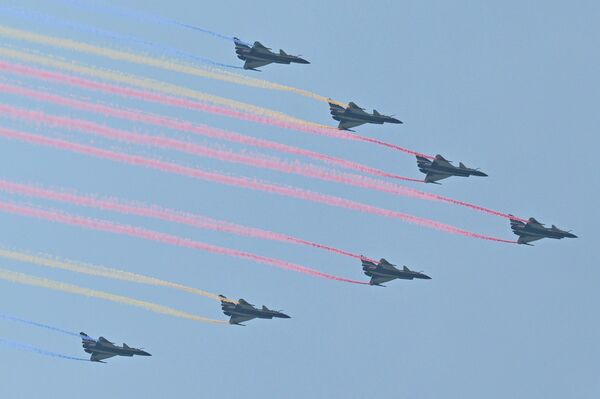
Two military conflicts less than a year apart have renewed attention on China’s prospects as an arms exporter. But even with a compelling commercial pitch built on advanced technology, low prices and no questions asked, the country will struggle to find a mainstream market beyond a highly concentrated group of existing clients.
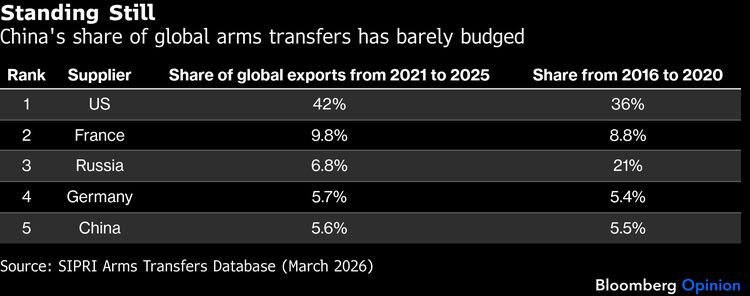
After decades of investment, China ranks in the top five of global military-equipment sellers in an industry hitting successive record highs, according to the Stockholm International Peace Research Institute, a leading tracker of such sales. But the rising superpower hasn’t fought a major war in nearly half a century, so its weapons are largely untested in contemporary warfare. Beijing’s share of arms exports has registered only minimal growth.
That’s why last year’s clash between India and Pakistan following a terrorist attack in Kashmir was so important. It was the first indication of how Chinese military technology might stack up against battle-tested Western systems.
Pakistan claimed it had used Chinese-made J-10C fighter jets to shoot down Indian combat aircraft supplied by countries including France, which SIPRI ranks as the world’s No. 2 arms-seller after the US. New Delhi eventually confirmed that at least one aircraft was lost.
The verdict on the Chinese hardware wasn’t definitive. Four days of a medium-intensity conflict offered only limited insight into its quality and durability. Even so, the fighting thrust the country’s weapons systems into the spotlight — which hasn’t faded.
All eyes are on how much tangible support Beijing may be offering Iran, a strategic partner , during the ongoing conflict with the US and Israel. There is no evidence of Chinese arms being deployed directly. That said, Beijing does have a history of supplying dual-use technology with both civilian and military applications, the Pentagon says , specifically components for ballistic missile and drone programs.
This is significant because Iranian drones have been used to strike US military facilities, energy infrastructure and civilian targets in the Middle East. Some intelligence experts also believe Iran may be using a Chinese satellite navigation network. However, this kind of help would have been supplied well before the start of the current hostilities. Beijing’s support to Tehran during the conflict has been mostly economic .
In fact, China’s strategy of avoiding military entanglements and binding security commitments is one of the reasons why it struggles to break through in the export market. Countries aren’t just purchasing equipment, they’re buying a relationship, Siemon Wezeman, a senior researcher at SIPRI, told me. Beijing's reluctance to show up for partners such as Iran and Venezuela , which were attacked by the US this year, is a hurdle to winning new customers.
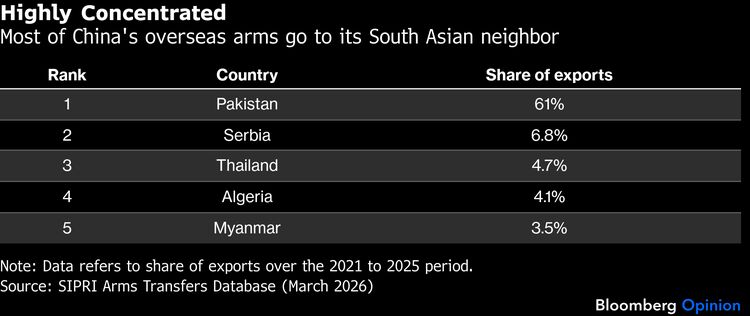
Beijing’s export ambitions hinge on just one country. Described by China as an “ ironclad brother ,” Pakistan received 80% of its weapons imports from there in the 2021 to 2025 period, as noted by SIPRI, up from 73% in the previous five years. The purchases — including advanced fighter jets, missiles, radars and air-defense systems — have been driven by Islamabad’s long-standing rivalry with India.
The global arms trade is heavily shaped by US policy and how countries respond to it. Twenty years ago, the US and China accounted for roughly equal shares of Pakistan’s weapons imports. But the relationship with Washington deteriorated more than a decade ago due to frustrations over Islamabad’s alleged support of Taliban-linked militants operating in then-US-backed Afghanistan, leaving Beijing to fill the vacuum.
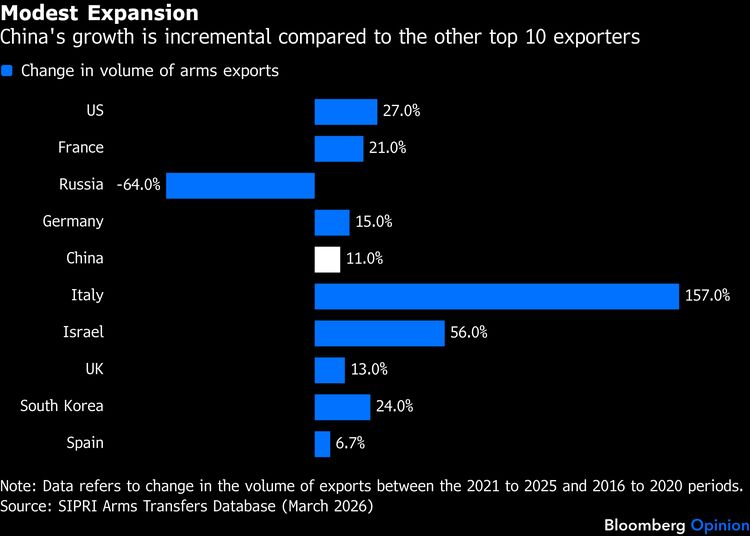
China’s modest growth in arms exports over the last five years can thus be attributed almost entirely to increasing demand by Pakistan, whose imports rose 66% during that time, SIPRI data shows. Last month, China acknowledged for the first time that its personnel provided on-the-ground support to Pakistan during last year’s confrontation.
After the clash, Islamabad announced a 20% hike in its military budget. That boost could help explain the rising fortunes of AVIC Chengdu Aircraft Co., the maker of J-10C jet, which delivered a record profit last year and nearly doubled sales in the first quarter of 2026.
China has dozens of other customers, but those relationships are far smaller. Of its remaining 10 biggest clients, only Saudi Arabia is a top-20 arms importer, SIPRI says, and receives just 1% of Chinese exports. Riyadh’s far deeper security partnership with Washington limits how far ties can develop.
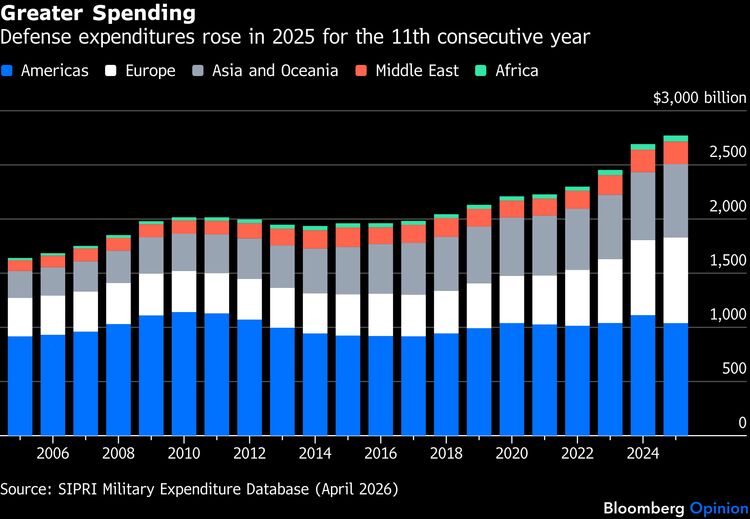
To be sure, China’s potential as an arms exporter shouldn’t be dismissed lightly. It’s among a handful of countries outside the US with a comprehensive, end-to-end defense industry.
Still, its ability to sell weapons systems pales against its prowess in dominating other industrial sectors such as cars, ships and batteries. And it lacks the necessary arena to test and improve its equipment in real combat situations.
To tout its wares, China should expand joint military exercises and continue to show off fighter jets at international defense shows. But it will struggle to capture a larger slice of the global arms market until it can sell closer relationships, too.
More From Bloomberg Opinion
- Japan Is Stepping Up as Asia’s New Powerbroker : Karishma Vaswani
- If Even Armenians Reject Russia, Putin’s Got a Problem : Marc Champion
- South Korea Is the Answer to America’s Naval Problem : Juliana Liu
Want more Bloomberg Opinion? OPIN <GO> . Or you can subscribe to our daily newsletter .