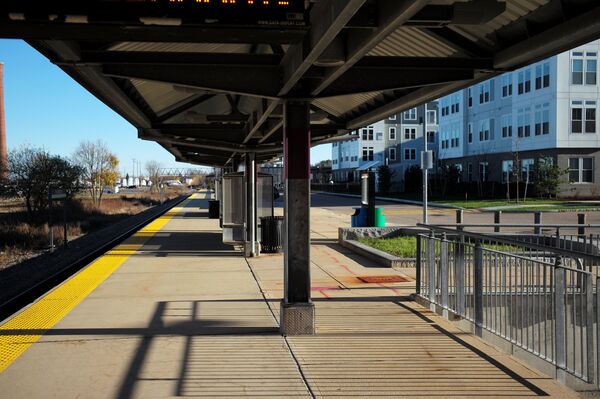
The principle behind transit-oriented development, or TOD, is so fundamental it might not seem like it needs an acronym. An urban planning term that emerged in the US in the 1980s, TOD calls for housing to be built near public transportation, boosting transit ridership and affordability at the same time.
But in a postwar era of suburban sprawl, highway building and deepening car dependency, centering public transit in the housing conversation was a major departure from the US norm. In recent decades, many state and local governments in the US embraced transit-oriented development policies to encourage denser, more walkable development as a solution to housing shortages, rising home prices and relentless gridlock.
According to a new analysis and data tool from the Urban Institute, the push has paid off: In 2022, 45% of all homes were located within a half mile of bus or transit stops, amounting to 67 million housing units. That represents a 36% growth in just the last two decades, with some places seeing even faster growth in their urban areas.
“The positive news is that overall in urban areas, housing units are more likely to be developed near transit than elsewhere, and in almost all states there was more housing development in areas near transit than elsewhere,” said Yonah Freemark, lead author of the analysis.
Policies that encourage TOD are fixtures of the pro-housing Yes In My Backyard movement , and many of the zoning reforms that have gained momentum across the US in recent years, from New York City to Los Angeles , emphasize making it easier to build taller apartments on plots near major transit hubs.
The Urban Institute report offers a revealing snapshot of the progress that’s already been made on the TOD front, both at the state and the metropolitan level. But it also points to a more sobering conclusion: America’s shift away from sprawl remains deeply uneven.
Zoning laws continue to block the construction of multifamily housing in some transit-accessible areas, and plenty of new housing growth has centered on areas far from transit lines. Even if local governments have made progress in building near public transit, the service itself often lags in quality. Just 10% of US housing is located within a half mile of bus or rail service that arrives at least every 15 minutes, according to the analysis. In nearly half of the 20 most populous urban areas, the share is even lower.
Making Headway
There’s no one way to measure progress, says Freemark. When it comes to sheer volume, New York City dwarfs all other urban areas in the US, having added more than 682,000 housing units near rail stations between 1980 and 2022. (The next highest count is just under 122,000 additional units in San Francisco.) That’s 41% of the area’s overall housing growth. No surprise there: The densely packed region is home to North America’s most extensive subway and commuter rail network.
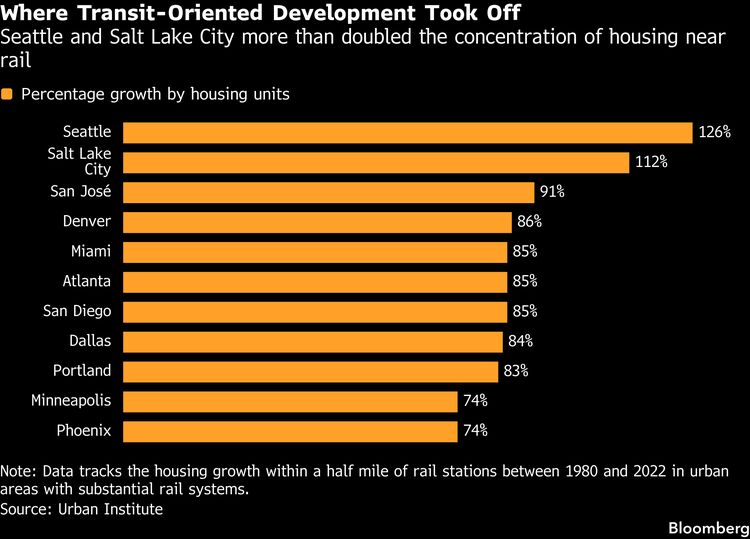
But other measures point to smaller metropolitan areas with more modest transit systems as leading the charge — notably Seattle and Salt Lake City, two regions nestled in states on opposite sides of the political spectrum. In that same 40 year span, each has more than doubled its housing supply near rail transit, with 101,000 housing units in Seattle and 38,600 in Salt Lake City. “Both of those regions share a growth approach where they are trying to restrict growth in greenfield areas and encourage more growth in infill areas near transit,” Freemark said.
Washington’s approach stretches back to 1990’s landmark Growth Management Act, which called on cities to build up rather than out in an effort to preserve natural land and to encourage transit use. Today, Seattle is in the midst of a multibillion-dollar construction boom aimed at extending the region’s light rail system into more suburbs, drawing new riders along the way.
Meanwhile in red-leaning Utah, a bipartisan desire to preserve open land amid a massive population surge in the 2000s informed much of the development patterns in Salt Lake City. A 2004 comprehensive plan from two of Utah’s top metropolitan planning organizations prioritized preserving green space, in large part by encouraging compact, mixed-use neighborhoods centered around “high-capacity transit stations.” All the while, the Utah Transit Authority was vastly expanding its commuter and light rail network, making the region one of the US leaders at the time for per capita transit investment.
“It’s more than just the cities themselves,” said Freemark. “It’s the states that are helping to make this feasible.”
Falling Behind
In contrast, urban areas that have not made significant TOD headway saw their efforts mired in various challenges. Several Rust Belt regions have struggled to add housing in the face of population loss and post-industrial decline. In St. Louis, Baltimore and Pittsburgh, the construction of transit-oriented housing made up 2% or less of overall housing growth; Cleveland saw negative growth.
In many fast-growing regions, ongoing sprawl-based development patterns and a relative lack of investment into transit systems hinder progress. Among the 20 most populous US urban areas, Atlanta, Dallas and Houston have the least share of housing near any bus or rail transit, each at below 50% — an even less near frequent transit. Over the last 40 years, the construction of transit-oriented housing in each of these regions made up less than 5% of overall housing growth, according to the analysis. That’s despite them being among some of the fastest-growing metropolitan areas in the US.
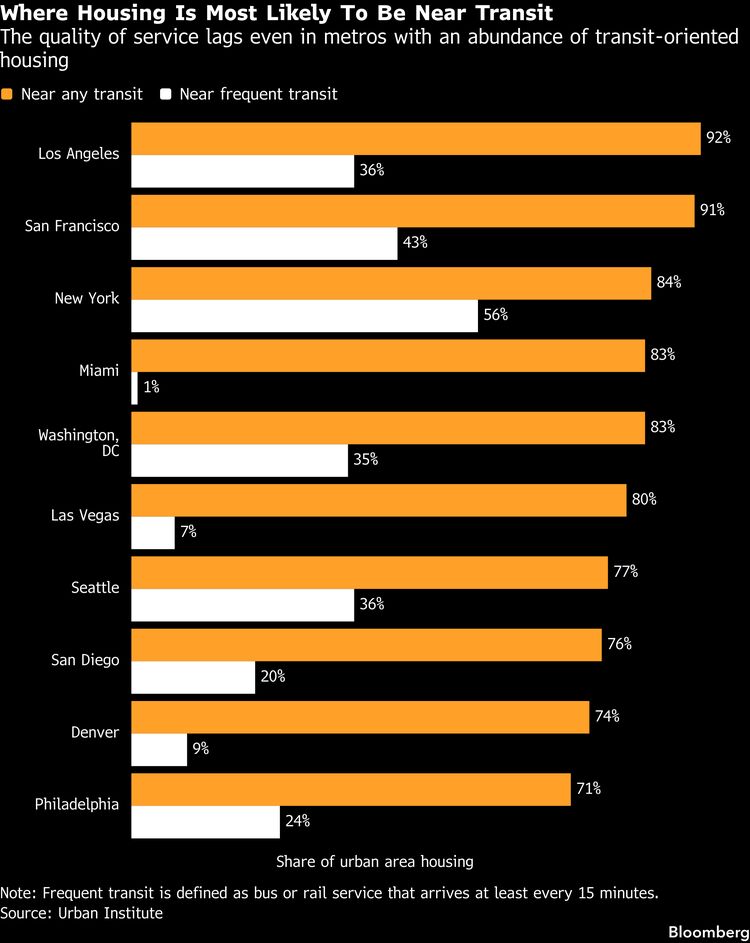
Take Atlanta, where just 42% of housing is sited near transit. A recent study from the Johns Hopkins Bloomberg School of Public Health crowned it as one of the most sprawling urban areas in the US. (The school is supported by Michael Bloomberg, founder and majority owner of Bloomberg LP, parent company of Bloomberg News). A separate analysis also put the region at the top of the list for having one of the worst traffic congestion in the country. Back in the 1960s, the Metropolitan Atlanta Rapid Transit Authority planned a 97-mile regional rail network connecting the counties surrounding the city. But much of the system was not built , and suburban voters have repeatedly blocked referendums to expand it.
“When you see data showing people who live in the Atlanta urban area just don’t have access to transit, what you’re seeing is the consequence of the failure to get transit out to a lot of the suburbs,” Freemark said. But it’s not too late, he adds: The ongoing growth — plus the need to address housing gaps — offers opportunities to make policy changes that can boost transit-oriented development.
A proposed 2021 ordinance in Atlanta sought to do just that, by rezoning single-family areas near MARTA stations to allow more apartment construction. At the state level, Washington, Maryland and California have all passed reforms in the past year requiring or streamlining development near transit stations, including by overriding local zoning restrictions. California’s State Bill 79, which goes into effect in July, is slated to add more than 1 million apartment and condo units near rail stations, ferry terminals and bus stops in urban centers across the state. Housing density advocates are cautiously optimistic that nearly half of those units will be constructed in Los Angeles, where 72% of residential land is currently zoned for single-family housing.
Not everyone is a fan of TOD. Foes often cite the risk of displacement and gentrification ; others are more broadly opposed to high-density development in residential areas dominated by single-family homes. Incentivizing developers to capitalize on transit infrastructure can bring unintended consequences: In 2025, some Burbank residents attempted to block a planned bus rapid transit line , because SB79 would allow denser development near the new route.
Aside from zoning reforms, another key strategy is to get more people to take transit, in part by making investments that improve service. Research has shown that having faster, more frequent buses and trains can boost support for dense housing development. In urban areas with at least 1 million residents, adding one extra mile of bus or rail service could result in 2.5 additional transit rides per resident each year, according to the analysis. And a 10% increase in urban housing near frequent transit correlates to 10 additional trips per resident annually.
This is hardly a novel idea: The obvious synergies of pairing housing with transit led to the growth of “ streetcar suburbs ” in many North American cities of the early 20th century, with real estate developers spearheading the construction of electric trolley lines into outlying areas. That model faded with the rise of the private automobile, but the walkable neighborhoods they left behind typically remain desirable — a testament to TOD’s enduring effectiveness.
“In order for transit-oriented development to work, you need a combination of excellent transit service itself and zoning that allows for that new development to occur,” said Freemark.