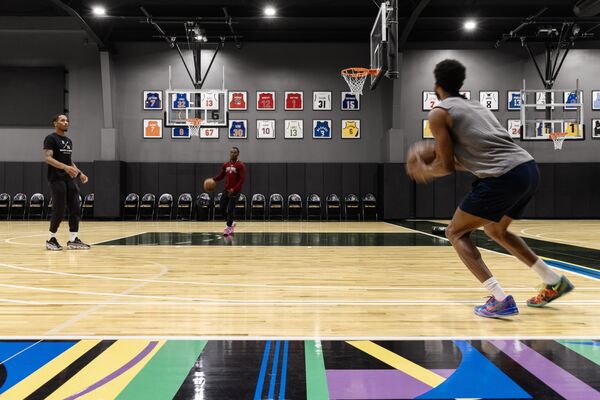
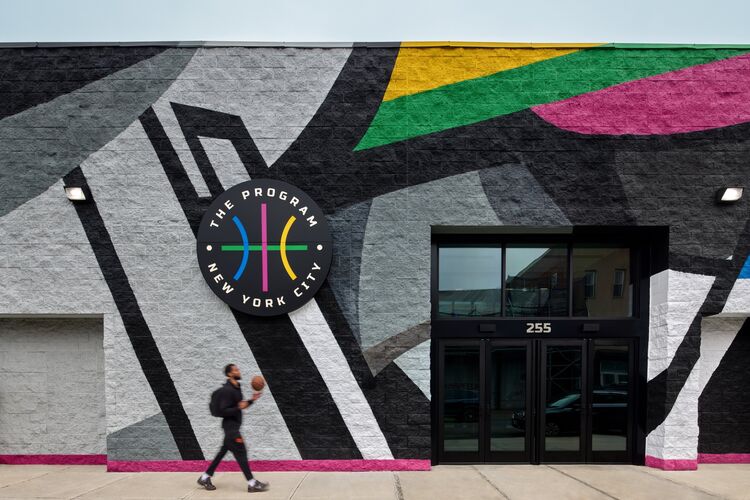
Inside a converted warehouse in Greenpoint, Brooklyn, past the neon-lit ceiling and the conference room for film review, sits a sleek new hardwood court that reflects the elevated state of youth sports in the US. Called The Program, it’s a $4 million members-only basketball training facility for players aged 6 and up, offering skill-building drills, weight training and a recovery room. The 12,500-square-foot space has a membership fee of $500 a month.
Since opening in September, The Program has been slammed, said cofounder Griffin Taylor.
“Basketball has become more of a for-profit engine than it ever was,” said Taylor, a self-described basketball junkie, “and with New York City having a severe dearth of facilities, it’s really been a boom.”
Youth sports is a $40 billion industry in the US, with the average participating family spending more than $1,000 a year on one child’s main sport — a 46% increase since 2019, according to research from the Aspen Institute. Sports parents now enter a world of corporate brand sponsorships, AI-enabled analysis and coaching, and year-round training and travel. In May, affordability concerns around youth sports led two members of Congress to introduce a bill that would limit private equity investment in leagues, equipment and related services.
“Parents will pull back on almost any expenses, but won’t pull back on investing in their child’s youth sports endeavors,” said Taylor. “It’s recession-proof.”
Read more: Inside the Empire That Sports Parents Built
For cities, the boom has triggered a scramble to develop facilities that serve travel ball dads and moms. But as sports culture shifts away from playground basketball, sandlot baseball and street hockey, advocates for public play see troubling trends in the increasingly costly and competitive youth sports environment.
Development Driver
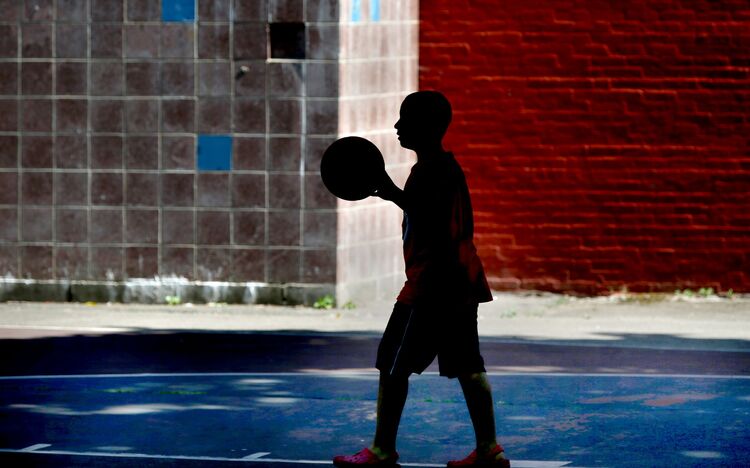
In New York City, you’re never far from a backboard; as filmmaker Spike Lee wrote in a New York Times op-ed on the eve of the Knicks appearance in the NBA Finals, the city “is home to maybe the most basketball courts in the world.” Street ball, played on gritty public courts with double rims and no nets, is a core part of the culture. But these days, basketball has become “more of a country club sport,” said Taylor. More players from wealthier backgrounds and competitive pressure for college scholarships means that private training services are in high demand.
The Program isn’t the only new facility built to feed those hoop dreams. MADE Hoops and HBML Development, which secured funding from LeBron James and Kevin Durant, opened a new 15,000-square-foot center near the Brooklyn Navy Yards in March. At the national level, Vancouver, Washington-based Shoot360 uses a franchise model, offering computer vision and AI to gamify training; the company boasts 20,000 members and 60 locations, with a goal of 600 locations globally by 2030.
The rush for training and playing sites has caught the eye of developers and local governments. The Youth Sports Business Report has tracked hundreds of millions of dollars worth of investment in mixed-use, retail and entertainment complexes built around youth sports tournaments and games. One proposed $1 billion project in Ocoee, Florida, dubbed The Dynasty , would include 17 fields for soccer, football, baseball and lacrosse, plus indoor training facilities and two resort-style hotels.
“These complexes are new anchors for cities, and they’re chasing them like they would chase a new factory or company HQ,” said Meghann Martindale, a principal at real estate services firm Avison Young.
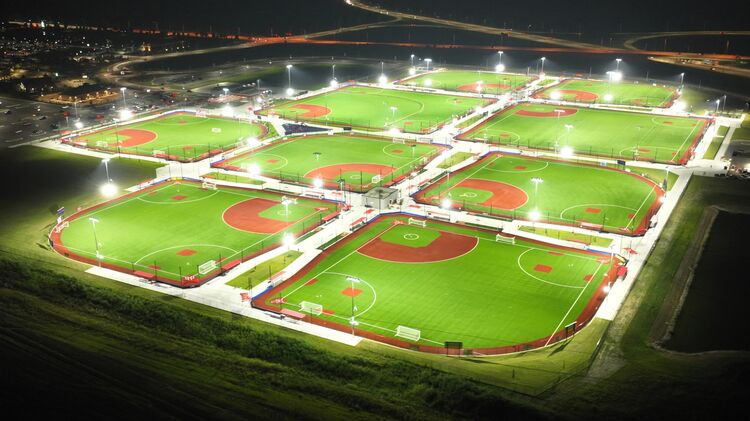
Take the Wintrust Crossroads Sports Complex project in New Lenox, Illinois, a $70 million facility that opened last July (and yes, it does have a naming sponsor). This Chicago suburb decided to pursue a public-private development partnership with the Sports Facilities Companies, a Florida-based firm that builds and manages these kinds of sites, to turn 100 acres of highway-adjacent land into a site for softball, baseball, soccer and lacrosse tournaments. Sports Facilities senior vice president of development services Jake Whittaker projects it’ll draw 600,000 visitors annually.
These types of facilities are only projected to grow. Sports Facilities alone operates 140 projects across the US, and has 26 more in development, serving as magnets to pull in games, players and parents.
Read more: Parents Are Spending $100,000 for Their Kids to Chase Baseball Greatness
Tim Baldermann, New Lenox mayor, says that the development has not only added facilities and access for local players and leagues, but also spurred retail and hotel projects that will pay back the city’s initial investment in a year. Weekends are booked solid through November 2026.
“Before the first pitch was thrown, we brought in $600,000 in sponsorships,” Baldermann said.
Cost Factor
In 2025, the Aspen Institute’s State of Play survey found that roughly 20% of US kids age 6 to 17 play in a private club. Trends lines show more wealthy families increasingly opting out of public or community sports programs. Meanwhile, federal data shows that children from the lowest-income homes played sports at half the rate of those from the highest-income group.
“The market is shifting,” said Christopher Knoester, an Ohio State University sociology professor who studies youth sports. “An increasing number of people believe that there are preferable experiences and advantages to getting the goods and services that are associated with paying to play. That eliminates the market for what used to be community programs.”
Several factors fueled the trend, Knoester said, including a generational shift in parenting style, the growth in female players due to the passage of Title IX, and the heated competition for college scholarships. Meanwhile, a drop in funding for community programs coupled with the Great Recession in 2008 strained public facilities.
The LA84 Foundation, a nonprofit that emerged from the 1984 Los Angeles Summer Olympics and supports wider access to youth sports, recently released its 2026 California Play Equity Report . The group found that 78% of California parents making $50,000 a year or less had trouble paying for their children’s participation in sports, as did 47% of those making over $100,000.
“The entry portal for kids to just be active and play has been crushed,” said foundation president Renata Simril. “They’re looking at these kids in third grade, wearing the sleeves and the leg compressors and the shorts and looking like they’re a mini LeBron James. The kids who just want to come in and try a sport, they say that I’m not good enough.”
While overall participation levels haven’t decreased — 6% more kids played a team sport in 2024 than 2023 — it’s not quite that simple, said Knoester. Intense, year-round training can contribute to injuries, anxiety and burnout.
“There’s the glass-half-full story, that more people are being exposed to and participating,” he said, “and the glass-half-empty story, that the increase is overwhelmingly a result of people playing and then dropping out.”
Out of the Park
Finding affordable places to play has become harder, too.
“Community-based local leagues that have limited resources often play on fields that aren’t well-maintained because budgets can’t cover the cost of maintenance,” said Allison Colman, senior director of programs at the National Recreation and Park Association.
Cities saw a bump in federal funding for outdoor recreation post-Covid, said Will Klein, associate director for parks research at the Trust for Public Land: A record $12.2 billion was invested in the park and recreation system in 2024. But much of that one-time windfall went to the multibillion-dollar deferred maintenance backlog. Municipal parks remain historically underfunded, and the creation of new ones has fallen behind population growth. A 2025 TPL report found that 65 of the 100 biggest US cities have less park space per capita than a decade ago, and two-thirds of the new parks in major cities in recent years were created by private developers.
LA84’s Simril says this challenge could become an opportunity, as the high costs of building and maintaining public parks and programming comes amid the groundswell of interest in getting kids off their screens and into the physical world.
“We see this as an extraordinary platform to get policymakers, legislators, parents to see the crisis hiding in plain sight,” she said. “Not all kids have access to play, and that for us to change the system, we have to value why we play in the first place.”
LA84’s charitable partner Play Equity Fund successfully lobbied for a new California law that will create a commission to study and support youth sports. Illinois took a similar path, with Governor JB Pritzker signing the Illinois Youth Sports Commission into law last August. The issue is a rare bipartisan winner, Simril says: LA84 surveys have shown 70% of voters would approve of more taxes to fund youth sports.
Several cities have explored creative funding solutions. St. Paul, Minnesota, created a fee assistance program that helps cover the cost of city recreation programs . Portland, Oregon, passed a tax levy to fund recreation centers and local parks programming . In Baltimore, the nonprofit Peace Players engages youth in after-school sporting programs, part of a larger suite of initiatives aimed at providing alternatives and activity by leveraging violence prevention efforts.
In Philadelphia, as in many US cities, a two-tiered system has emerged , with a stark divide between playing fields in the urban core compared to suburban areas. A 2023 study by Temple University found that 60% of the city’s 1,400 public sports facilities were rated below average. To narrow the resource gap, the nonprofit Philadelphia Youth Sports Collaborative has partnered with local school districts to start a sports curriculum and support the formation of after-school intramural leagues. The group, launched in 2008, also helps train coaches to run local programs and works with the city to build capacity and lobby for more funding.
The group’s president, Beth Devine, describes the group as a convener that can help steer resources to the right place.
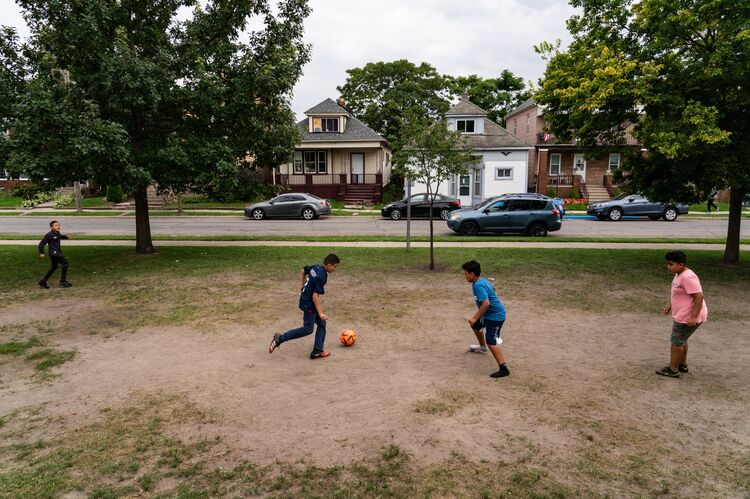
“It doesn’t need to happen at a monstrous, big multiplex,” said Devine. “It can just happen down the street. I’ve learned that we’ve micromanaged and professionalized everything. In order for kids to pick up or kick the ball, it just needs to be there.”