Shipping through the Strait of Hormuz remained heavily constrained in the past day as tensions between the US and Iran intensified, sharpening concerns about maritime security.
Only four commercial vessels, mostly linked to Iran, were observed crossing the strait on Tuesday, according to ship-tracking data compiled by Bloomberg. There were no crossings recorded Wednesday morning.
The slowdown in visible traffic in the strait came as the US carried out air strikes against Iranian military infrastructure near the waterway, hours after President Donald Trump on Tuesday accused Tehran of shooting down an American military helicopter. Iran’s military said it targeted a US naval facility in the Middle East early Wednesday.
Trump said that Iran would “ pay the price · ” for dragging its feet in peace negotiations, though administration officials maintained that diplomatic channels remain open despite the latest hostilities. Later Wednesday, he told reporters that the US would hit Iran “ hard · ” again today, accusing Tehran of delaying an agreement that was “really close.”
Despite the sparse visible traffic, evidence continues to mount that some vessels are moving through the area without broadcasting location signals. Iraq · has accelerated loadings at Basrah, with observed exports and departures totaling about 7 million barrels so far this month, while ship-to-ship transfers near Oman and the UAE have become more common.
Kiara M, a supertanker carrying about 2 million barrels of Iraqi crude, emerged off Sohar on Tuesday after a likely dark transit through the strait. Alraya, another Iraq-linked very-large crude carrier, similarly arrived off Oman earlier this week after disabling its tracking signal. Such dark transits suggest actual shipping volumes may exceed those shown on conventional tracking systems.
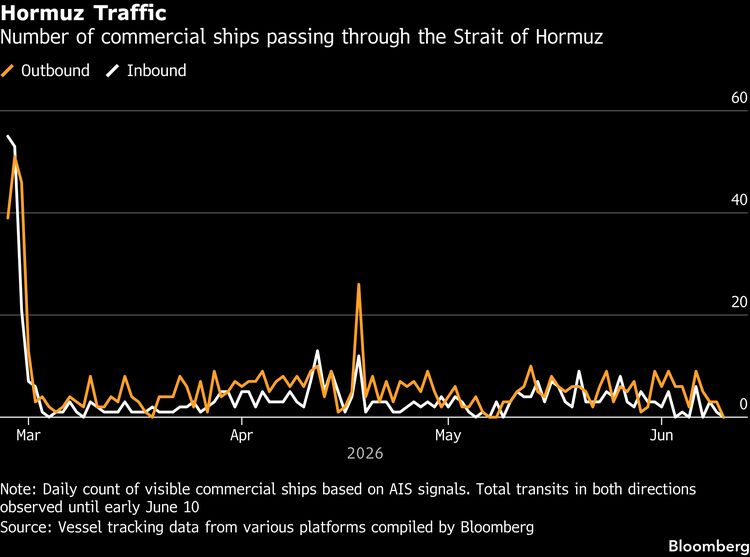
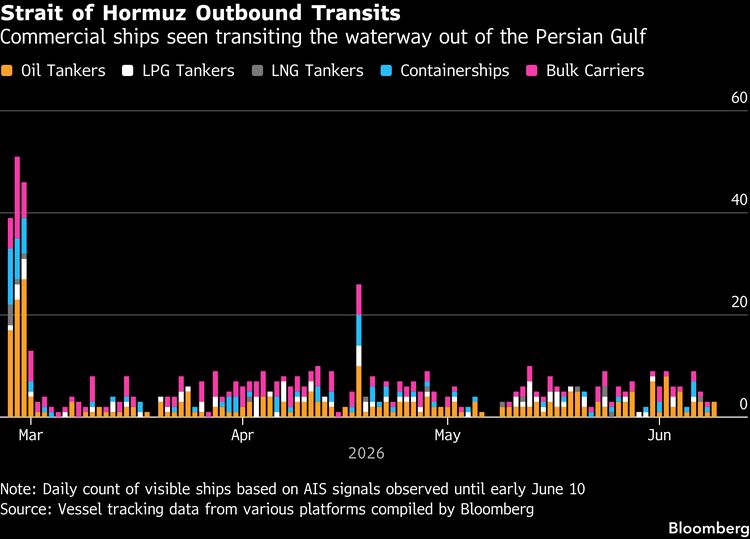
Three fuel tankers departed the Persian Gulf on Tuesday, including one linked to China and two associated with Iran.
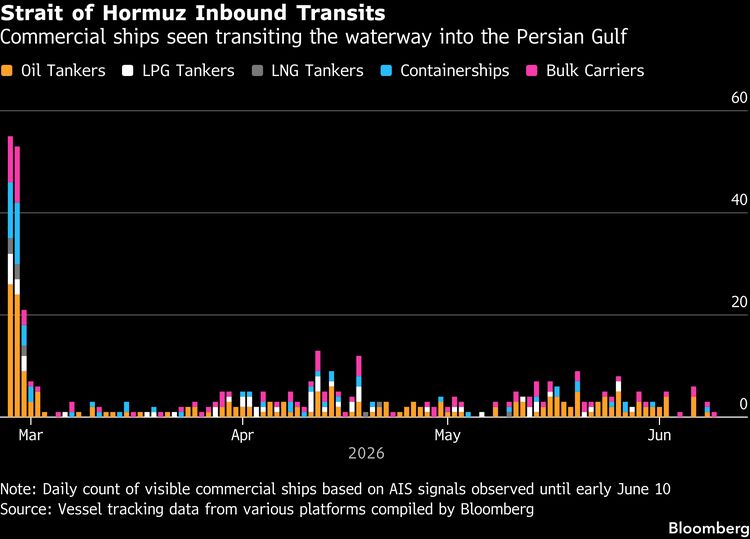
Inbound commercial traffic on Tuesday involved a single Iran-linked bulker.
Meanwhile, a tanker that had previously carried Iranian crude suffered a fire in the Gulf of Oman, according to maritime security firms and regional naval forces. The incident came days after a US fighter jet struck an empty tanker in the same waters as Washington continued efforts to restrict shipping movements linked to Iran.
Ongoing AIS signal disruptions continue to cloud shipping activity, prompting regular revisions to transit counts as vessels reappear beyond higher-risk areas and additional tracking data becomes available from providers including Kpler and Vortexa, and in satellite imagery.
The US naval presence may also be distorting the observations. Iran-linked vessels entering or leaving the Gulf could be switching off AIS signals to avoid detection, making it harder to track flows in real time.
Even before the US barred movement to and from Iranian ports, it was common for Iran-linked vessels to “go dark” when approaching Hormuz. Signals were often not restored until well into the Strait of Malacca — around 13 days’ sailing from Iran’s Kharg Island.
NOTES:
Because vessels can move without transmitting their location until they’re well away from Hormuz, automated positioning signals were compiled over a large area covering the Gulf of Oman, the Arabian Sea and the Red Sea to detect those that may have departed or entered the Persian Gulf.
When potential transits are identified, signal histories are examined to determine whether the movement appears genuine or is the result of spoofing — where electronic interference can falsify the apparent position of a ship.
Some transits may not have been detected if vessels’ transponders haven’t been switched back on. Iran-linked oil tankers often steam from the Persian Gulf without broadcasting signals until they reach the Strait of Malacca about 10 days after passing Fujairah in the UAE. Other ships may be adopting similar tactics and won’t show up on tracking screens for many days.
This tracker will be published during heightened tensions involving Iran, and aims to capture traffic for all classes of commercial shipping.
Please note that the Hormuz Tracker now includes an NSUB sign-up option. The manual code is NI HORMUZTRAK.